Just One Table: The Simple Psychology of Having Your Own Space at Home

From a very young age, we have been taught to view adulthood as a race—the race to chase larger titles, higher credit limits, bigger cars, and even bigger homes. But if you look closely at the daily life of the modern-day young adult, the true reality is one of quiet containment—confined to our corporate cubes and concrete boxes where attendance is not optional but mandatory. Most of us spend our mornings trapped inside the digital glass of our phones, our afternoons navigating the never-ending grids of corporate spreadsheets, and our evenings trying to keep our living spaces looking presentable, organized, and “mature.”

Beneath the aesthetic demands of keeping a home looking proper, a quiet crisis is arising—one where our spatial identity is defined by our peers, our family, or society. For many of us, the dream of an entire dedicated room or a detached backyard studio is locked behind the gatekeepers of modern real estate. The reality is often a desk tucked into a bedroom corner in a shared flat, or a single table carved out of a high-rent apartment in an expensive, concrete jungle we call “the city.”

But the true boundary isn’t measured in sprawling square footage; it is measured in raw, uncompromised autonomy. The human spirit simply requires absolute control over whatever small perimeter it manages to claim.

Key Takeaways

  • You don’t need a spare room to have a sanctuary at home; one desk or table that you fully control is enough.
  • A personal desk setup isn’t defined by the absence of work but by the presence of you: objects tied to your interests, history, and goals.
  • “Kidult” guilt fades once you stop seeking outside approval. It’s a space you contribute to and owe to no one.
  • Physical objects such as die-cast cars, model kits, and small figures give your brain a tactile break from weightless digital work.
  • Autonomy is contagious: personalizing a desk at the office often encourages colleagues to do the same.

The Reality of the Bedroom Desk Setup: Building Space in a Tight Corner

There is a common misconception that a functional work desk and your deeply personal sanctuary cannot exist on the same piece of wood. We are often sold the idea that a remote workspace must be a sterile laboratory optimized solely for ergonomics, productivity, and how clinical your background looks on a video call. The only exceptions are typically given to YouTubers, influencers, and streamers, while the average corporate or white-collar worker has to stick to a boring desk setup.

But a personal desk setup isn’t defined by the absence of work; it is defined by the presence of you. It is a physical defense system built right into your day.

Whether you are working from a bedroom corner in a shared flat or sitting in a bustling, cubicled corporate office, the psychological necessity remains the same: we require a perimeter where the rules of the rigid adult world are quietly negotiated. The good news is that you don’t need a separate room to achieve this. However, you do need to have the confidence and audacity to claim whatever little space you have to make it your own. There’s some research behind this: in a University of Exeter experiment, people who could arrange their own workspace got roughly 30% more done than people in a bare one (Knight & Haslam, 2010). The hard truth is that the autonomy you want can be claimed in centimeters, right under the nose of a spreadsheet.

Clinical Workstation vs. Personal Desk Setup: The Evolution of the Square Meter

The Clinical WorkstationThe Personal Desk Setup
Optimized for corporate productivity, client compliance, and clean video backgrounds.Carved out for individual autonomy, creative hobbies, and personal history.
Feeds weightless digital stress via metrics, spreadsheets, and emails.Offers tactile decompression via physical objects you can touch, roll, and feel.
Conceals the self to fit a manufactured mold of what an “adult worker” should look like.Establishes a subtle anchor—a reminder of who you are before, during, and after the log-in hours.
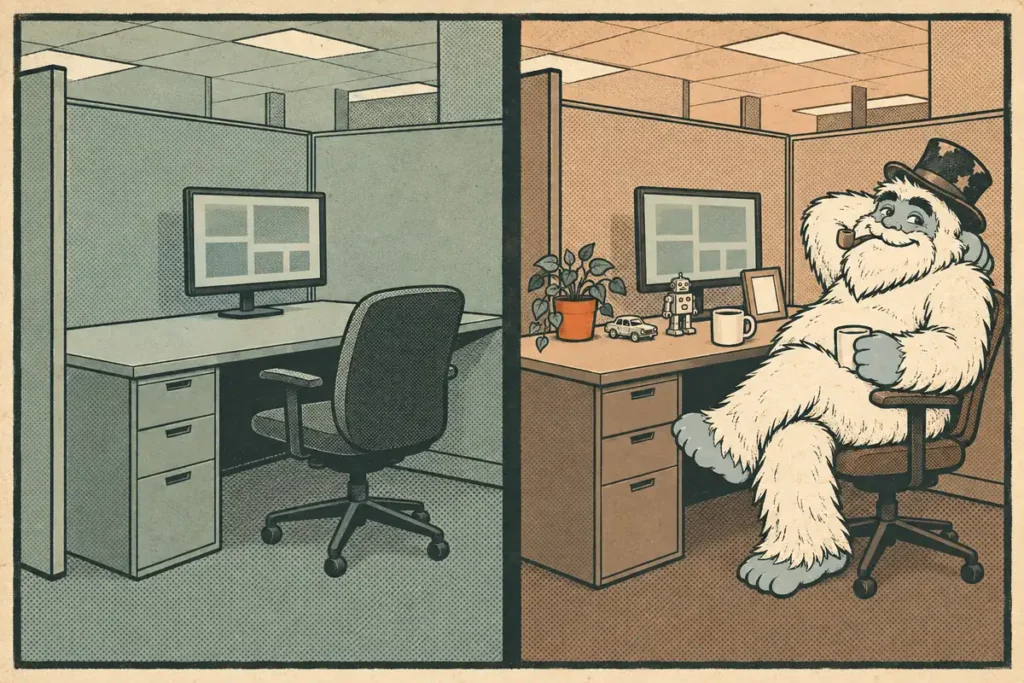
Two-panel comic comparing a bare clinical workstation with the Funcle Yeti's personalized desk setup
Same square meter, two very different jobs.

For me, living and working where I’m constantly observed—whether by flatmates, family, or colleagues behind a Zoom lens—is draining in a very specific way. It keeps me in a kind of “performance mode.”

When I had a conventional office job, I refused to let that clinical energy dictate my sanity. I optimized my desk for comfort and creativity. I brought in a few Hot Wheels cars, some old Happy Meal toys, and a small plant to sit alongside my work monitors.

Initially, I wondered if I should keep my inner world entirely private from colleagues. If you aren’t comfortable revealing that side of yourself to your team, the strategy is simple: keep your personal anchors just outside the camera’s line of sight, or let a soft background blur protect your perimeter during meetings. A tiny die-cast car sitting right below your monitor doesn’t need to be part of the company agenda; it is there entirely for your baseline sanity.

However, I chose to leave my pieces visible, and a quiet magic happened. Not only did my colleagues love the items, but I watched a fascinating shift occur in the office culture. Within a few weeks, the people sitting around me started quietly bringing in their own collectibles, plants, and desk toys. They began personalizing their own spaces simply because someone else had broken the ice. I realized then that when you dare to personalize your space in a corporate environment, you aren’t just decorating—you are signaling. Autonomy is contagious.
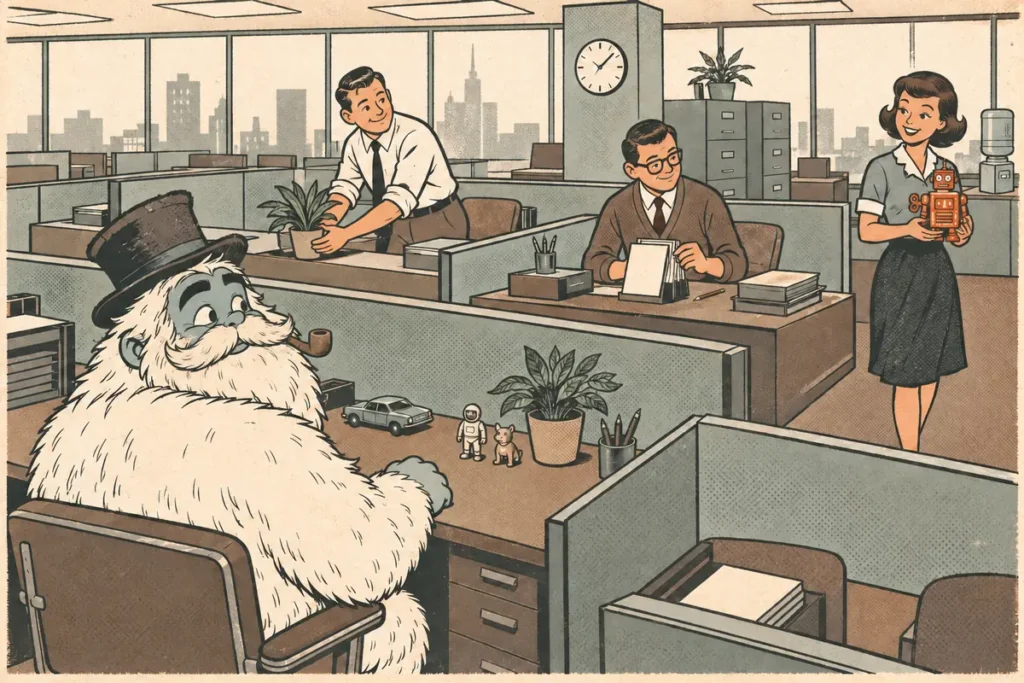
Comic of office colleagues adding plants and desk toys to their cubicles after seeing the Funcle Yeti's desk
Autonomy is contagious: one personalized desk gave the whole row permission.

Is a Desk Full of Toys “Childish”? Navigating the Kidult Stigma With Intentional Living

Claiming a table as an adult inevitably creates a strange, subtle friction with the domestic world. When you choose to decorate your one square meter of autonomy with a Gundam helmet, action figures, a retro console, or raw consumer electronics instead of minimalist, neutral vases, people notice. Even the most understanding partners, parents, or roommates will occasionally drop a well-meaning joke. They ask when you’re going to “grow out” of the plastic, or laugh gently at the sight of a grown adult carefully unboxing a collectible.
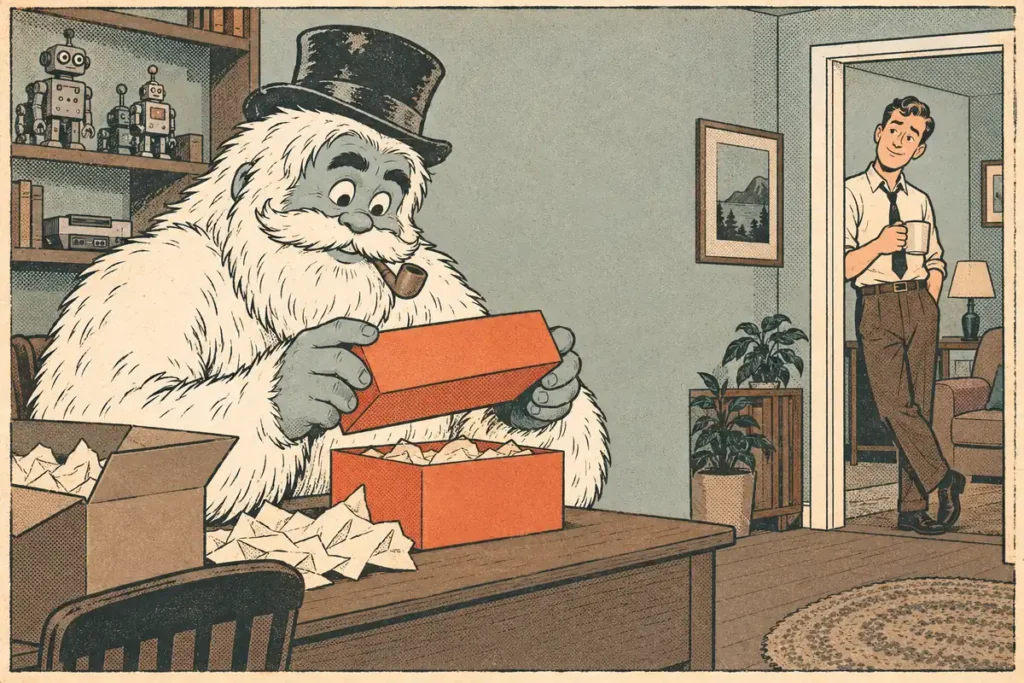
Funcle Yeti calmly unboxing a collectible at his desk while a flatmate teases him from the doorway
The well-meaning joke lands. The unboxing continues.

The real issue is that modern households have very little space free to be completely dominated by any single person at all times. Because of this, even silly, harmless jokes can cause you to get into your own head and introduce a layer of “kidult” guilt.

An adult sanctuary isn’t a spatial luxury; it is a vital psychological defense system—one where you use things you are familiar with to give yourself a break from the mundane life while still grounding yourself to reality.

The only way to get over the stigma of having what most consider toys decorating your workspace is to stop seeking external validation and simply do it for yourself. It feels far less guilty when you realize that this is a space you owe to no one. You contribute to the home, you pay the rent, and other people’s opinions of your table are entirely irrelevant regardless of how flashy it looks.

My workspace is a mini-laboratory for my honest, unvarnished interests. It isn’t childish, because a personal desk goes way beyond assembling Lego sets. It can be an art station, a tech layout, a mini workshop, or a toy train setup. The sky is the limit, and how it looks varies entirely based on what grounds your baseline sanity.

Tactile Breaks: Why Physical Objects Matter on a Digital Worktable

When you spend your entire working life staring at a computer screen, your brain undergoes a specific type of weightless exhaustion. The stress of digital work is algorithmic, technical, and empty. You solve a digital problem, and your reward is simply more digital noise. Passive scrolling isn’t much of a break either. In one experiment, people who use Facebook passively felt worse afterwards than those who used it actively (Verduyn et al., 2015), and in my own experience it leaves me both overstimulated and empty.

This exhaustion happens because the digital world lacks friction. In his book Non-things: Upheaval in the Lifeworld, the Korean-born, Berlin-based philosopher Byung-Chul Han notes:

“Today, we are in the transition from the age of things to the age of non-things. It is not things, but information that determines the living world.”

Han argues that when we lose our relationship with physical objects, we lose our anchoring in reality. Information doesn’t possess a body; it floats, demands constant attention, and never truly satisfies the senses.
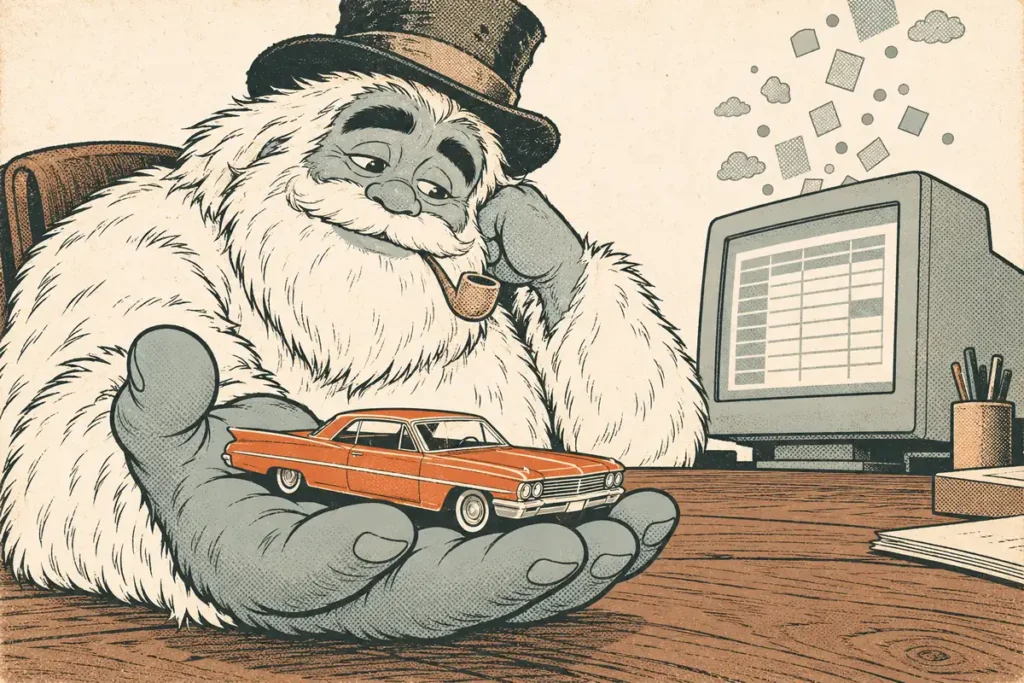
Comic of the Funcle Yeti holding a small die-cast car in his palm as a tactile break from spreadsheet work
Information floats. A die-cast car has weight.

This is where the physical items resting on my desk graduate from being mere decorations to functioning as literal mental anchors, philosophical reminders, and real-time relief valves. They are what the philosopher Martin Heidegger, in Being and Time (1927), called ready-to-hand—objects that possess a tactile reality that pulls us out of our heads and back into our bodies. When I place raw, tactile materials in my immediate workspace, I give my brain an analog escape hatch:
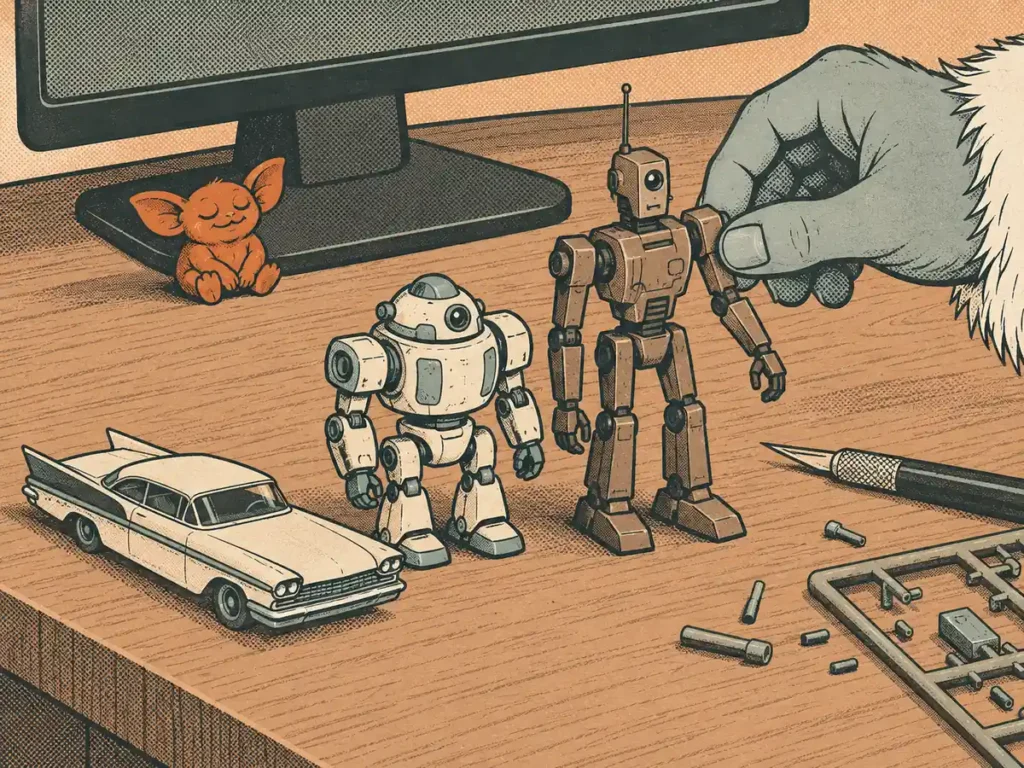
Desk still life with a die-cast car, two hand-built robot model kits and a small creature figurine under a monitor
Small anchors, within arm’s reach.
  • The 1:64 Scale Chevy Impala Die-Cast: Keeping a classic muscle car—painted in a deep gloss finish and resting right on the wood grain of your desk—acts as a vital visual bridge. It isn’t just a toy car; it is a physical manifestation of a long-term aspiration, a mechanical piece of history you plan to own in full scale someday. Rolling or simply just looking at the cool, weighted metal across your palm offers an instant, tactile break from a weightless day of spreadsheets, grounding your current labor in a tangible future goal. Furthermore, this is the perfect way to get started on reclaiming your space whether it is at work or home without the inconvenience of losing the limited space on your desk.
  • The Master Grade (MG) Gunpla Model Kits: Having a classic Gundam RX-78-2 standing shoulder-to-shoulder with its iconic red rival, the MS-06S Zaku II, introduces a deep layer of creative history to a tight workspace. Because these aren’t just bought—they are painstakingly built, sanded, and snapped together by your own hands—their presence on a small table is a testament to un-optimized, patient craftsmanship. Not to mention the memories such pieces evoke from the cartoons and anime you used to watch in awe as a child.
  • The Cubone Figure: A small Pokémon figure sitting quietly beneath your monitor base. In the vast landscape of modern animation subcultures, Cubone stands out as a symbol of resilience, quiet solitude, and carrying one’s history openly. Having this small entity resting on your desk injects a distinct, silent jolt of childhood nostalgia into a dull corporate afternoon slump. It serves as a reminder of who you were before the log-in hours began.

In today’s world, an adult sanctuary isn’t a spatial luxury anymore; it is a vital psychological defense system where a human can freeze their professional duties and personal responsibilities even for a little while. By keeping these objects within arm’s reach, we resist the weightless drift of the digital screen. We remind ourselves that we are creatures of muscle, bone, and memory—not just processors of data.

Frequently Asked Questions About Personal Desk Setups

What is a personal desk setup?

A personal desk setup is a workspace arranged around who you are, not just around productivity. It can hold your work monitor alongside objects tied to your interests and history, such as die-cast cars, model kits, figures, or plants, so the same table works as both a workstation and a small sanctuary.

Can you create a personal sanctuary at home without a spare room?

Yes. Personal space is measured in autonomy, not square footage. A desk in a bedroom corner, a table in a shared flat, or a single surface in a small city apartment can become an adult sanctuary as long as it is genuinely yours to arrange.

Is it childish to keep toys and collectibles on your desk as an adult?

No. Many adults, often called kidults, keep collectibles, figures, and retro items nearby because they ground them. A personal desk can just as easily be an art station, a tech layout, a mini workshop, or a toy train setup. What matters is that it reflects your honest interests rather than other people’s expectations.

How do you personalize a work desk without it showing on video calls?

Keep your personal anchors just outside the camera’s line of sight, such as below the monitor or to one side, or use background blur during meetings. The objects are there for your own baseline sanity, not for the company agenda.

Why do physical objects help with screen fatigue?

Digital work is weightless: it produces information but gives the senses very little to hold on to. Physical objects you can see, touch, or roll in your palm offer a tactile break that pulls you out of your head and back into your body, an idea explored by philosophers Byung-Chul Han and Martin Heidegger.

What is the easiest way to start personalizing a small desk?

Start with one small object that means something to you. A single 1:64-scale die-cast car fits under a monitor, takes up almost no desk space, and works just as well at the office as it does at home.
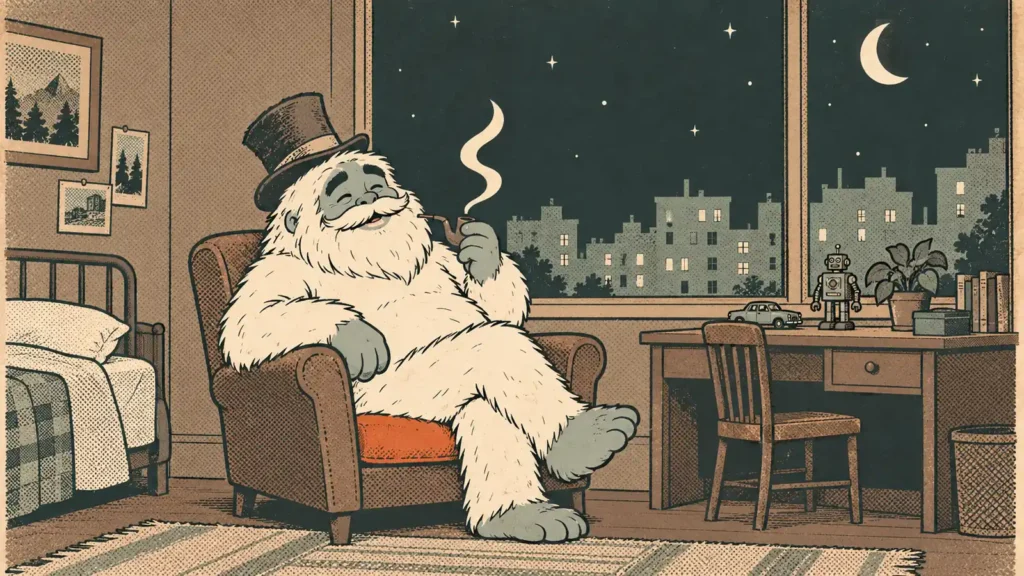
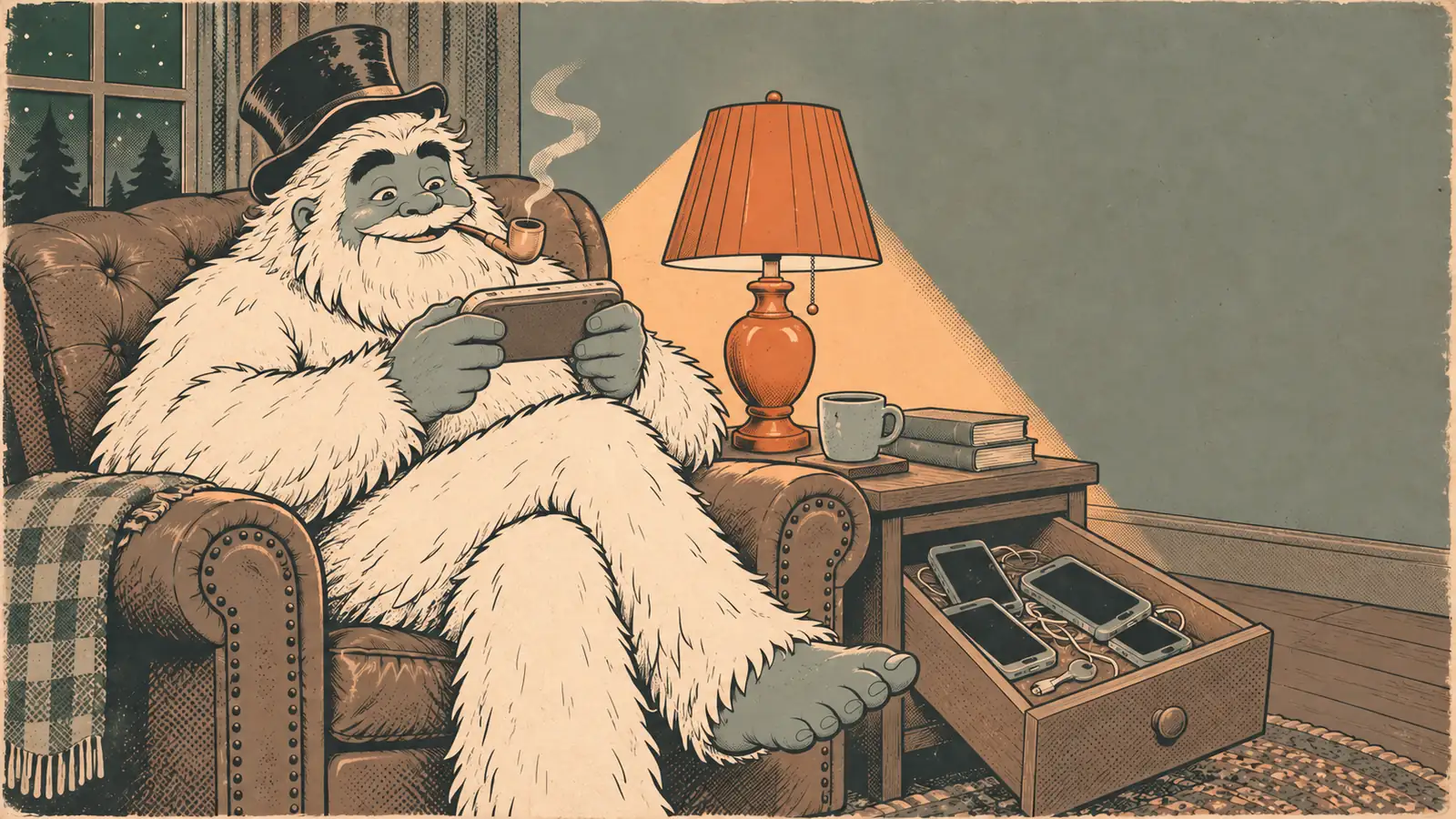
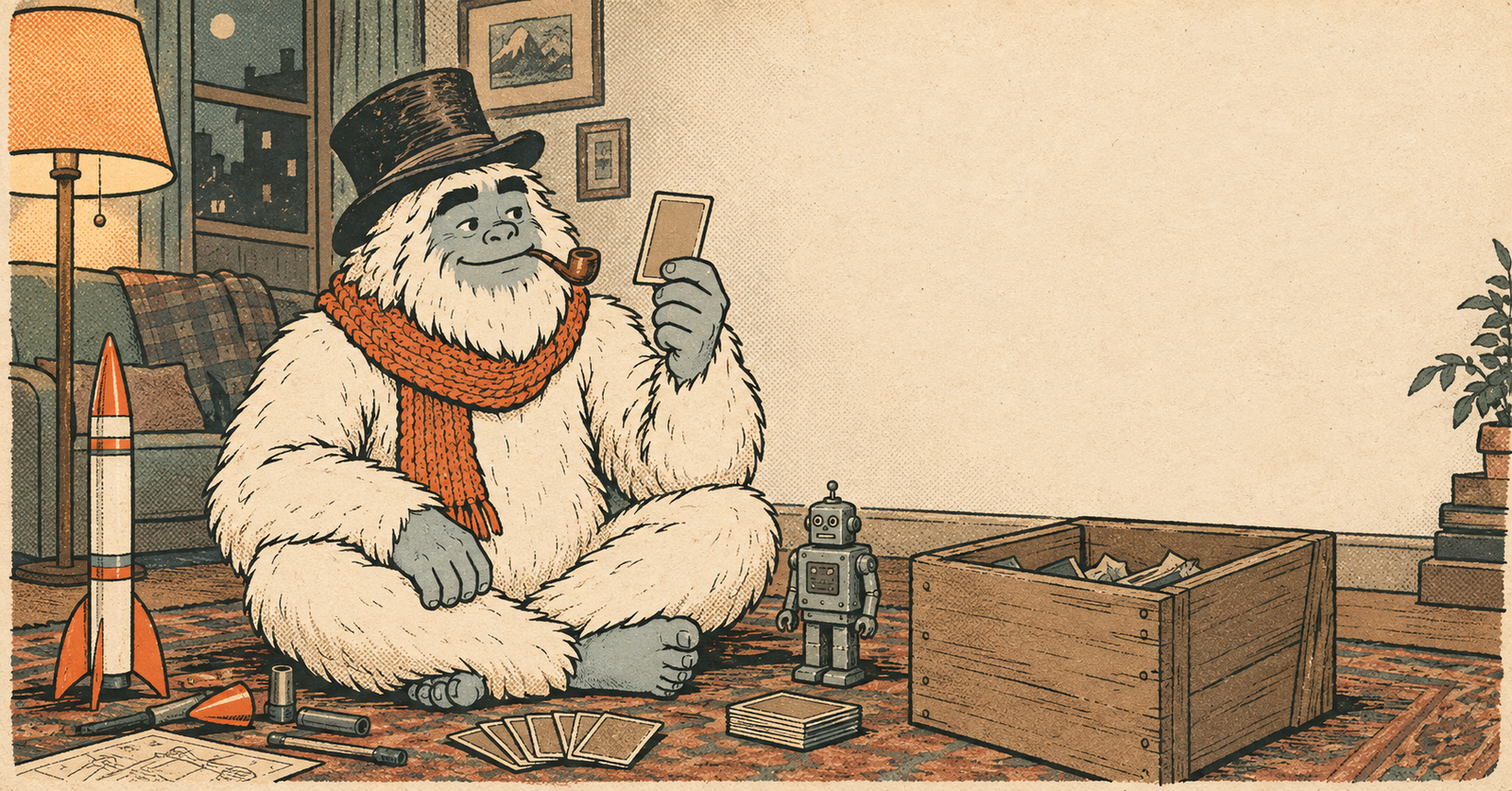
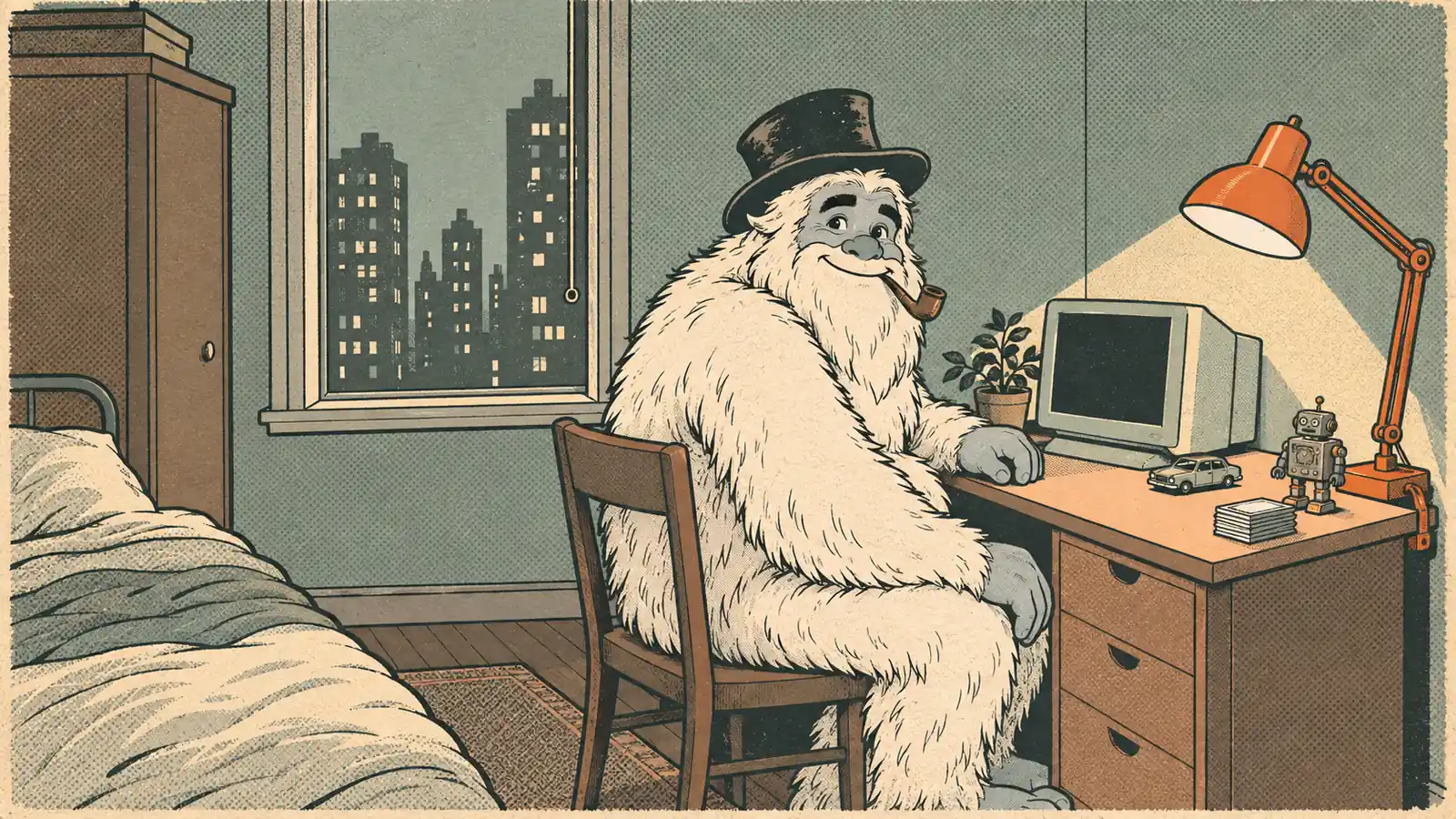
Funcle Yeti resting in an armchair beside his corner desk at night, pipe in hand
A space you owe to no one.

Sources and Further Reading

  • Han, Byung-Chul. Non-things: Upheaval in the Lifeworld. Translated by Daniel Steuer. Polity, 2022 (originally published in German as Undinge, Ullstein, 2021). Library catalogue record
  • Han, Byung-Chul. “I Practise Philosophy as Art.” ArtReview. Read the interview
  • Whyman, Tom. “Ghost of the Jukebox” (review of Non-things). Literary Review. Read the review
  • Wrathall, Mark. “Martin Heidegger.” Stanford Encyclopedia of Philosophy, first published 31 January 2025 (see section 2.1 on readiness-to-hand). Read the entry
  • Heidegger, Martin. Being and Time (1927).
  • Knight, Craig, and S. Alexander Haslam. “The Relative Merits of Lean, Enriched, and Empowered Offices.” Journal of Experimental Psychology: Applied 16, no. 2 (2010). Study summary
  • Verduyn, Philippe, et al. “Passive Facebook Usage Undermines Affective Well-Being: Experimental and Longitudinal Evidence.” Journal of Experimental Psychology: General 144, no. 2 (2015): 480–488. Abstract
  • Sonnentag, Sabine, and Charlotte Fritz. “The Recovery Experience Questionnaire.” Journal of Occupational Health Psychology 12, no. 3 (2007): 204–221. Record
  • Routledge, Clay, et al. “The Past Makes the Present Meaningful: Nostalgia as an Existential Resource.” Journal of Personality and Social Psychology 101, no. 3 (2011): 638–652. Record

Illustrations generated with AI in the Funcle Yeti house style.
Entry 03: Reworking the First Hemp Chore Jacket Sample

Logged–23 September 2026, Kathmandu.

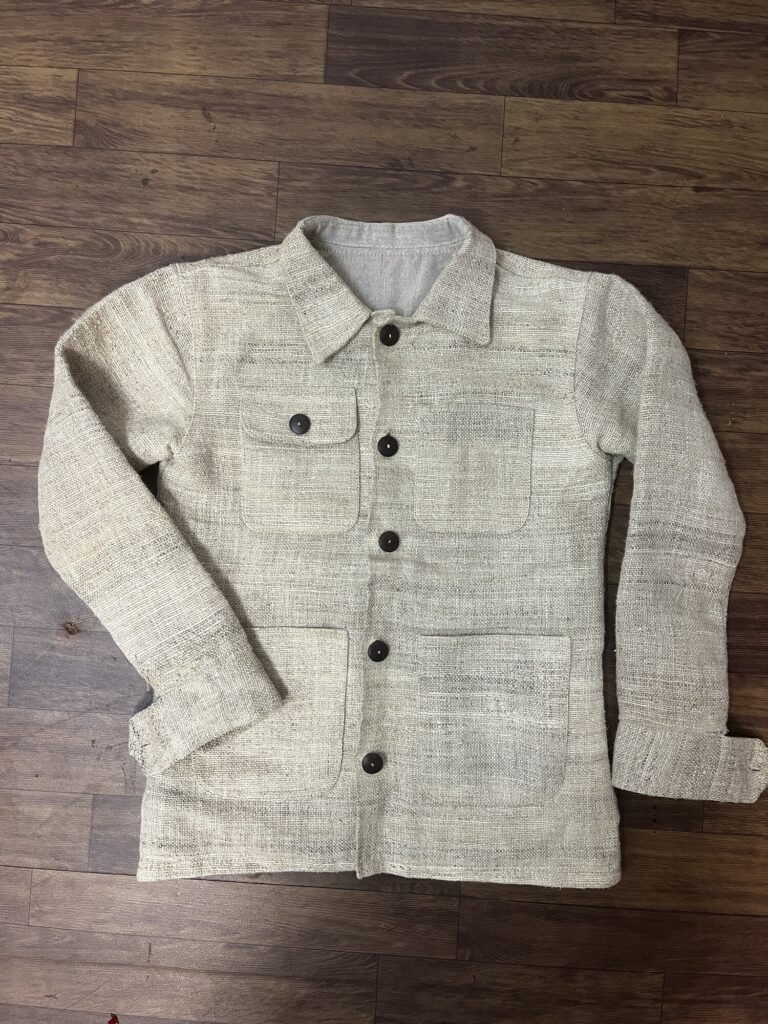
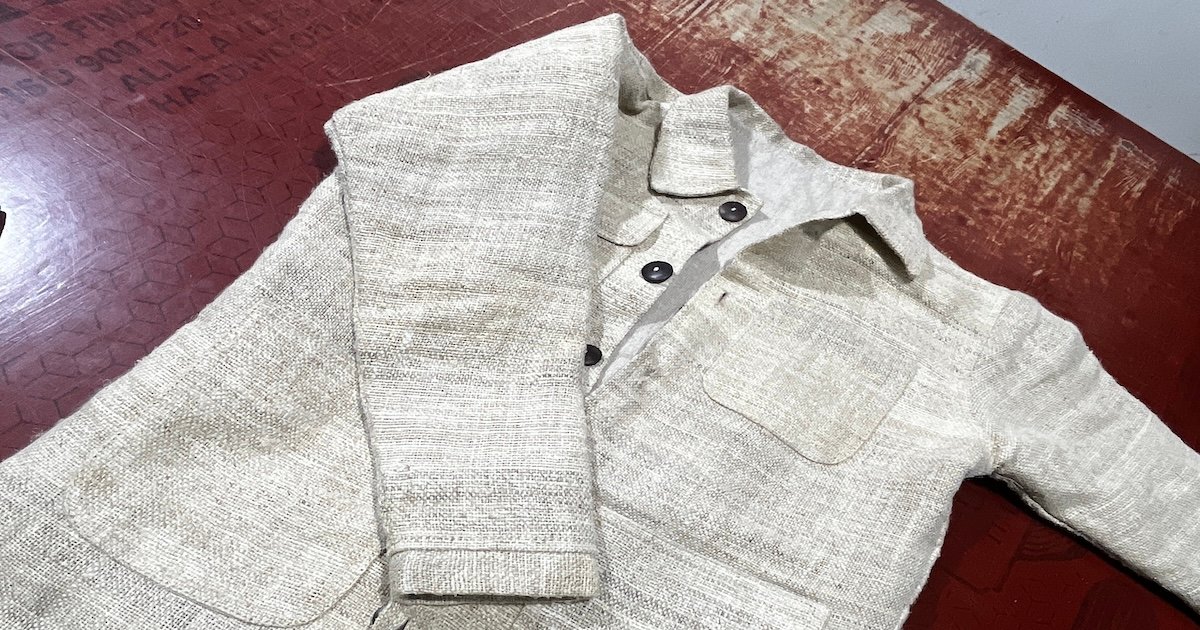
V2 isn’t a new sample. It’s the first sample of our handwoven hemp chore jacket, the one that came back wrong, reworked at the workshop in a single sitting. It now has longer cuffs, reshaped sleeves, cotton lining at the neck and a cotton patch inside the elbow.

It fits better than V1, and it still doesn’t fit right: the sleeve is narrow at the wrist, so the cuff folds back only once. On its first wear, the unlined hemp cuffs rubbed the wrists.

What Needed Fixing

The first sample’s sleeves were short at the cuff, wide through the bicep and over-tapered toward the wrist. It had no foldable cuffs, and none of the cotton liner patches we’d specified at the neck and elbow. The measurements it was meant to be cut from had been lost in a handoff months earlier.

One Sitting at the Workshop

The rework happened in front of me, and it’s photographed as it happened. One tailor did the work, over an hour or two.

Master Dai was there. (Master is the title for the lead tailor; Dai means elder brother, the word for someone whose read on the work outranks yours.)

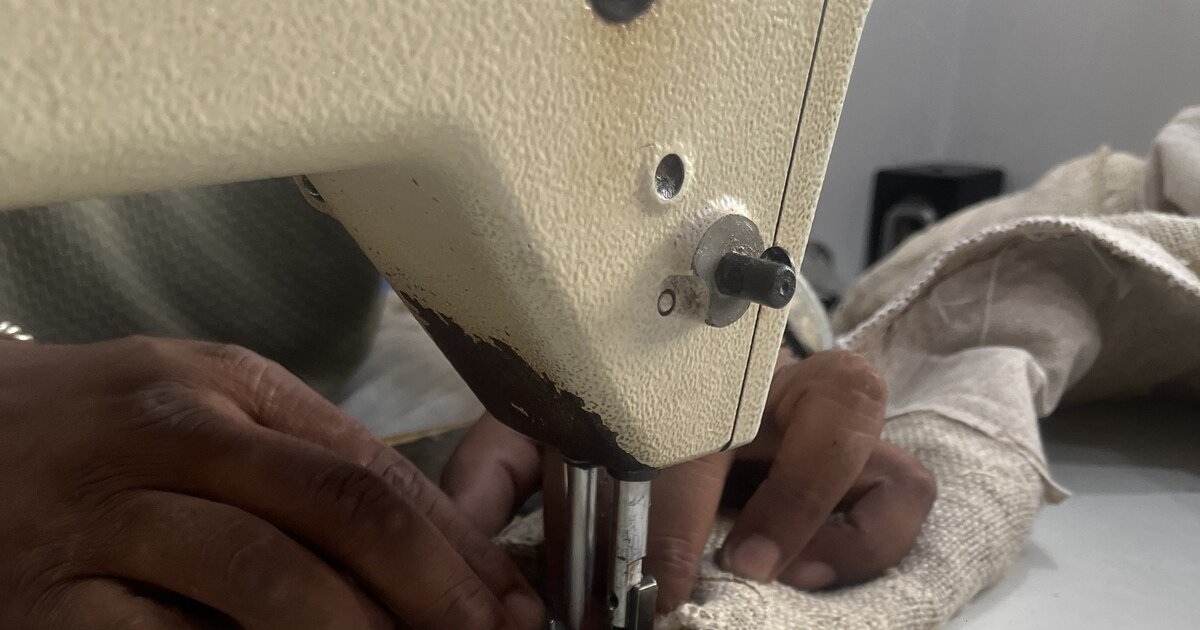
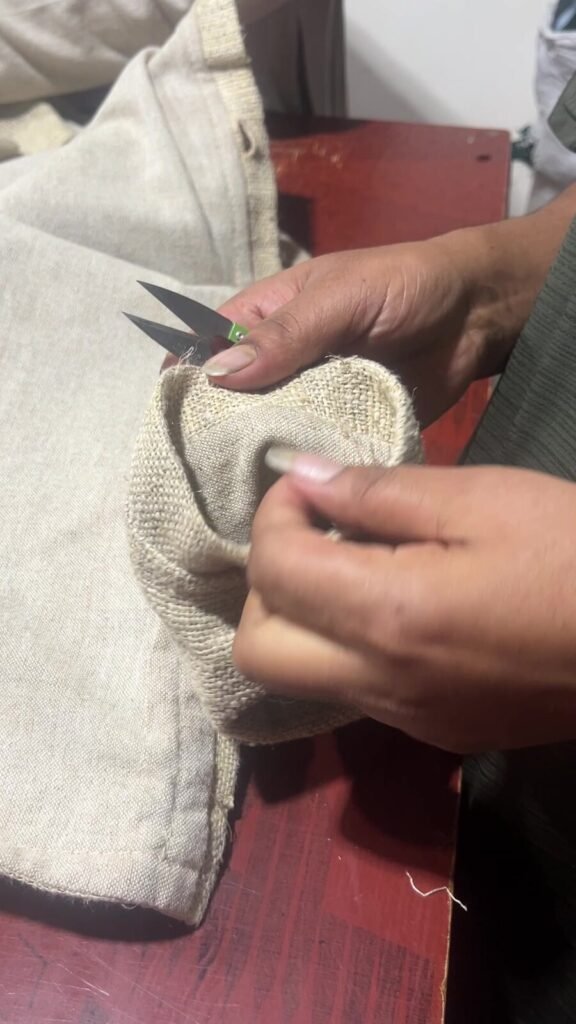
To change the sleeves, the tailor first unpicked the seams of both layers: the hemp shell and the cotton liner. Here’s what changed.

Tailor unpicking a stitched seam on a handwoven hemp chore jacket with small scissors

Area

V1

V2

Where it stands

Sleeve length

Short at the cuff

New, longer cuff

Fixed: the sleeve now covers the full arm

Lower sleeve

Too narrow toward the wrist

Seam allowance let out toward the wrist

Better, still narrow at the wrist

Bicep

Too wide

Taken in

Looks okay, not ideal yet

Cuffs

Not foldable

Foldable, per spec

Fold back only once: too narrow at the wrist to roll up to the elbow

Neck

No liner patch

Cotton lining added

Done

Elbow patch

Missing

Cotton patch stitched to the inside of the hemp shell

In place, but on the shell, not the liner

Cuff lining

—

None

Open: see below

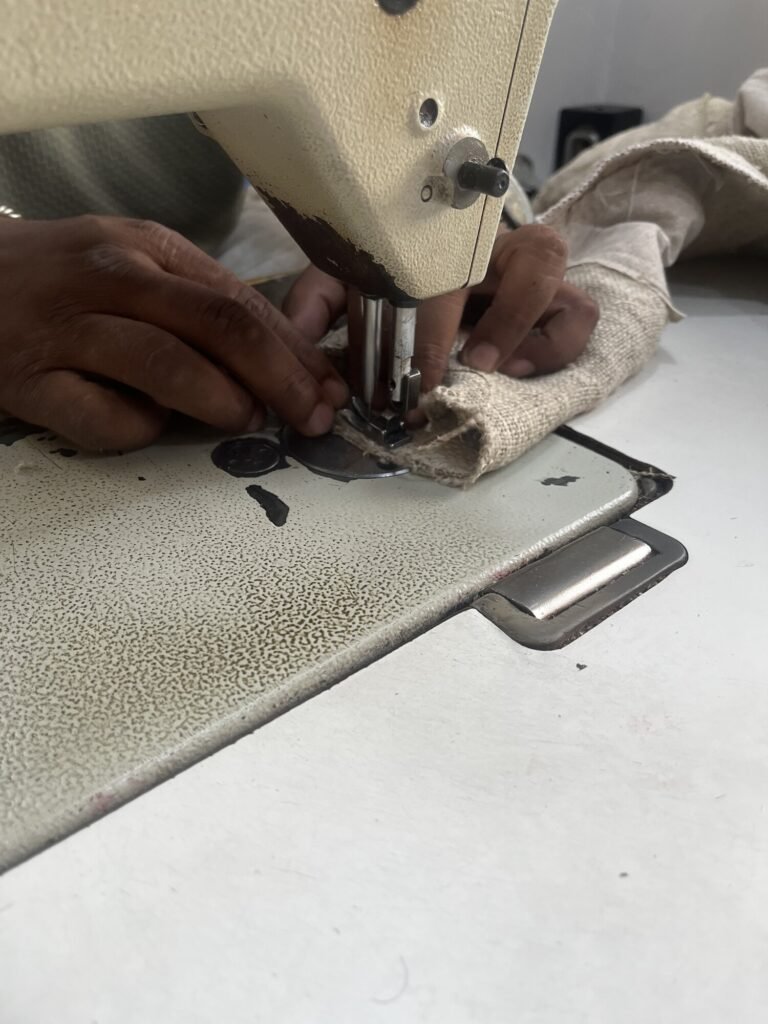
Tailor machine-stitching a new, longer hemp cuff onto a chore jacket sleeve

The spec put the elbow patch on the liner, as an extra layer where a lining is likely to wear through first. On this sample it couldn’t be attached to the liner, so it’s stitched to the inside of the hemp shell instead.

Cut cotton elbow patch piece before stitching, hemp chore jacket rework

Why Couldn’t the Sleeve be Fully Fixed?

V1’s sleeve was cut the wrong shape: too wide at the bicep, too narrow toward the wrist. The tailor let out the seam allowance toward the wrist and took the sleeve in at the bicep.

Taking in is always possible; letting out isn’t. A seam can only give back the fabric already folded inside it. Past that, more width means new fabric, such as a new sleeve or an inserted panel, or a corrected pattern.

That’s why the wrist end is better and still narrow. For Run One, the correction belongs in the pattern, not in more alterations to one sample.Lorem ipsum dolor sit amet, consectetur adipiscing elit. Ut elit tellus, luctus nec ullamcorper mattis, pulvinar dapibus leo.

Buttonholes: One Last Stop

The new cuffs needed buttonholes, and the buttonhole machine isn’t at the workshop. It’s at the first supplier’s shop in Thamel, so the jacket went there the same day, with collection set for the next day.

When I went back, the buttonholes hadn’t been done yet; they were finished later that day. It’s worth knowing for Run One’s timeline: when one garment’s machines sit at two addresses, a finished jacket can take an extra trip and an extra day.

While I was collecting it, another customer at the shop asked about the jacket. The shop told them it was a one-off, which, being a sample, it is.

How Does Wearing a Hemp Jacket Feel Like?

V2’s first time outside was the walk home on Wednesday 23 September: 15 to 20 minutes on a cool evening, worn over a shirt with a backpack on. It was a humid, overcast day in Kathmandu, between about 18°C and 26°C.

The jacket was comfortable the whole way, neither cold nor too warm, even with the backpack. One walk isn’t a warmth test, and it isn’t logged as one: it’s a first impression.

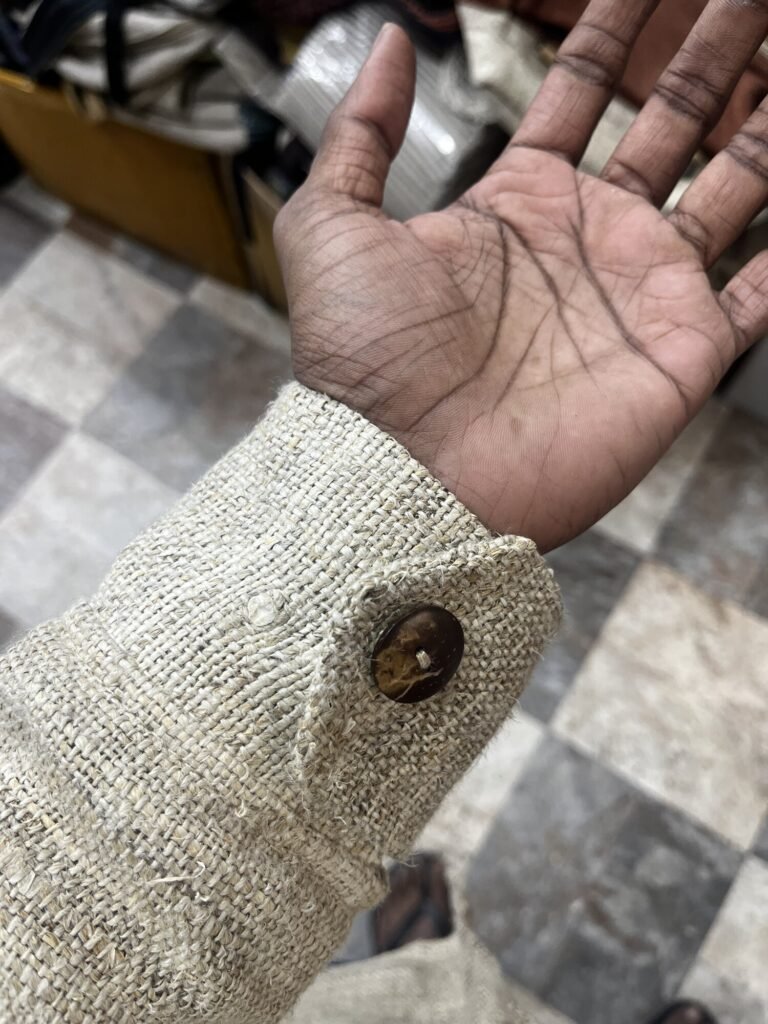
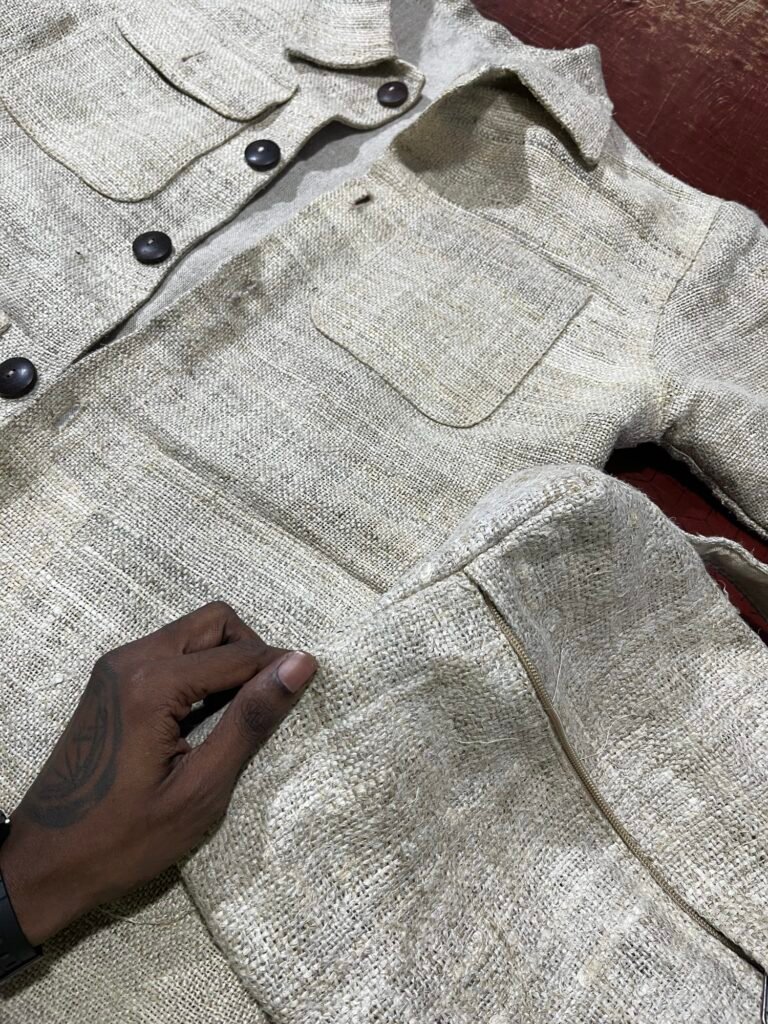
Close-up of an unlined handwoven hemp cuff with its new button

On the body, the sleeves now cover the full arm, and the bicep is no longer too wide; it looks okay, not ideal. The wrist end is still narrow, so the cuff folds back once and the sleeve won’t roll up to the elbow.

The cuffs rubbed against the wrists. They’re unlined hemp: the neck now has cotton against the skin, and the cuffs don’t.

The tailor’s view is that these cuffs can’t take a liner. Whether a cuff built with a lining from the start is possible is one of the first questions for the second supplier.

The rub also reopens a decision from the first sample. Master Dai suggested a hemp-cotton blend at the collar and cuffs, for softness, and we turned it down for durability. One walk is thin evidence, but it points his way.

Hemp is widely reported to soften with washing and wear, so some of this may ease on its own. V2 hasn’t been washed yet, and Master Dai says the hemp is prewashed before it’s cut. Whether a wash at home softens the cuffs is something we’d rather find out than assume.

Still Open After V2

  • Can the cuffs be lined, and can the elbow patch go on the liner as specified? Both questions go to the second supplier.
  • Does the hemp-cotton blend come back for the cuffs?
  • The sleeve correction has to reach the pattern, whoever cuts Run One.

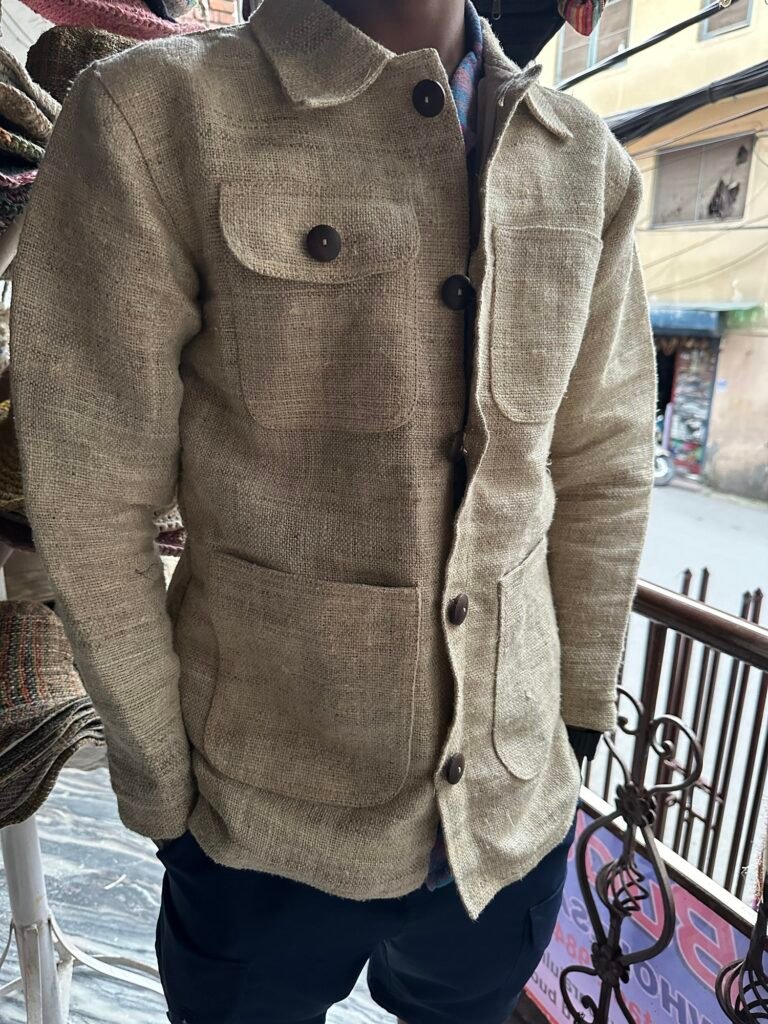
Reworked handwoven hemp chore jacket sample (V2), front view, undyed hemp shell with new longer cuffs

Entry 02: The First Hemp Chore Jacket Sample Came Back Wrong

The first sample of the Funcle Yeti chore jacket was made in Kathmandu from handwoven hemp, and it did not pass.

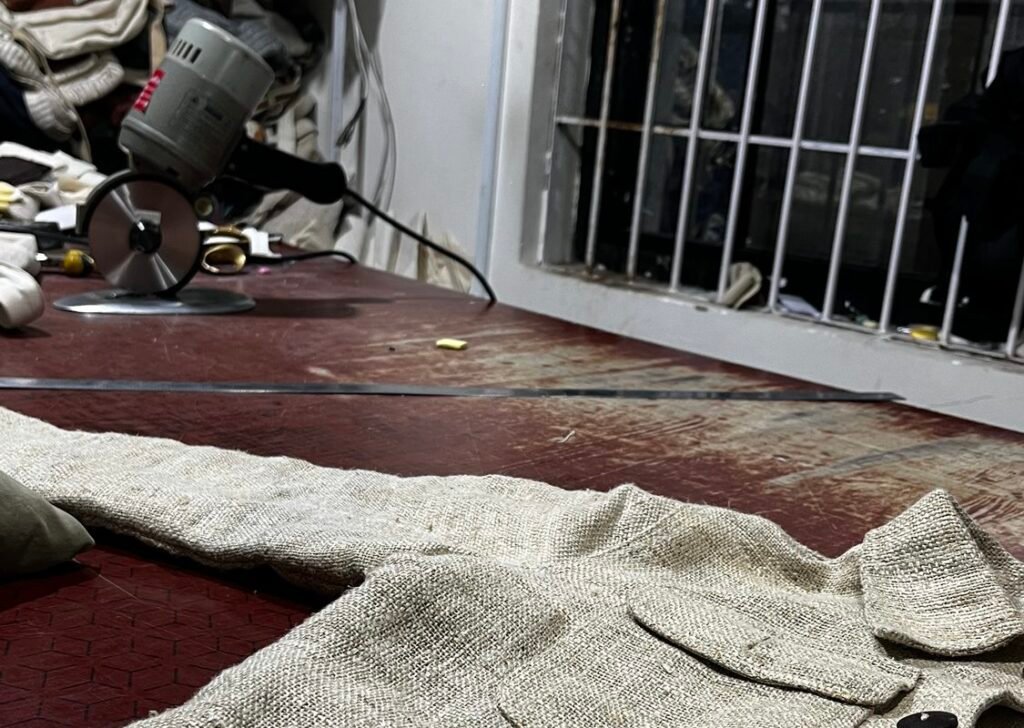
Rotary fabric cutter and offcuts in the Kathmandu workshop where the hemp chore jacket is made

What Was Specified

The brief asked for foldable cuffs and cotton liner patches at the neck and elbows — the two places a jacket gives out first on anyone who actually wears one. Reinforce them at the start and you’re patching in year eight instead of replacing in year three.

First fitting of the handwoven hemp chore jacket showing a short cuff and tapered sleeve

What Came Back

No foldable cuffs. No liner patches at the neck or elbows.

The fit was closer than it had any right to be, and there’s a reason for that. My measurements had been taken months earlier and left with the workshop, and by the time the sample was cut they’d gone missing. The Master Dai worked from judgment instead. Master is the title for the lead tailor; Dai means elder brother — what you call a man whose read on the work outranks yours.

Close-up of the collar and cotton liner on a handwoven hemp chore jacket sample

He got the torso right by eye, which is a genuinely impressive thing to do. The sleeves he did not. Too short at the cuff, too wide through the bicep, and tapered hard enough that you notice it on the first wear rather than the tenth.

The One Thing That Was Right

He lined it in a cotton matched close to the hemp. I thought it looked dull. He was thinking about dye transfer onto undyed cloth over ten years of washing, which is the correct thing to be thinking about. The liner stays.

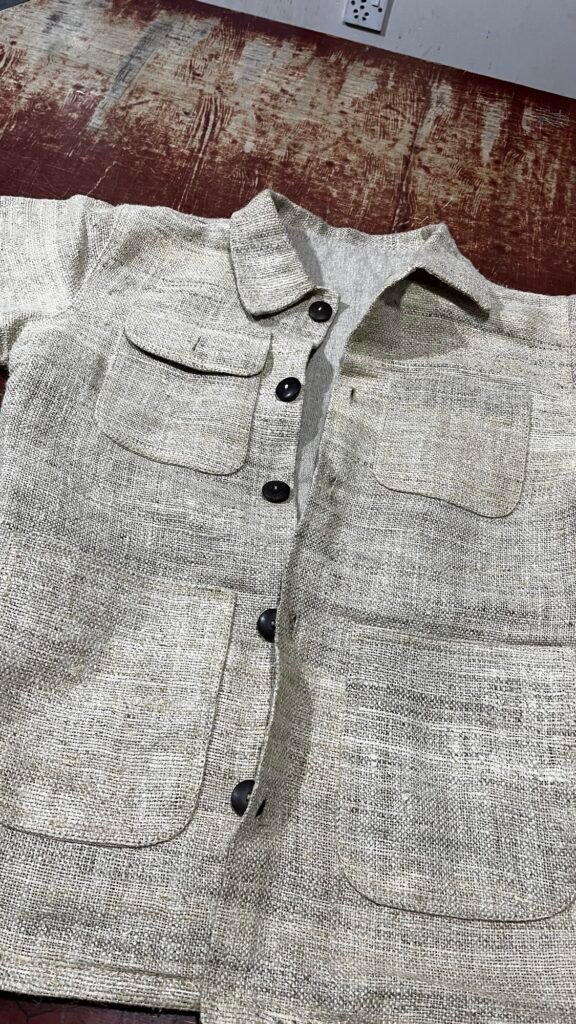
Handwoven hemp chore jacket first sample laid flat on a workbench in a Kathmandu workshop

What Happens Next

The sample went back for rework. V2 is in progress. If it holds, the same spec goes to a second workshop — with the measurements taken fresh, on the day, by someone who doesn’t have to guess.

Seeing the thing exist in cloth for the first time was a good day, for the record. It just wasn’t a finished jacket.

Entry 01: Looking for Hemp in Kathmandu

We spent a few weeks walking into hemp shops across Kathmandu to see what was already being made. Almost all of it was the same jacket: a zip, a hood, a winter cut. Very little of it was pure hemp — most was a blend, usually with cotton, sometimes without saying so.

Nobody was making a chore jacket in handwoven hemp. That gap is the reason Run One exists.

What the Shops Said About Weight

One shop owner told us pure handwoven hemp runs at least 300gsm, and realistically 350–360. That’s secondhand, from a retailer rather than a weaver, and we’ve treated it as a starting point rather than a number.

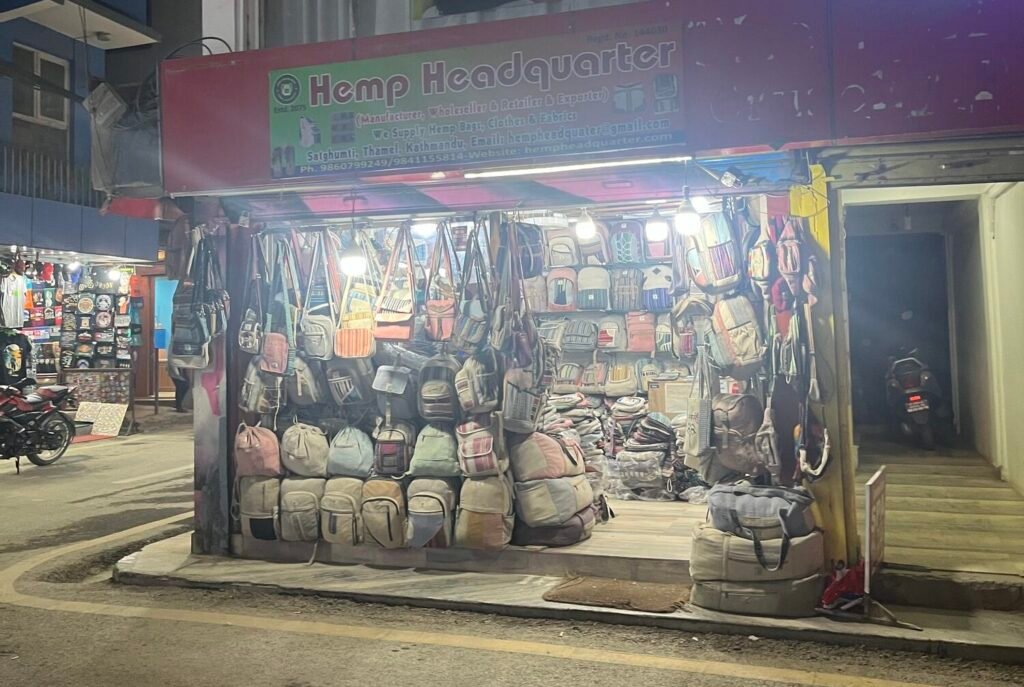
Hemp goods shop in Thamel, Kathmandu, selling hemp bags and accessories
A hemp shop in Thamel — mostly bags, not jackets.

The Swatches

Shop 1 gave us four options (that we liked): two dyed, in a pattern they call “zigzag weave” — visually it reads closest to a twill or herringbone, though the shopkeeper’s term was “Zig-Zag,” so we’re not stating that as fact. And two undyed in plain weave, one of which is wood-ash treated. It basically means that these wild harvested hemp from the mountain is boiled in wood ash to make it softer.

The shop also confirmed the ash treatment directly — it’s genuinely part of their process, not something we’re guessing at. It’s noticeably softer in the hand, entirely handwoven and sometimes costs more due to the additional processes and labor intensive production.

We’re using the plain, untreated, undyed option for Run One. No dye, because it’s a step that adds cost, adds a thing that can fade, and hides what the fibre actually looks like. Not the ash-treated version either, for now — we don’t yet understand enough about what the treatment does to the fibre over time to build it into a jacket worn for over ten-year, and that’s a question for the next visit, not a guess we’re comfortable publishing.

Top left/Bottom right: dyed zigzag-weave swatches, purple and rust. Bottom left: undyed plain weave, wood-ash treated — confirmed by the supplier, softer to the touch. Top right: undyed plain weave, untreated — the one we’re using.

The First GSM Test, and why We’re not Quoting the Number

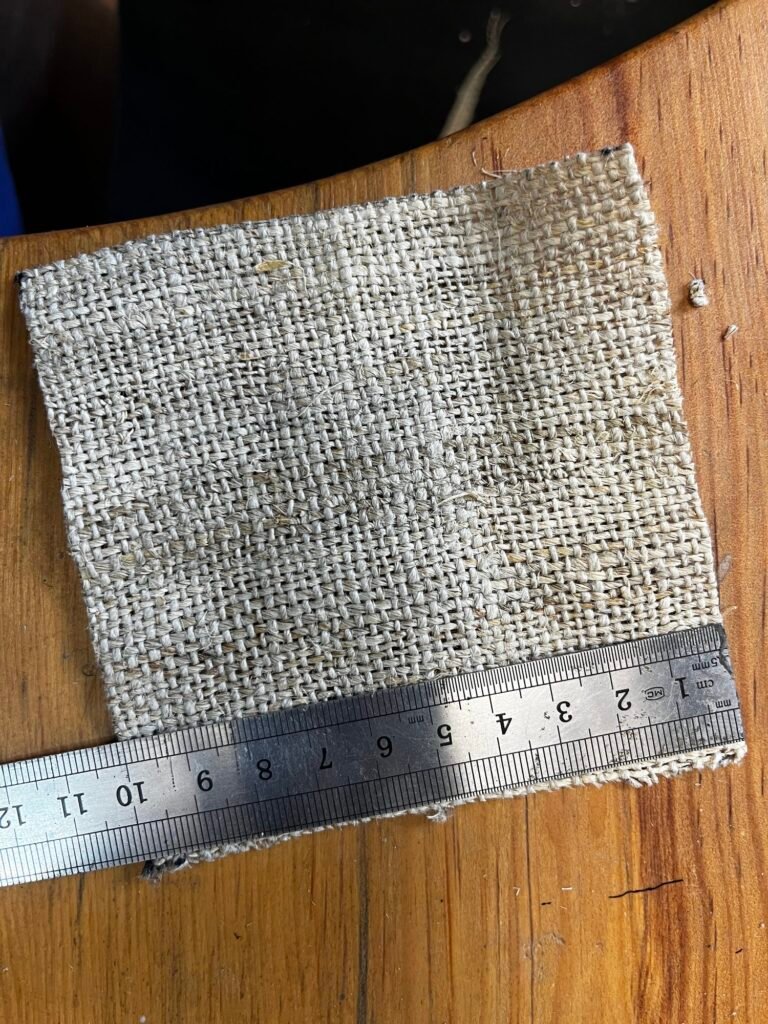
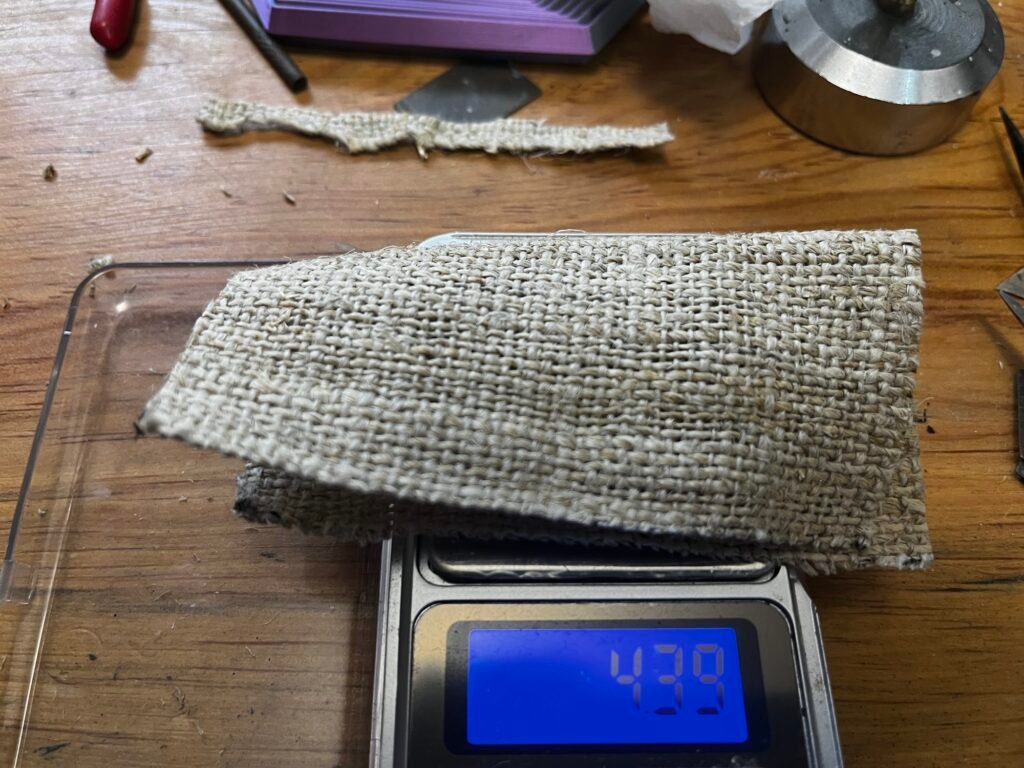
We ran a rough check at home on a 0.01g scale: the swatch weighed 4.39g. Assuming a clean 10cm × 10cm square, that works out to about 439gsm — well above what the shop had quoted.

The swatch on hand wasn’t a clean 10cm square — the first sign this test needed redoing properly.

We don’t trust that number, and the reason is visible in the photo: the swatch wasn’t actually 10cm square. It ran past that mark on one edge, which means the true area was larger than we assumed — and the same weight over a larger area means a lower real GSM. The 439 figure is almost certainly too high; we just don’t know by how much yet.

There’s a second reason to be cautious, one that would apply even to a perfectly cut square: hand-tensioned weaving means density drifts across a bolt, so one square only ever tells you about that square.

First GSM reading (4.39gm) — from an irregular cut, so treated as inconclusive rather than final.

The proper version takes several squares from different parts of the same batch, averaged, with the spread reported alongside. We’ll run that for both suppliers once we have swatches from each, and publish the range as well as the average — the variation is a real property of hand-woven cloth, not an error to hide.

One thing we can’t solve: the batch we test may not be the batch that gets cut. Hemp moves through these workshops faster than a sample takes to approve. So the test tells you what this workshop’s cloth typically runs, and we’ll test the actual Run One yardage separately once it’s bought.

Where This Goes Next

Supplier 2 has been visited once, briefly. No swatches yet.

Supplier 1 has the brief and is making the first sample.


The 30-Year-Old Game Boy That Still Works

I never owned a Game Boy.

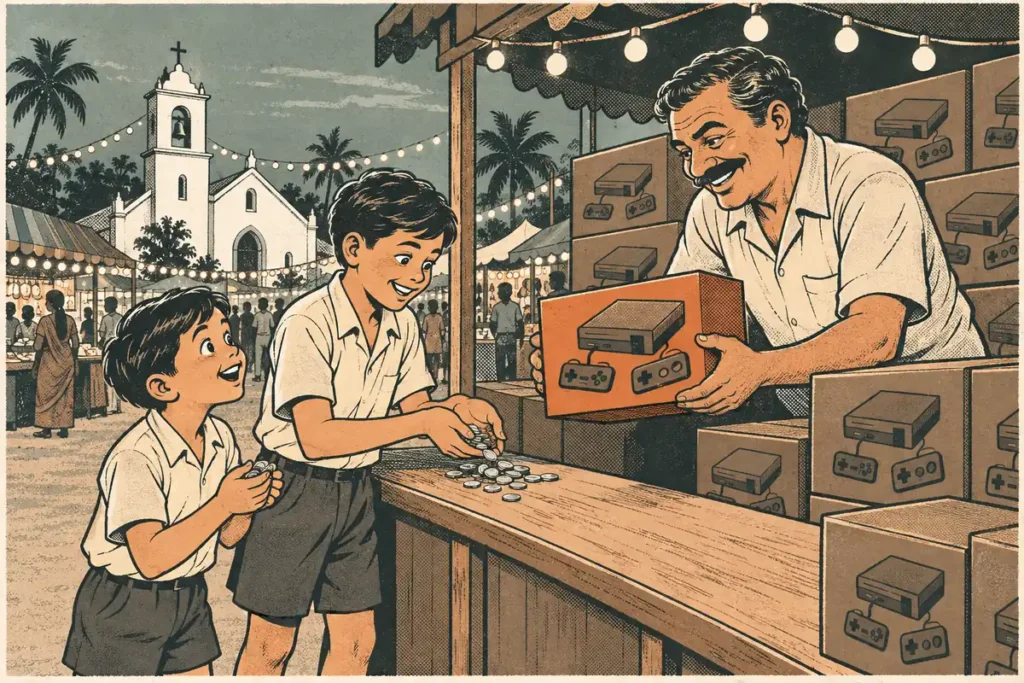
What my brother and I had was a box from a festival market in a small church town in Tamil Nadu, in the south of India, where our family went every year. We saved for it the way kids save for anything: badly, and then all at once. Every rupee of pocket money we had been given for the trip went into one pile, and the pile came to about 500 rupees. That was the price of the cheapest video game console on the stalls.

Two young brothers pooling their coins at a night festival stall to buy a cheap boxed video game console
About 500 rupees: every coin of the trip money, pooled.

Neither of us can remember a brand name. Inside the box were a plain plastic console, a pair of wired controllers, a light gun, and a cartridge about the size of a cassette tape that promised hundreds of games on its label. In practice it was the same dozen or so — Mario, Contra, a high-jump game, a handful of sports games — repeated under different names to make up the number. It was almost certainly an unlicensed copy of Nintendo’s home console (the NES, sold in Japan as the Famicom), one of the millions of “Famiclones” sold at markets and fairs across Asia, Eastern Europe and Latin America. It was supposed to be junk.

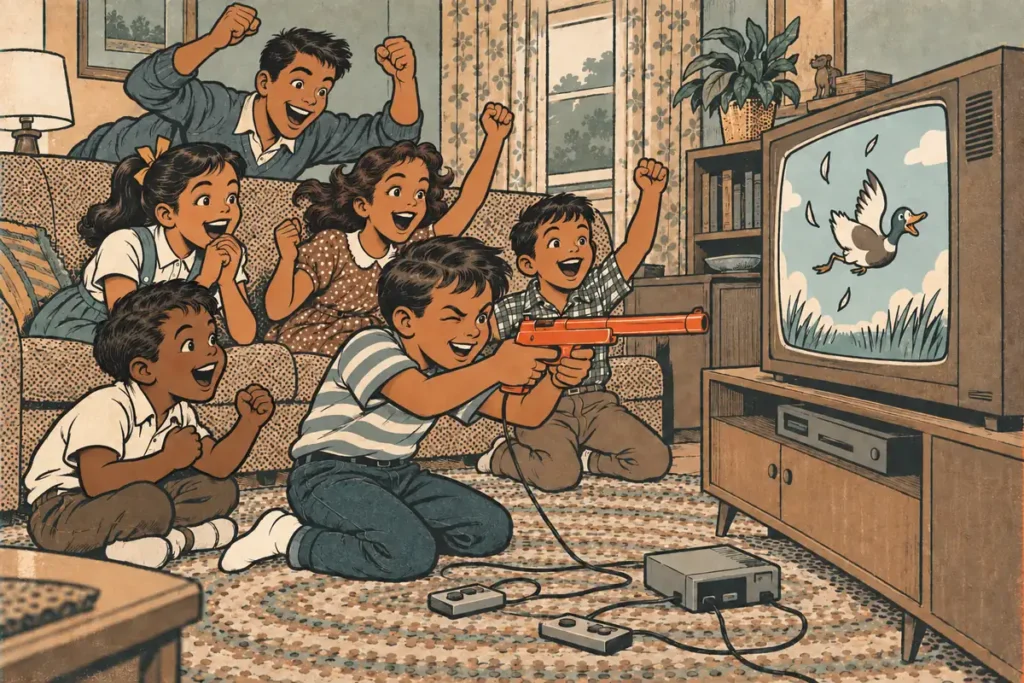
The game everyone wanted was Duck Hunt. You pointed a plastic gun at the television, pulled the trigger, and a duck flying across the screen dropped out of the sky. For a room full of kids at the time, it was the closest thing to virtual reality any of us had ever seen. When the dog popped up out of the grass holding two ducks at once, the whole room went mad.

A crowd of cousins cheering as a boy aims a toy light gun at a duck falling on an old box television
The closest thing to virtual reality any of us had seen.

We were never allowed to play alone, and never for long. After a couple of hours, a parent or our grandfather would call time — unless it was Sunday, when the whole gang of cousins got a few extra hours and we tried to beat each other’s scores in Mario.

That cheap, flimsy, unbranded box lasted for years.

Meanwhile, in lofts, drawers and shoeboxes at parents’ houses all over the world, there are grey bricks that belonged to the kids who did get a Game Boy. They are heavier than you remember. The D-pad is worn smooth in one corner, there is the faint ghost of a sticker on the back, and the battery cover is held on with tape because the little plastic tab snapped off sometime around 1997. Put four AA batteries in one, slide the switch, and it does the thing. The Nintendo logo drops down the screen, there is that small, bright ping, and Tetris is right there where you left it. Thirty-odd years later, it just works.

Now go and find the phone you retired three years ago. You know the one. It is in the kitchen drawer with the takeaway menus and the spare keys. Charge it overnight and it might boot. It might even hold a charge until lunch. But half its apps will not install, the battery has the stamina of a hangover, and it has quietly become an object you keep only because you feel bad throwing it away.

One of these things was built by a company that wanted you to keep it. The other was built by a company that needs you to replace it. That difference is what this whole corner of Funcle Yeti is about. And the 500-rupee box from the festival market, it turns out, has something to add.

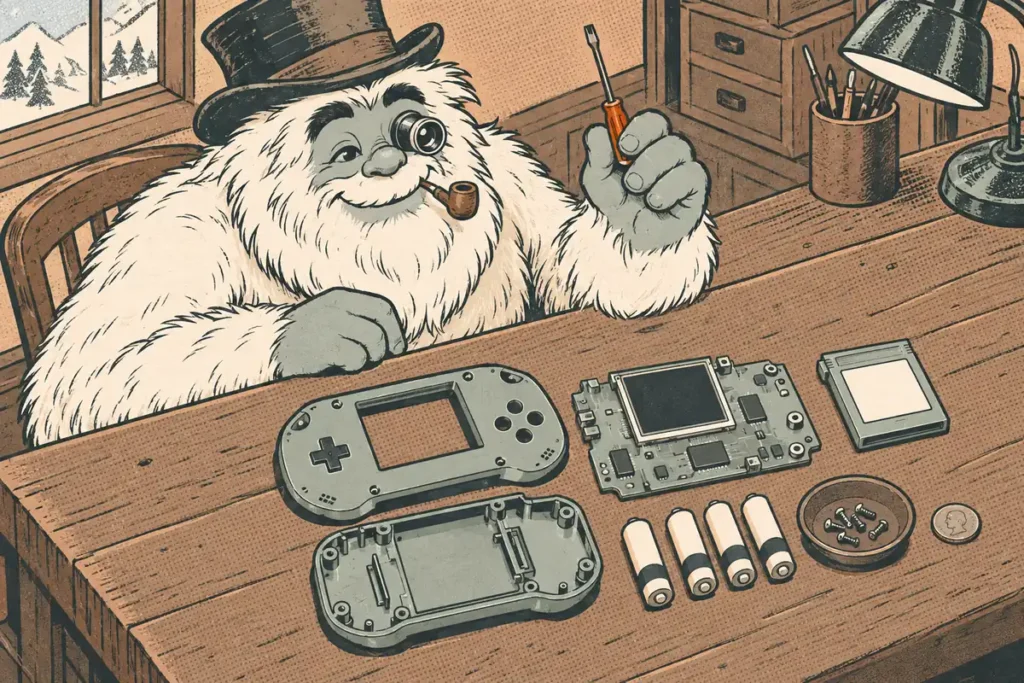
The short answer: most original Game Boys still work because Nintendo built them simply: a thick plastic shell, a basic processor, four AA batteries from any shop, games that lived on cartridges, and screws you could undo. Modern phones are sealed, glued and dependent on software updates that eventually stop. Even a cheap clone console, built the same simple way, could last for years if someone looked after it.

Why Does the Original Game Boy Still Work?

The original Game Boy launched in Japan on 21 April 1989, in North America on 31 July 1989, and in the UK and Europe on 28 September 1990 at £69.99. Even then, it was not the most impressive handheld on the shelf. Its rivals had colour screens and backlights. The Game Boy had a greenish, unlit display that you had to angle towards a lamp like you were reading under the duvet.

But Nintendo had made a deliberate set of choices. Instead of chasing the fanciest screen or the fastest chip, the Game Boy put its money into the things that actually mattered to a kid. It was cheap enough for parents to say yes to. It ran for up to 30 hours on four AA batteries. And it was tough enough to survive being dropped, sat on, thrown in a rucksack and left in the back of a car all summer.

Look at how it was put together and the durability makes sense:

  • Simple parts. A thick ABS plastic shell, a handful of buttons, a basic processor and a screen. Fewer things to fail.
  • Batteries from any corner shop. When the power ran out, you did not need a charger, a cable or an appointment. You needed four AAs, and a coin to open the cover if the tab had gone.
  • Generous tolerances. Nothing was engineered to the edge of what was physically possible. There was room inside for things to flex, heat up and cool down.
  • No software to expire. The game lived on the cartridge. There were no updates to download, no account to log into, no server that could be switched off. The Game Boy you bought in 1990 is, in every way that matters, the same Game Boy today.
The Funcle Yeti opening a handheld console with a screwdriver, showing its simple circuit board and four AA batteries
Simple parts, AA batteries, screws instead of glue and nothing to update.

Our clone shared most of these virtues, mostly by accident. It had no screen of its own to crack; it borrowed the family TV. There was nothing to update and nothing to log into. Everything it would ever do was already on the cartridge.

Then there is the Game Boy that became a legend. In early 1991, during the Gulf War, an Iraqi Scud missile hit the barracks where a US Army nurse named Stephan Scoggins had left his Game Boy. The fire destroyed nearly everything. The Game Boy came out with its front scorched and blistered and its buttons partly melted. And it still switched on.

Nintendo gave him a replacement and kept the burnt one, putting it on display at its New York store, playing Tetris, for years. It was the most convincing advert the company ever had, and they did not have to write a word of it. In 2023, Nintendo Life reported that it had been taken off display and returned to Nintendo of America’s headquarters in Redmond, Washington, but the point had long been made.

So Why Doesn’t My Phone Last Like That?

It would be easy to say “they don’t make things like they used to” as if companies simply forgot how. That is not what happened. Manufacturers today can build to tighter tolerances, with better materials, than anything available in 1989. The capability is there. What changed was the business model around it. It even has a name: planned obsolescence, the practice of designing products to need replacing sooner than they have to.

A modern smartphone is designed to be thin, sealed and glued. The battery, the one component guaranteed to wear out, is usually locked inside a body you are not supposed to open. The device depends on software updates that eventually stop, and on apps that eventually refuse to run on old versions of that software. When the battery fades or the updates end, the phone does not fail so much as get politely retired.

Sometimes it is less polite than that. In December 2017, Apple admitted that its software updates had been slowing down older iPhones with worn batteries. The company said it was to stop them shutting down unexpectedly, and that may well be true, but in 2020 it agreed to pay up to $500 million to settle a US class action, plus $113 million to more than 30 US states. Whatever the intention, a lot of people replaced phones that only needed a new battery.

None of this is new, either. In the 1920s, the world’s biggest lightbulb makers formed what became known as the Phoebus cartel and agreed to cap bulb life at around 1,000 hours. Built-in expiry dates are almost a century old. The Game Boy just happened to come from a moment, and a company, where durability was the thing being sold.

The phones of that era came from the same school of thought. The first mobile I ever held was my father’s Nokia, the kind with a green, pixelated screen, and the only thing I was allowed to do on it was play Snake. I dropped it once. I remember the half-second of pure terror — not for the phone, but because it was my father’s — and then the relief when it carried on as if nothing had happened. I had no idea those phones were built like a rock. By the time I got a phone of my own, at sixteen or so, screens had colour, Android was arriving, and Snake had become a bright, curving thing that was far more than a line of pixels. It looked a lot better. Whether it would have survived the same drop is another question.

Was It All a Swindle?

Here is where it is worth being fair, because the lazy version of this essay is just an old man shouting at an iPhone.

The phone in your pocket does an absurd amount more than a Game Boy ever could. It is a camera, a map, a bank, a library, a record collection and a way to hear your mum’s voice from the other side of the world. The trade-offs that made phones fragile — thinner bodies, sealed cases, constant updates — also made them waterproof, powerful and secure. Not every one of those decisions was a con.

We should be honest about survivorship bias, too. The Game Boys still working today are the ones that survived. Plenty of 90s electronics were cheaply made and are long gone, which is exactly why nobody writes nostalgic essays about them. Nostalgia has a habit of remembering only the winners.

But my own childhood complicates that in a way I did not expect. My cousins had the same kind of cheap console we did — theirs was a slightly pricier version that folded open like a tiny laptop, with its own small screen, so it could come along on every family trip, even the dull ones to the church town. The picture was terrible. Nobody cared.

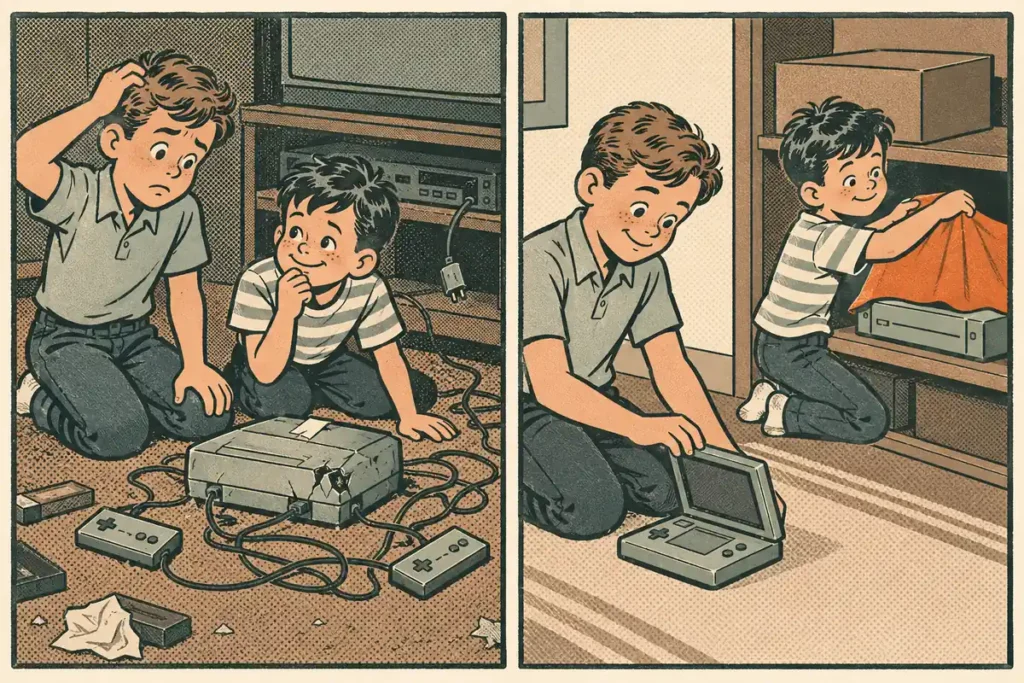
My brother and I were not careful owners. We dropped ours, banged it about, and yanked its wires out of the back of the VCR every time we wanted to play. It survived a few years of that before we had well and truly battered it. My cousins looked after theirs properly. It lasted at least five.

Similar machines, similar prices, two very different lifespans. The difference was not the factory. It was us.

Two boys with a battered game console beside cousins carefully covering theirs with a cloth
Similar machines, similar prices, two very different lifespans.

That is the part the survivorship argument misses. How long something lasts is decided partly by how it was built and partly by how it is treated — and the second only counts if the first allows it. A cheap console with simple parts could reward a bit of care with years of extra life. A sealed phone with a glued-in battery mostly cannot, however gently you hold it.

So even after all the fair caveats, something real is left over. The Game Boy proves it was possible to make a mass-market electronic device, sell it cheaply to children, and have it still work three decades later. The fact that we mostly stopped doing that was a choice, not a law of physics.

Things Last When You’re Allowed to Fix Them

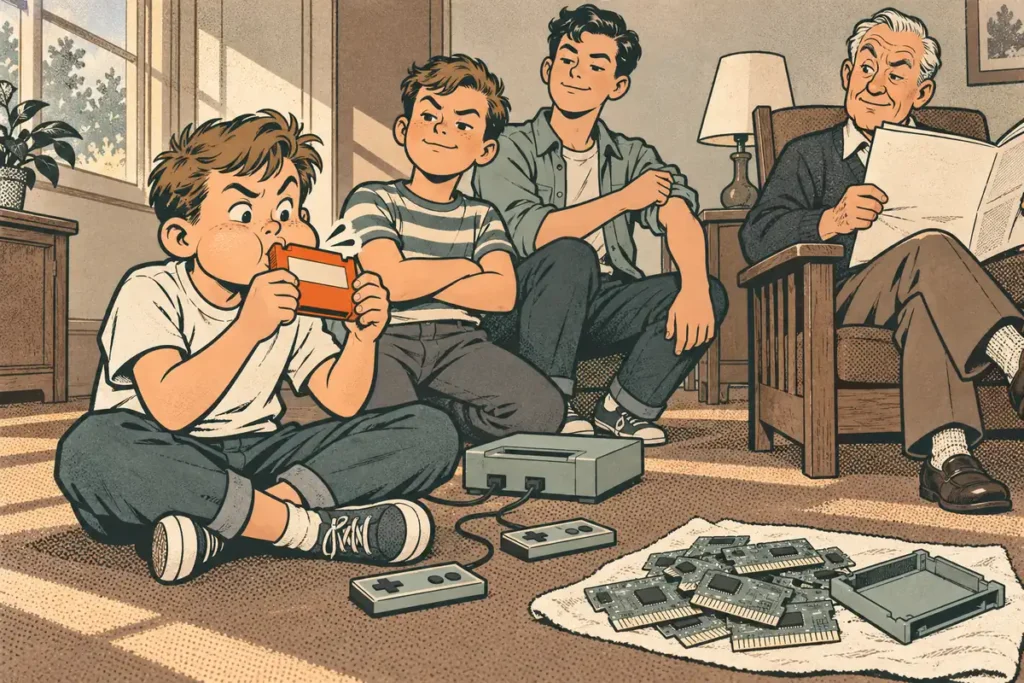
A boy blowing into a game cartridge while his older brother and cousin queue behind him, beside a pile of bare circuit boards
The first fix every kid knew. It probably wasn’t the blowing.

In our house, repairs had a chain of command. When the console played up — and it was almost always the cartridge — the first fix was the one every kid of that generation knew: pull it out, blow into it, push it back in. It worked nearly every time. (It probably was not the blowing. Taking the cartridge out and putting it back reseated the contacts, and Nintendo’s own small print said as much: “Do not blow into your Game Paks or systems. The moisture in your breath can corrode and contaminate the pin connectors.” Nobody told us, and it would not have stopped us.) If that failed, my brother took over. If he failed, it went up to our older cousin, who was the final authority on anything with wires.

At some point we got curious and cracked a cartridge open. I remember how surprised we were. Inside that big plastic shell was one small, thin circuit board and a lot of empty space. After that, we stopped bothering with the shells and kept a little pile of bare boards, which looked terrible and worked fine.

None of us would have called that repair. But it was: a machine simple enough that a ten-year-old could see where the game actually lived.

That is the deeper reason so many old Game Boys still work, too. They were tough, but more importantly, when something did go wrong, you could do something about it.

Take the cartridges. Games like Pokémon Red and Blue saved your progress using a tiny coin-cell battery inside the cartridge, and after fifteen or twenty years those batteries die and take your save file with them. For a lot of people, that was a genuinely upsetting discovery. But the fix is a new coin cell, a few minutes with a soldering iron and some patience. A whole community of people do exactly this, and their tutorials are free online.

The same goes for the Game Boy’s most common fault: the dead vertical lines that creep across the screen as the ribbon connection wears out. It looks terminal. It is usually a fixable connection, not a dead machine. Screws, not glue. Standard parts, not proprietary ones. That is the whole secret.

There are signs this thinking is finding its way back. Since June 2025, EU rules have required phone makers to keep spare batteries and screens available for at least seven years after a model stops being sold, and to make batteries either replaceable with basic tools such as a screwdriver or, in water-resistant phones, durable enough to keep 80% of their capacity after 1,000 charges. It took legislation to force it, but the idea is the same one Nintendo built into a grey plastic brick in 1989.

What an Old Console Teaches You About Owning Things

Our console never really died. It was replaced by curiosity. My father brought home a second-hand computer for his office, and almost overnight the console was old news; we spent our energy trying to persuade the woman who worked there to let us play when he was out. There was a gaming centre nearby, too, with a PlayStation and Spider-Man, but it charged by the hour, and the money always ran out long before the fun did. Nothing about that hour was ours to keep. We grew up and went chasing newer, better things. Or so we thought.

Years later, I bought one of those little retro handhelds that come loaded with the old games. Last October, On the flight home from China, I played my way back through the lot — Mario, Contra, Mortal Kombat, and the Pokémon game my brother and I used to play on that old office computer — and managed to evolve a Pokémon before we landed. It was wicked — the good kind of nostalgia — and it took me straight back to a room full of cousins shouting at a duck.

The Funcle Yeti playing a small retro handheld game console in a dark aeroplane cabin at night, clouds outside the window
Thirty thousand feet up, a Pokémon evolves before landing.

And holding it, I understood what Game Boy owners mean when they talk about theirs. An old console does not feel like a gadget. It feels like an object, one of the physical things that keep you grounded in a screen-heavy life. It has a history. The scuffs are yours. The worn patch on the D-pad is from your thumb, specifically, over hundreds of hours. Nothing about it is waiting to be replaced.

That is the feeling this part of Funcle Yeti is chasing. Built to Last is where we write about things that were made simply, made to be repaired and made to outlive the moment they were bought in: the Game Boys, the Nokias, the cast-iron pans, the boots and jackets that got handed down. Not because everything old was better — it was not — but because the things that lasted have something to teach us about what we choose to bring into our lives now.

The Game Boy was never the most powerful machine in the room. Neither was a 500-rupee box from a festival stall. They just refused to quit, for as long as someone was willing to look after them. There are worse things to aspire to.

Frequently Asked Questions

Does the original Game Boy still work?

Many do. Original Game Boys from 1989 and 1990 often still switch on and play today, because the hardware is simple, runs on four AA batteries and has no software that can expire. The most common faults, such as dead lines on the screen or flat save batteries in cartridges, can usually be repaired.

How long does a Game Boy run on batteries?

The original Game Boy ran for up to 30 hours on four AA batteries. Because it used standard batteries from any shop, a flat Game Boy never needed a charger, a cable or a replacement battery pack.

Why did old electronics last longer than modern phones?

Old devices like the Game Boy were built simply, with thick shells, few parts, standard batteries and screws you could undo. Modern phones are thin, sealed and glued, and depend on software updates that eventually stop. Manufacturers didn’t forget how to build durable things; the business model changed.

Did blowing into game cartridges actually help?

Not really. Taking the cartridge out and pushing it back in reseated the metal contacts, which is what usually fixed the problem. Nintendo warned against blowing, because the moisture in your breath can corrode the pin connectors over time.

What is a Famiclone?

A Famiclone is an unlicensed copy of Nintendo’s NES or Famicom console. Cheap Famiclones were sold at markets and fairs across Asia, Eastern Europe and Latin America, often bundled with controllers, a light gun and a multi-game cartridge that repeated the same games under different names.

Do EU rules require replaceable phone batteries?

Partly. Since June 2025, phones sold in the EU must have spare batteries and screens available for at least seven years after a model is discontinued. Batteries must be replaceable with basic tools, unless they keep 80% of their capacity after 1,000 charge cycles and the phone is rated IP67 for water and dust resistance.

Sources

Illustrations generated with AI in the Funcle Yeti house style.
The Powerless Kid, The Invincible Hero: How a Childhood Coping Mechanism Became Adult Strength

Loved overpowered anime characters as a kid? You may have been using them as a coping mechanism.

Is it just me, or does everyone have this memory? You’re a kid, goofing around with your cousins, and some uncle or aunt wanders over to tell you to enjoy it while it lasts, because being a child is the best time of your life.

I never gave it much thought back then. Looking back, I think they were already feeling the weight of adulthood, the same crushing pile of responsibilities that’s landing on us now.

But for a lot of us, childhood wasn’t the easy part. And if you grew up quietly obsessed with overpowered anime characters, that obsession may have been doing more work than you realized.

THE SHORT ANSWER
If you were drawn to overpowered (OP) anime characters as a kid, especially calm, untouchable ones like Sesshomaru from InuYasha or Hiko Seijūrō XIII from Rurouni Kenshin, it may have been more than taste. Researchers call the urge to become like a favorite character wishful identification, and research on children and media describes kids using their favorite heroes to shape who they are and to cope with everyday life. For a child with little control at home, a hero who could never be pushed around was a safe place to put that feeling.

When Home Felt Out of Your Control

Childhood is a landscape mapped entirely by other people’s rules. For a long time, you don’t realize you’re powerless; you simply live inside the boundaries you’re handed. But for plenty of kids growing up in the late ’90s and early 2000s, home wasn’t a soft sanctuary. It was a masterclass in navigating instability.

That instability wore different masks depending on the house you lived in.

For some, it was a parent who kept chasing the next get-rich-quick scheme, and the humiliating cycle of watching them ask a grandfather or an uncle to patch over the monthly shortfall. For others, it was absence: both parents working day in and day out, and a quiet, hollow house where a small mind worked out early that survival required loneliness. And for many, it was a high-decibel home, where an alcoholic parent’s verbal routine forced you to shrink into a corner. You learned to wear self-deprecation as armor, because the world outside couldn’t mock you if you’d already made yourself the punchline.

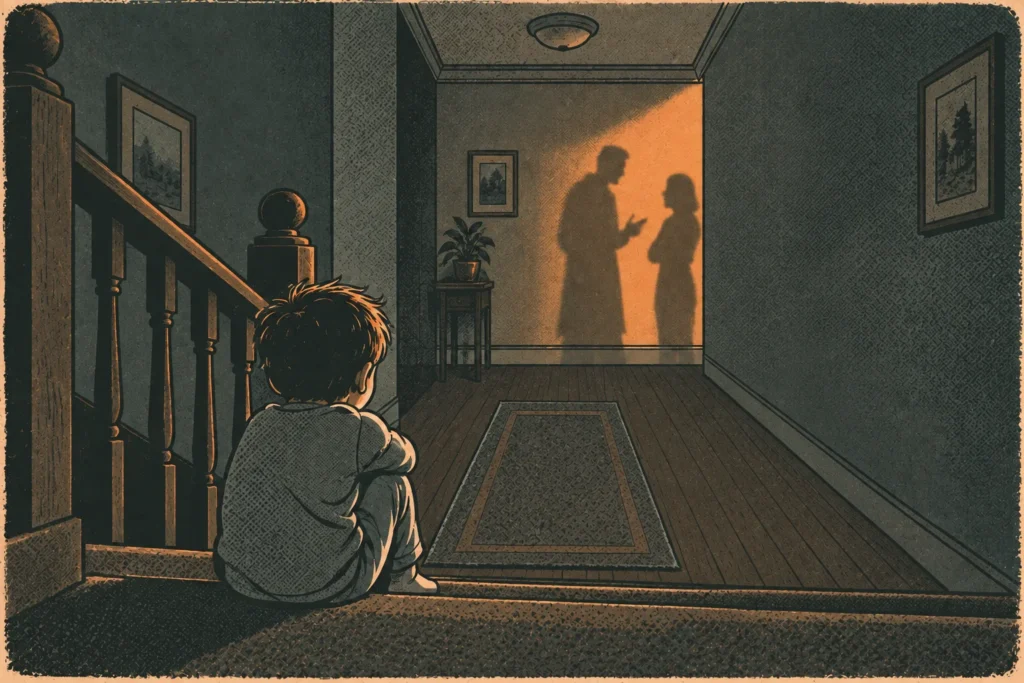
A child sits alone at the top of a dark staircase while harsh light and shadows spill from a room below.
For a lot of kids in the late ’90s and early 2000s, home was the least predictable place they knew.

The last of those has a name in public-health research. Experiences like growing up with a parent who misuses alcohol are called adverse childhood experiences (ACEs), and they are far more common than most of us assume. In CDC survey data from 2011 to 2020, 63.9% of US adults reported at least one ACE, and adults aged 25 to 34 were the age group most likely to report four or more: 25.2%, roughly one in four.

Whatever the specific texture of your reality, the result inside your head was the same: a paralyzing loop of script-doctoring. You replayed every confrontation, rewriting your own weakness into endless what-ifs and should-haves.

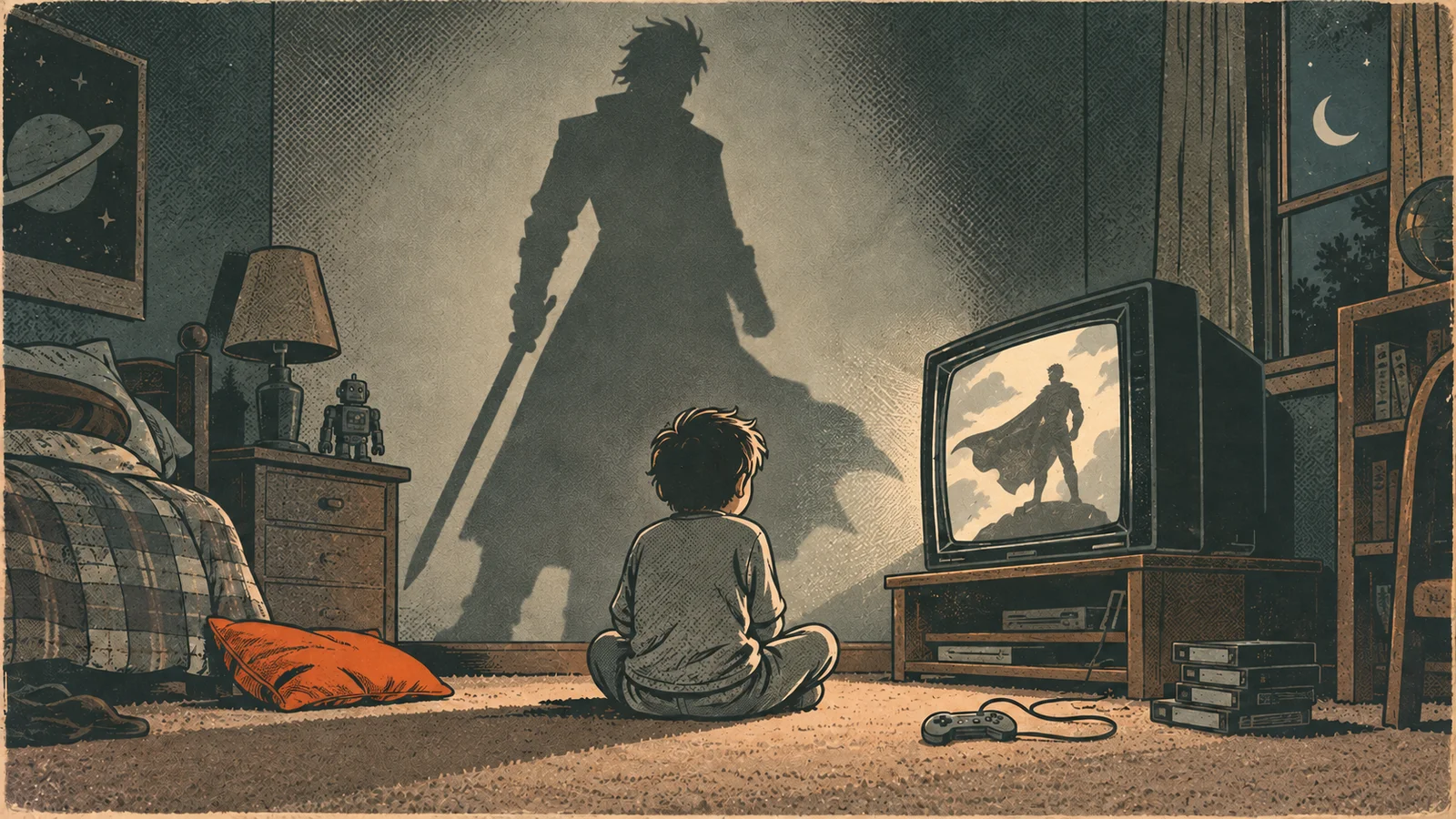
Looking back, I remember all the times we used to watch SpongeBob or DragonBall Z on TV with the volume down to just the first two blocks. Even without the sound of SpongeBob laughing his high pitched annoying laugh or when Goku screamed himself to become the Super Saiyan, we felt the laughs and the excitement.

Our one ear was always sharpened to our father’s footsteps, ready to run to the TV because the remote was broken perpetually in our house. On some days we used to make it just before he entered the room and on some days, we used to get our asses whooped.

The Blueprints of Stillness: Why Overpowered Anime Characters Felt Safe

When your real world feels out of your control, your mind drifts toward characters with an infinite aura: figures who move through chaos with a cold, untouchable grace. They don’t win by shouting. They win by being impossible to move.

The reality at homeThe overpowered sanctuaryWhat it gave a powerless kid
A parent chasing get-rich-quick schemes; money always running outHiko Seijūrō XIII (Rurouni Kenshin)Discipline and total, quiet control: the steadiness the house didn’t have
Parents always at work; a quiet, empty houseEightron (DT Eightron)A way out, and a protector who always came when called
Shouting at home, bullies at schoolSesshomaru (InuYasha)A boundary nobody could cross, held without ever raising his voice

Sesshomaru (InuYasha): The Boundary That Never Moved

Consider Sesshomaru from InuYasha. He didn’t need to raise his voice to command a room; his presence was the baseline everyone else had to adjust to. To a neurodivergent kid struggling to decode the social groups at school, or a kid who’d had ink splashed across his shirt by a class bully, that kind of calm looked like a superpower in its own right.

Then there’s his sword. In InuYasha: The Final Act, the 2009–10 series that finally finished the story, Sesshomaru manifests Bakusaiga [→ anime swords post · optional], a blade that isn’t inherited or stolen but grows out of his own body, after he has handed the technique he worked so hard to perfect over to his brother’s sword. It was the ultimate daydream weapon. You didn’t want to destroy the world. You just wanted an unyielding boundary against the people who talked down to you, and you wanted it to come from somewhere inside you.

Hiko Seijūrō XIII (Rurouni Kenshin): Stillness in a Room Full of Noise

The same logic applied to Hiko Seijūrō XIII, the thirteenth master of the Hiten Mitsurugi style and Kenshin’s teacher in Rurouni Kenshin (known in some markets as Samurai X). In a world full of frantic, shouting swordsmen, what defined him was how still he stayed. He never looked like he was trying. To a kid watching a parent fumble promise after promise, that looked like the most enviable thing in the world: complete control, and nothing to prove.

DT Eightron: A Way Out of the Empty House

In the more obscure corners of our childhoods sat shows like DT Eightron, a 1998 series from Sunrise, the studio behind Gundam. Its hero, fourteen-year-old Shu, grows up in Datania, a domed city run by a computer program whose “reset system” strips children of their emotions so they’ll work like drones. Shu dreams of seeing the ocean, so he escapes and joins a band of underground rebels, and whenever they’re in immediate danger, an eight-year-old hacker named Dolly can summon Eightron, a powerful, mysterious guardian. For a kid alone in a quiet house, that was the whole fantasy in one premise: a way out, and a protector who always answered.

In those solitary hours, you weren’t a kid hiding from a parent’s fumbled promises or an empty house. You were a warrior in a larval state, waiting for your turn to be invincible.

Was It Really a Coping Mechanism? What the Psychology Says

As far as I know, nobody has studied kids who worshipped Sesshomaru. But you’re not the only one who felt the pull. AnimeTok creator Tony Weaver Jr. told HuffPost that anime gave him characters he “could lean on when I wasn’t strong enough to be myself yet.” Two well-established ideas from psychology explain why that pull was so strong.

The first is wishful identification: the desire to become, or act like, a media character. In 1996, communication researcher Cynthia Hoffner interviewed children aged 7 to 12 about their favorite TV characters. How intelligent a male character seemed predicted how much kids wanted to be like him, and for boys, how strong he seemed predicted how close they felt to him. SAGE’s Encyclopedia of Children, Adolescents, and the Media notes that children pick favorite heroes and use them to shape their own identities, and that how much they lean on those heroes to cope with growing up and everyday life depends on their stage of development.

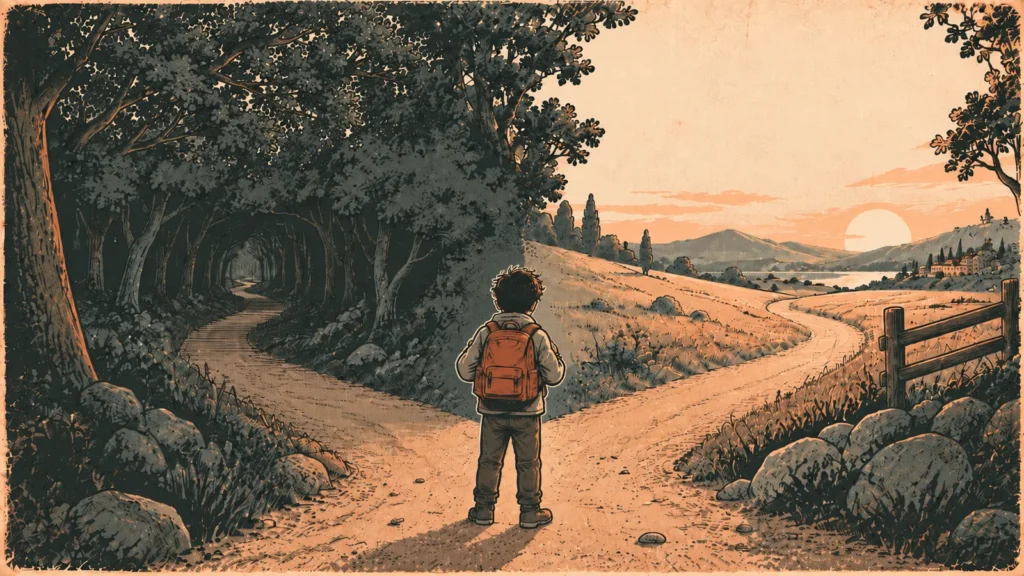
The second is escapism, and here the research gets genuinely useful. Frode Stenseng, a researcher at the Norwegian University of Science and Technology, splits escapism into two kinds. Self-suppression is running from painful thoughts and feelings. Self-expansion is escaping toward something: new experiences, new sides of yourself. Studies using his model link self-suppression to lower well-being and self-expansion to higher well-being, and he has since applied the same model to gaming and online streaming.

Diagram of two kinds of escapism: self-suppression, a path narrowing into a dark tunnel, and self-expansion, a path opening onto a meadow.
Two kinds of escape, from Frode Stenseng’s research: one helps you avoid feelings, the other helps you recharge.

Fans usually call the appeal of OP characters a power fantasy. For a powerless kid, it was closer to a shelter than a fantasy, and most of us were firmly in self-suppression mode. We weren’t building anything; we were getting through the night. The point of looking back as an adult is to turn that same pull into the second kind.

The Shift: From Revenge to Protection

There’s a minor canon event that happens as you grow older: the shift from loving Superman’s built-in invulnerability to understanding Batman’s brutal, self-inflicted discipline. You realize the true hero isn’t the one born without a ceiling. It’s the one who builds his own armor within the limits of being entirely human.

But the real evolution happens when the childhood resentment finally burns off.

When I look back at those late-night anime blocks through a more mature, stoic lens, I don’t see simple escapism. Those overpowered archetypes were a psychological shield that kept our core intact when we had zero real-world leverage to protect ourselves. Even Sesshomaru makes the turn: the demon lord who spends the early series coveting his brother’s sword slowly becomes the quiet protector of Rin, a human orphan who travels with him.

As an adult, that old conditioning morphs into a very functional kind of resilience. It’s the exact muscle memory I call on when I’m grinding through a brutal boxing spar. When I lose a round to a younger, faster, more athletic kid, my ego wants to revert to that childhood powerlessness. Instead, you lock back into the stoic baseline. You check the ego, keep your hands up, and focus on the earned progression of the work. It’s no accident that Hajime no Ippo, a series about a bullied kid who finds boxing and earns every inch of his strength, hit so many of us so hard.

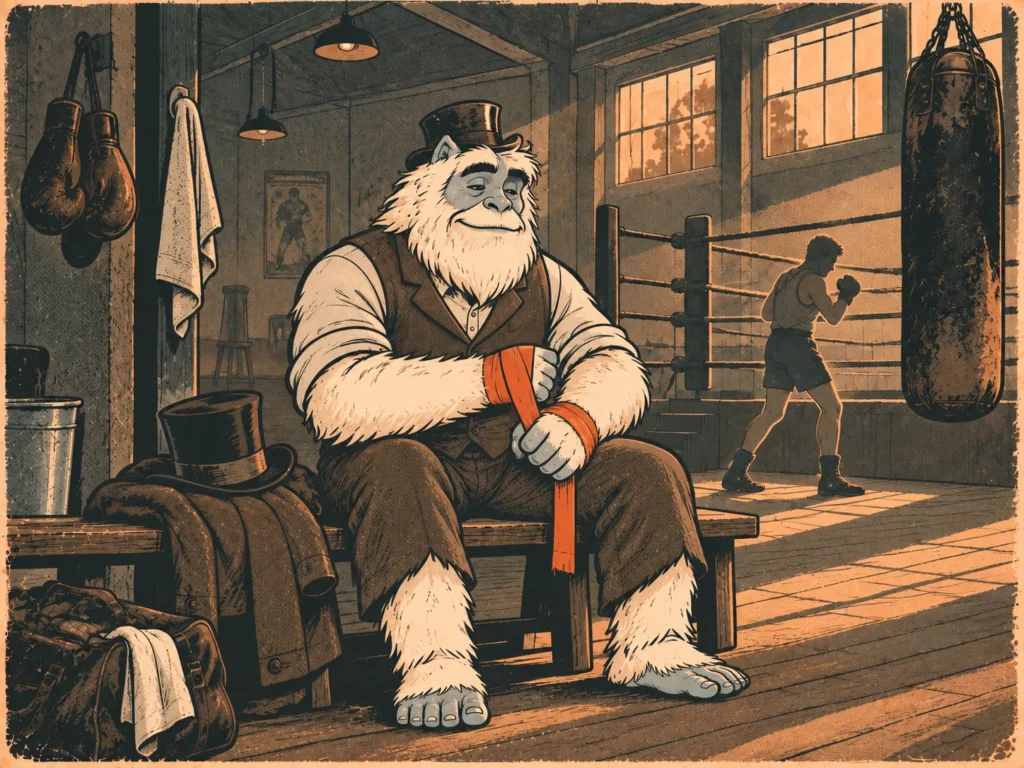
Illustration of the Funcle Yeti, a dapper yeti, calmly wrapping his hands on a bench in an old boxing gym.
Boxing as an adult: check the ego, keep your hands up, trust the slow work.

And the daydream changes. You stop wanting the sword for revenge against the past. You want the strength so that no one around you ever has to feel as powerless, or as small, as you once did.

Space to Breathe: Why Adults Still Need Their Own Territory

To maintain that level of internal resilience, you have to protect the environment you build it in. Processing the noise of your past needs physical territory to ground your adult identity, and a lot of it comes down to how much space you can claim in your life, whether that’s a clean desk in the corner of your bedroom or a room where your work stress can’t follow you in.

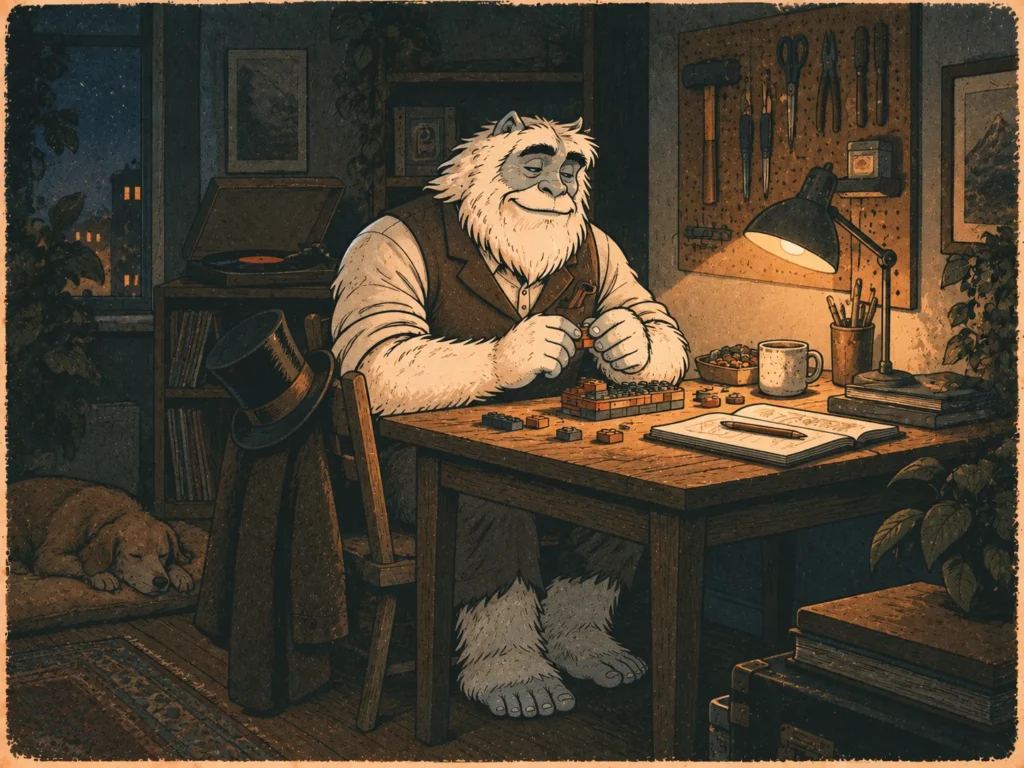
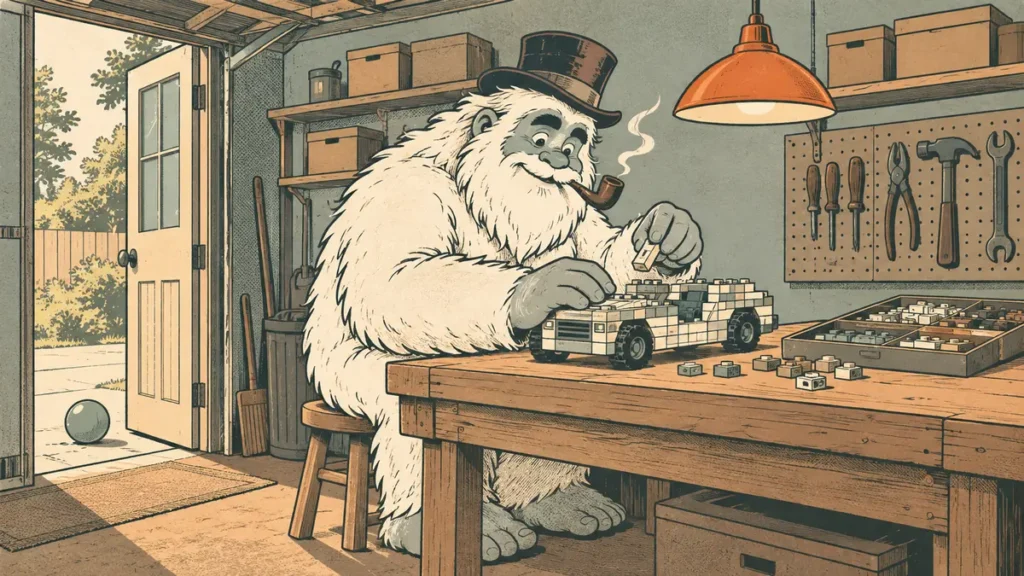
Illustration of the Funcle Yeti building a brick model at a single lamp-lit table in the corner of his home.
You don’t need a whole room. One table that’s yours is enough to start.

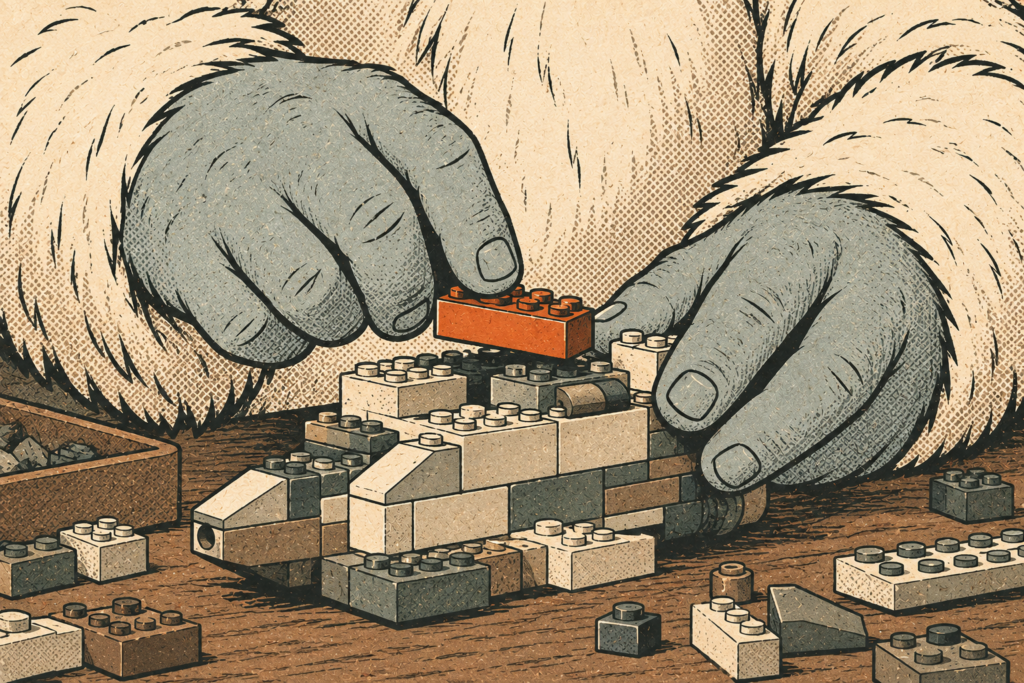
Without an intentional sanctuary, somewhere you can stop performing, the mind stays adrift. Your escape hatch might be a boxing ring, a messy workbench, or an evening spent snapping bricks together away from a screen. What matters is that it’s a domain where the rigid adult world is switched off for a while.

The Art of Moving Forward: Looking Back Without Living There

There’s a massive temptation in modern culture to treat nostalgia as a permanent residence, a cozy, continuous loop where we can hide from the demands of the present. But looking back endlessly is a stagnation trap.

Used well, nostalgia does the opposite. Research led by psychologists at the University of Southampton has found that nostalgia tends to surface when we feel low or lonely, and that it lifts mood, raises self-esteem and strengthens our sense of connection to other people. Their studies also found that nostalgic memories often follow a redemption arc, where a hard scene gives way to a triumph. That’s the version worth keeping: nostalgia as fuel, not as a hiding place.

The fumbled investments, the empty rooms and the high-decibel arguments happened. The coping mechanisms were necessary to get you across the finish line. But a stoic life requires radical acceptance: you accept the environment that shaped you, you thank the armor that kept you safe, and then you willingly lay it down.

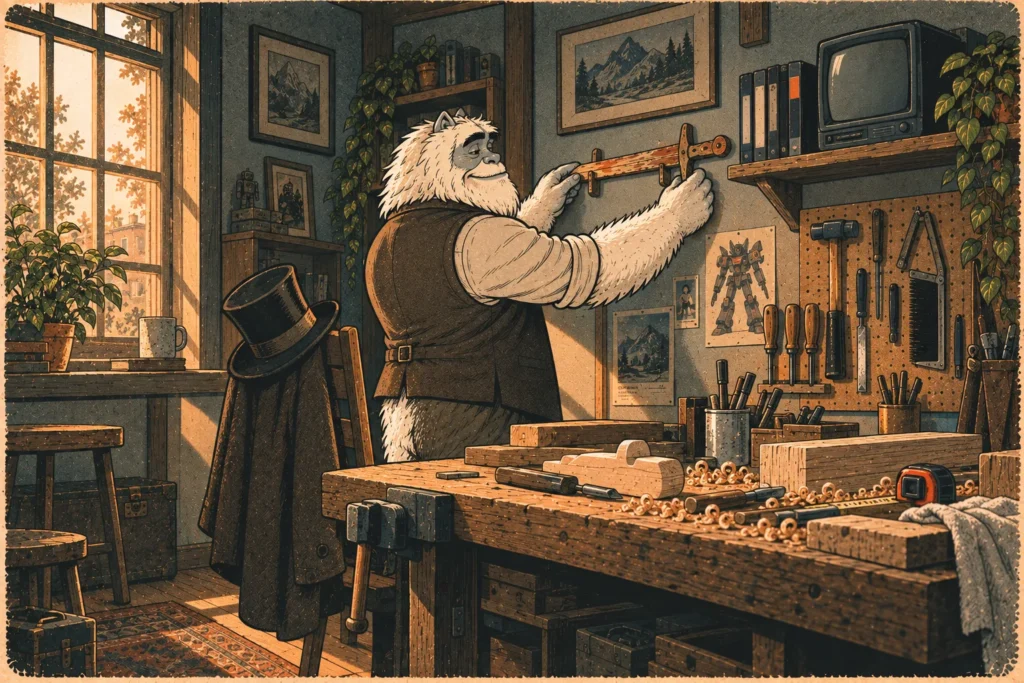
Illustration of the Funcle Yeti hanging an old wooden toy sword on his workshop wall above a half-finished project.
Thank the kid who survived, then get back to building something that lasts.

We don’t look back at our childhood heroes to escape today’s reality. We look back to thank the kid who survived the uncertainty, so that we can finally step out of the corner and build something that lasts.

FAQ

Is it normal to have used anime as a coping mechanism as a kid?

It’s a very human response. Children often imagine being like a favorite character, which researchers call wishful identification, and research on children and media describes kids leaning on favorite heroes as they work out who they are and cope with everyday life. For a child dealing with stress at home or bullying at school, a calm, powerful character can offer a feeling of safety and control that real life isn’t providing.

Why do people like overpowered characters?

Overpowered characters offer what fans call a power fantasy: the experience, through someone else, of never being pushed around. Part of the appeal is that they give a feeling of control to viewers who may not have much of it in their own lives. The calm, stoic kind, like Sesshomaru or Hiko Seijūrō, add something extra: control without anger, which can be deeply reassuring to anyone who grew up around shouting.

Is escapism through anime healthy?

It depends on what you’re escaping toward. Norwegian researcher Frode Stenseng’s model separates self-suppression escapism, which avoids painful feelings, from self-expansion escapism, which seeks positive experiences and growth. Studies using the model link self-suppression to lower well-being and self-expansion to higher well-being. Rewatching a favorite show to recharge is different from using it to avoid every hard feeling.

What is wishful identification?

Wishful identification is the desire to become, or act like, a media character. It has mostly been studied in children and teenagers, who look to characters as role models while they’re still working out who they are. In Cynthia Hoffner’s 1996 study of 7- to 12-year-olds, how intelligent a male character seemed predicted how much kids wanted to be like him.

Why do so many anime fans love Sesshomaru?

Sesshomaru pairs overwhelming power with total composure. He rarely raises his voice, never looks rushed, and over the course of InuYasha he slowly becomes protective of Rin, a human orphan who travels with him. That mix of untouchable strength and quiet loyalty is a big part of why he became a fan favorite [→ Morally Grey Characters · when live], especially for viewers who wanted a protector more than a fighter.

What should I do if old childhood memories start resurfacing?

If looking back is stirring up more than nostalgia, such as trouble sleeping, old anger or memories that feel heavy to carry, talking to a doctor, counselor or therapist can help. You don’t need to be in crisis to deserve support.

A NOTE FROM US
This is a personal essay, not clinical advice. If it stirred up something heavy, you don’t have to carry it alone. In the UK, Samaritans are free to call any time on 116 123; in the US, you can call or text 988.

CTA

Want more raw, documentary-style breakdowns of adult mindfulness, nostalgia and the spaces that help us breathe? [Subscribe to the Funcle Yeti newsletter]

Sources

Illustrations generated with AI in the Funcle Yeti house style.
“Grow Up!” – 6 Science-Based Reasons Why You Shouldn’t

Nostalgic hobbies are not a sign of arrested development. Across six psychology studies of 4,388 adults, recalling a nostalgic memory raised happiness, reduced loneliness and strengthened people’s sense that their life had meaning. The effects are modest and they are real. Here is what the research actually found — and where it stops.

Key Takeaways

  • Six studies of 4,388 adults in the UK, US and China found nostalgic recall raised happiness and offset loneliness; with a reminder, the effect held for two days.
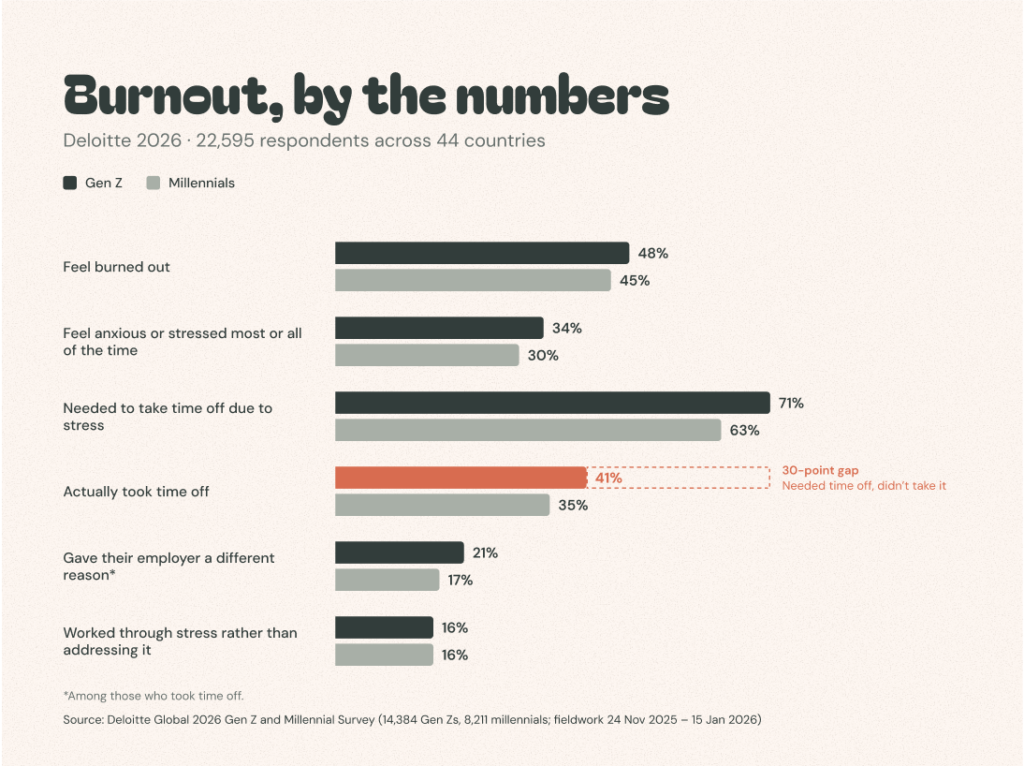
  • Deloitte’s 2026 survey of 22,595 people across 44 countries found 48% of Gen Z and 45% of millennials burned out, and 58% reporting digital fatigue.
  • 71% of Gen Z said they needed time off for stress. Only 41% took it.
  • Adults are not a fringe of the toy market. Circana reports buyers aged 15+ account for nearly 20% of global toy sales, with spending more than doubling since 2020.
  • Nostalgia’s benefits run through self-continuity — the sense of being the same person across time — which supports self-esteem and meaning in life.
  • The effect is not unconditional. In a study of 190 Syrian refugees, nostalgia raised self-esteem and meaning but lowered optimism among less resilient participants.
  • Varied nostalgic memories work better than repeatedly revisiting the same one.

If there is one thing every person in their 30s and 20s hates to hear, it’s the line “Grow up!”, especially if you are someone who enjoys doing something remotely nostalgic.

Sure, people are now more open about peculiar or not-so-mainstream hobbies and pastimes. But as soon as an adult has a HotWheels collection or God forbid, Pokémon cards, people feel the need to jump in and voice their opinion.

And the worst part is the “Grow up!” advice can come from anyone. It can be a girl/boyfriend, a wife, a husband, a parent, or even a colleague.

Who decides what is childish or when a grown-up should stop watching cartoons and anime?

Why is it anyone’s business what you do with your spare time?

Well. We can’t answer those questions for them. But we can tell you what the research actually says — and it is a good deal more interesting than “it’s fine, you do you”.

Is Nostalgia Actually Good for Your Mental Health?

Yes, measurably. Across six studies of 4,388 people in the UK, US and China, psychologists at the University of Southampton found that recalling a nostalgic memory raised happiness and reduced the sting of loneliness — and with a brief reminder, the lift was still detectable two days later. The effects are modest but real, and they replicate.

The research here is better than you would expect for something that sounds this soft.

The paper doing most of the heavy lifting is by Xinyue Zhou, Constantine Sedikides and Tim Wildschut — Sedikides and Wildschut run the nostalgia research group at the University of Southampton, and between them they have spent two decades measuring this stuff properly, with control conditions and everything.

Their 2022 paper in Social Psychological and Personality Science ran six studies. Three surveys covering 3,721 people across the UK, the US and China during pandemic lockdowns. Then three experiments where they deliberately triggered nostalgic recall. 4,388 participants in total.

What they found: people who revisited a nostalgic memory reported measurably higher happiness than those who recalled an ordinary one. Lonely people turned out to be more nostalgic, and that nostalgia then raised their happiness — partially offsetting the drop the loneliness had caused. And with a short reminder a day or two later, the lift held.

Their conclusion, in their own words, is that nostalgia is a psychological resource that can be harnessed. Not a symptom to be managed.

Which, functionally, is what your hobby already is.

Why Do Adults Still Collect Toys?

Because collecting activates the same dopamine-driven reward pathway that drives all goal-seeking behaviour, and because possessions genuinely form part of how people define themselves. The pursuit matters more than the object. It is also no longer unusual: Circana reports that buyers aged 15 and over now account for nearly 20% of global toy sales, with their spending more than doubling since 2020.

Buyers aged 15 and over now account for nearly 20% of global toy sales, according to Circana.

Start with the fact that you are not unusual. Circana’s 2026 global toy report puts buyers aged 15 and over at nearly a fifth of all toy sales worldwide, with spending in that group more than doubling since 2020. The global toy market is worth $123 billion and grew 8% in 2025 — and in developed markets, teenagers and adults are responsible for most of that growth.

There is an industry term for you now. You are a kidult, which is an ugly word for a fairly ordinary thing.

As for why — there are two mechanisms worth knowing about, and they explain almost everything about how a collection feels from the inside.

The dopamine and mesolimbic reward loop

Looked at neurologically, collectors are chasing the thrill of the chase rather than the object itself. The mesolimbic reward pathway is the neural circuit in charge of driving motivation and learning through the release of dopamine — and, crucially, it fires hardest in anticipation rather than on arrival.

This is why the hunt for the card so often feels better than owning the card. It is also why the sealed box you never opened is a warning sign rather than a trophy, but we will come back to that.

Belk’s extended self

The second mechanism is Russell Belk’s 1988 research on the extended self, published in the Journal of Consumer Research and still one of the most cited papers in the field. Belk’s argument is that humans have a natural tendency to use material possessions to define and anchor their identities. We are, in part, what we keep.

Put those two together and it is not difficult to understand why adults still collect toys, or why the number of adults doing it keeps going up. A collection is a self-portrait that you assembled slowly, on purpose, out of things that meant something.

Collecting Pokémon trading cards or Dragon Ball action figures may still seem childish to some. You probably have that one annoying friend or family member who never fails to make fun of this harmless hobby of yours.

“Why do you still buy this stuff? You are in your 30s!”

You probably laugh it off or internally scream, “Well, why don’t you fuck right off in your 30s!?”

The fact is that you don’t collect Star Trek action figures or a fully electronic Iron Man mask because you are immature, but simply because you want cool stuff. If anything, you are more mature than your peers about the things you enjoy, and about reclaiming your true self despite the constant societal pressures.

Can Nostalgia Help You Stop Overthinking?

It can, with one condition. Nostalgic media use during the COVID-19 pandemic was associated with better wellbeing in research by Wulf, Breuer and Schmitt — but only when it worked as a resource rather than an escape. Used as avoidance, the same behaviour predicts worse outcomes. The difference is whether you return to the present afterwards.

Wulf, Breuer and Schmitt found nostalgic media use supports wellbeing when it restores rather than replaces.

The study is Escaping the Pandemic Present, by Tim Wulf, Johannes Breuer and Josephine Schmitt, published in Psychology of Popular Media in 2021. Their finding was that during a crisis, people are especially motivated to consume nostalgia-inducing media — and that this is broadly good for them, right up until it isn’t.

Because holding onto nostalgia becomes a double-edged sword the moment you stop using it as inspiration and start using it as an exit. Taking strength, and even borrowing happiness, from your past is perfectly okay. Letting it consume you is a path you don’t want to start down.

With the pressures of life weighing on you every day, it is already challenging to keep your mind sane. Every one of us overthinks. For some of us it is the pressures of parenthood and marriage, for others it is the aging of our parents, and for some it’s both and maybe more.

So the next time you find yourself replaying Pokémon FireRed for the nth time, or YouTubing clips from Johnny Bravo, give yourself some credit.

At the very least, your escape from reality does not involve intoxicating yourself to the point that you lose sight of yourself.

Does Nostalgia Help With Burnout?

It will not fix burnout, and nothing in the research claims it does. What it offers is a low-cost form of recovery for people who are not getting any. In Deloitte’s 2026 survey of 22,595 people across 44 countries, 48% of Gen Z and 45% of millennials reported burnout, and 58% reported digital fatigue specifically — the condition a quiet, analogue, notification-free hobby happens to target.

The burnout generation — it’s the name coined for millennials by Anne Helen Petersen, a BuzzFeed culture writer, back in 2019. Seven years later, nobody is seriously arguing with her.

What the 2026 Deloitte numbers actually show

Today, in 2026, burnout is close to a baseline condition, and the numbers say so. Deloitte’s 2026 Gen Z and Millennial Survey ran from November 2025 to January 2026 and covered 22,595 people across 44 countries. Here is what it found.

What Gen Z and millennials report — Deloitte 2026 (n = 22,595, 44 countries)

MeasureGen ZMillennials
Feel burned out48%45%
Needed time off due to stress71%63%
Actually took the time off41%35%
Gave employer a different reason21%17%
Report digital fatigue58%54%
Anxious or stressed most/all of the time34%30%
Long-term financial future as top stressor44%39%
Delayed a major life decision over money55%52%
Deloitte surveyed 22,595 people across 44 countries between November 2025 and January 2026.

Read the third and fourth rows together, because that is the whole story. 71% of Gen Z needed time off because of stress. 41% took it. And of those who did, one in five told their employer something else.

That’s not a burnout problem. That’s a permission problem.

There’s a specific modern flavour of this too: 58% of Gen Z and 54% of millennials report digital fatigue — the constant alerts, the tool-switching, the low hum of six open tabs. Which goes some way to explaining why grown adults are spending three hours on a plastic brick set that does exactly one thing and never notifies you about anything.

Separately, 34% of Gen Z and 30% of millennials report feeling anxious or stressed most or all of the time. Nostalgic hobbies won’t fix the conditions causing that, but the research suggests they do something measurable for how you carry it.

And look at what’s actually driving it. When Deloitte asked what contributes most to stress, the top answers weren’t laziness or screen time. They were long-term financial futures (44% of Gen Z, 39% of millennials), the health and welfare of family, and day-to-day finances.

Cost of living has been the number one concern for five consecutive years. More than half of both generations — 55% and 52% — say they’ve delayed major life decisions like marriage, starting a family or starting a business because of money. For God’s sake, every one of us knows at least one person who has practically given up on building a family despite very much wanting one, for the very real reason of money.

So when someone tells you to grow up, ask what exactly they think you’re avoiding.

Can Childhood Hobbies Reduce Loneliness?

Yes, and the mechanism is indirect. Zhou and colleagues found that lonely people become more nostalgic, and that nostalgia then raises happiness — partially offsetting the drop loneliness causes. A shared hobby adds a second route by supplying actual social contact. The research frames nostalgia as a psychological resource to be used, not a symptom to be managed. 

Zhou et al. (2022) found nostalgia offsets loneliness indirectly; a shared hobby adds the direct route.

They say living in the past and focusing too much on the future is a recipe for disaster. While we do not condone dreaming your life away, reigniting your childhood hobbies — or the dreams you never chased — could help you combat loneliness.

The six-study paper above is the strongest evidence for this. The three survey studies found that the lonelier people were, the more nostalgic they became, and the more nostalgic they became, the happier they reported being. The three experiments then showed this worked causally: people who were prompted to revisit a nostalgic memory came away measurably happier than people prompted to recall an ordinary one.

But life as an adult can be lonely sometimes, especially if you are unapologetically happy with what others may consider trivial or childish hobbies. So it is upon us to take the stigma out of adults buying Hot Wheels that give them a glimpse of their past selves, and to recreate those moments of joy without fear of judgement.

So the next time someone tells you they want to build that 3,803-piece Death Star LEGO, or buy that ridiculously expensive Transformer that can actually fucking transform — just be happy for them, as you would want them to be happy for you.

How Does Play Improve Emotional Regulation?

Absorbing, low-stakes play engages the brain’s default mode network, the system active during rest and self-reflection, which supports emotional processing. Complex building tasks like LEGO and Gunpla add a second effect: a problem with a definite solution, in a session you control, which is the opposite of most adult stress.

Absorbing construction tasks quiet the default mode network — the same system active in rumination.

Any activity that draws on nostalgia or the feel of something familiar — even just daydreaming while listening to music — can activate the brain’s default mode network. That’s the network that comes online when you stop actively concentrating, and it does a lot of the quiet work of processing what has happened to you.

Why LEGO works as a stress tool

It is no wonder that many adults now use complex puzzles, LEGO and Gunpla included, to de-stress. Researchers at the University of Arizona have discussed LEGO’s role in building flexible and creative mindsets in adults, and the appeal is not complicated: it is a problem with a definite solution, on a timescale you control, with an instruction booklet. Name one other part of adult life that offers that.

Of course, these games will stress you out now and then. The piece will be missing, or the step will be wrong, or the thing will not click. But that also provides an opportunity to practise emotional regulation on something where the stakes are zero.

Even though you may not realise it, these childish games are helping you “grow up” more than sitting through a French film pretending to enjoy it.

Does Child-like Curiosity Help You Grow as an Adult?

Yes — and this is where nostalgia stops being consolation and starts being useful. Positive autobiographical memories reinforce self-worth and self-continuity, the sense that you are the same person over time. Sedikides and Wildschut describe this as nostalgia’s meaning-making function: it helps people read their own life as coherent rather than accidental.

Positive memories reinforce self-worth — and making new ones works the same way.

One of the best things about the psychology of nostalgia is that it helps you grow into a better person, if you are willing to make the effort. Adults who take up puzzle-building hobbies like LEGO or Gunpla are more likely to keep acquiring new skills and to work at their problem-solving.

You can also use it as a parent, or an uncle or aunt, to connect with a young one. Imagine sharing a hobby with the little ones you love — not only do you get to spend the time, you get to make memories that could last a lifetime.

Remember that time you wanted to build a model aeroplane and fly it through a hoop? Well, it is never too late for that. You even have your mini servant to hold up the hoop or fetch the plane when you need it.

The first serious LEGO set I built as an adult was the Tumbler — the Batmobile from Bale’s Batman, a little over three thousand pieces. My mini servant wasn’t a niece or a nephew; it was my girlfriend. It took days and days, and it was worth every one of them.

And as you build this new relationship with a child or a significant other, you are simultaneously building up your own self-esteem. Positive memories help reinforce self-worth — what Sedikides and Wildschut call self-continuity, the sense of being recognisably the same person across a life. It helps us find the meaning in the life we have actually lived, rather than the one we meant to.

When Nostalgia Stops Helping

Everything above comes with a limit, and the research is clearer about it than most articles on this subject will admit.

Wildschut et al. (2019) found nostalgia reduced optimism among less resilient participants.

The most instructive study here is Hanin, by Wildschut, Sedikides and Alowidy, published in the European Journal of Social Psychology in 2019. They worked with 190 adult Syrian refugees living in Riyadh. Nostalgic recall raised self-esteem, meaning in life and social connectedness — which is remarkable on its own, given what those participants had lived through.

But it also lowered optimism. And the whole pattern was moderated by resilience: the more resilient participants got the benefits and avoided the costs, while the less resilient ones saw their optimism fall. Nostalgia is bittersweet by design — participants reported genuinely mixed feelings — and that mixture is part of the mechanism, not a flaw in it.

Which gives you a practical test, and it is a simple one. Does the hobby return you to the present, or replace it?

The warning signs are not the hobby itself. They are spending you cannot afford. A collection that has quietly become an obligation. The sealed box you will never open, bought for a version of you that doesn’t exist. Using the thing to avoid a decision rather than to recover from one.

One more finding worth carrying: the same six-study paper found that the benefit holds better when you draw on different memories rather than replaying the same one. Nostalgia works like a varied diet, not a single comfort food.

When I say make your inner child happy, it is not an excuse for anything, or an encouragement to live in the past. Adult responsibilities are very real and you must face them regardless of what life throws at you.

The point is to treat nostalgia, and the things you loved doing, as a resource for strength to move forward — and, above everything, as a space to breathe and be yourself unapologetically.

FAQ

Is it normal for adults to still like childish things?

Yes, and it is increasingly common. Circana reports that buyers aged 15 and over now make up nearly 20% of global toy sales, with spending in that group more than doubling since 2020. Psychologists studying nostalgia treat attachment to childhood objects as ordinary identity maintenance, not regression.

Is nostalgia a sign of depression?

No. Nostalgia is bittersweet by design — mixed affect is part of how it works — but research consistently finds it raises mood and meaning rather than lowering them. Frequent nostalgic thinking paired with withdrawal, loss of interest or persistent low mood is worth discussing with a professional, but nostalgia itself is not a symptom.

What is the psychology behind collecting?

Two mechanisms. The mesolimbic dopamine pathway rewards pursuit rather than possession, which is why the hunt often feels better than the acquisition. And Russell Belk’s 1988 “extended self” research found people routinely use possessions to define and anchor identity. A collection is partly a self-portrait.

Can nostalgia be bad for you?

It can, when it functions as avoidance rather than recovery. In a study of 190 Syrian refugees, nostalgic recall raised self-esteem, meaning and social connectedness but reduced optimism, with the pattern strongly moderated by resilience. The practical test is whether the hobby returns you to the present or replaces it.

How does LEGO help with stress?

Absorbing construction tasks engage the default mode network and offer something adult life rarely does: a problem with a definite solution, on a timescale you control, with no notifications. Researchers at the University of Arizona have discussed LEGO’s role in building flexible and creative mindsets in adults.

What does “kidult” mean?

An adult who buys and enjoys products traditionally marketed to children — toys, games, collectibles, animation. It is an industry term rather than a clinical one, and it describes the fastest-growing segment of the global toy market.

Sources

Illustrations generated with AI in the Funcle Yeti house style. Charts produced by Funcle Yeti from cited data.
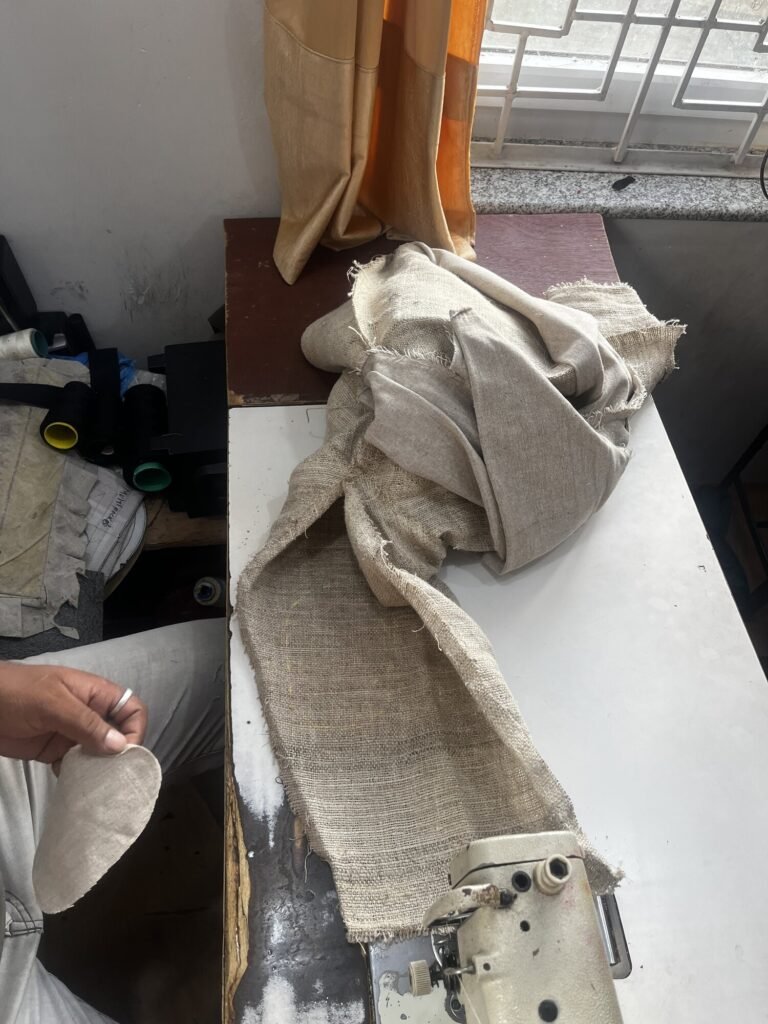
Breaking the Bricks: Why Adults are Spending Hundreds on Lego to Escape the Screen​

The blue light of a monitor has a specific kind of weightlessness to it. We have come to a phase where our entire lives are dominated by these little digital boxes. Think about it – many of us spend hours dragging digital cells across a spreadsheet, shipping code into a cloud, or something else. And the worst part? Even when we feel like taking a break from work, we just switch to a smaller screen.

We doomscroll on Insta, TikTok, or a gazillion other apps. And if not that, we take up some game or another, and we even lie to ourselves by playing a strategy or puzzle game and saying we are just exercising our brain. But in reality, we have become a generation that runs after dopamine, chasing instant gratification one hit after another.

The numbers back up the feeling. Ofcom’s 2025 Online Nation report found that UK adults now spend an average of four and a half hours online every day. And in Deloitte’s 2026 Gen Z and Millennial Survey of 22,595 people across 44 countries, 58% of Gen Z and 54% of millennials reported digital fatigue.

Our hands are warm, eyes tired, and mind hollowed out by a digital world that has become far too smooth. Even our entertainment has grown impatient. Remember when retro racing games like Need for Speed: Most Wanted (2005) forced you to take a funny-ass-looking car (read: Chevy Cobalt SS) at the beginning and work your absolute way to the top? The progression was slow, but it was earned. Modern games, by comparison, hand you a million-dollar supercar as a beginner, or let you skip the effort entirely if you can afford to shell out real money on microtransactions. The gratification is instant, but it feels completely unearned. In other words, dopamine has become an almost entirely digital commodity.

However, in the middle of all this, there is an understated rebellion happening on the dining tables of grown adults today: Lego, and the Lego-like brick toys we all grew up with but never really could afford. In fact, even now Lego charges a premium for its adult-oriented sets, whether it’s a wickedly detailed 3,306-piece 1989 Batmobile or a massive 9,023-piece Death Star from Star Wars.

And it’s no longer a niche. Circana’s 2026 global toy report puts buyers aged 15 and over at nearly 20% of global toy sales, with their spending more than doubling since 2020, and building sets are among the categories outperforming the market. The LEGO Group’s consumer sales grew 16% in 2025, more than twice the 7% growth of the toy market as a whole.
Young adults, including millennials, zillennials, and even Gen Z, are now intentionally taking time away from their digital prisons to spend more time in the real world. Their joy, or their dopamine chase, now starts with a heavy box of Lego (or another building-brick set) that is entirely offline. For the next few days, the digital rectangle doesn’t exist. There are no algorithmic pings, no endless doomscrolling on Instagram, and no corporate noise. There is only a physical (sometimes digital) blueprint, a messy workspace, and a slower, tactile gratification you can actually touch, feel, and build from scratch.
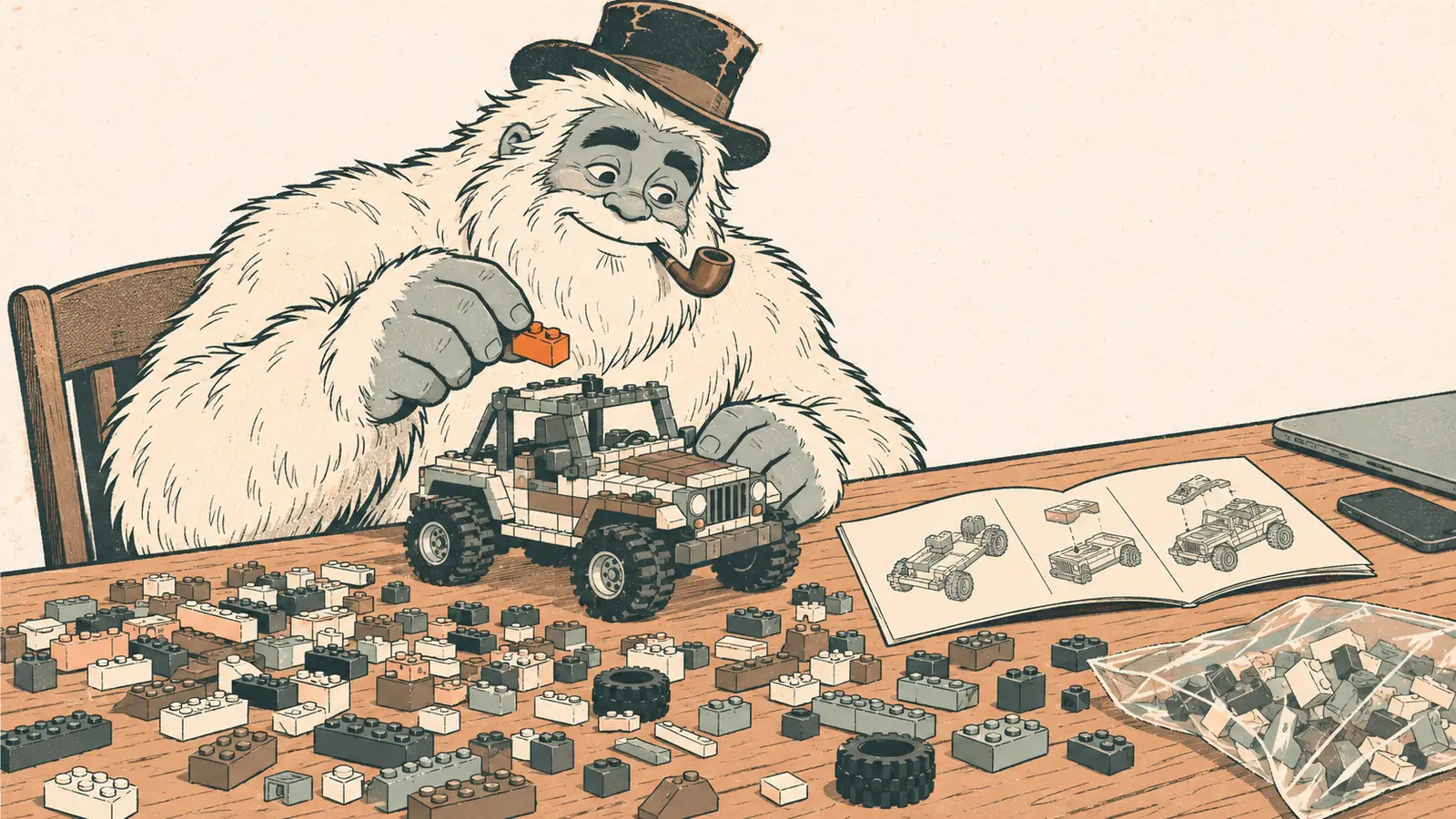
Why do Adults Build Lego Sets?

Comic close-up of a yeti’s hands pressing two plain building bricks together

The psychological pivot from childhood play to adult building isn’t new, and it isn’t about escaping maturity, but rather about surviving it. When you work in IT, a creative field, or any white-collar job, you spend the majority of your life managing intangible systems in front of a screen. It is only natural for the brain to crave a physical, closed loop—a direct, visible consequence of your labor.

Building a complex brick model or a Lego-like set provides exactly that. It forces a deep, structural focus that acts as an automatic off-switch for work anxiety. Unlike doomscrolling—which confuses the brain by making you consume massive amounts of random, disjointed information—assembling a model requires genuine cognitive presence. Psychologists have a name for that kind of absorbed, just-hard-enough concentration: flow, a term coined by Mihaly Csikszentmihalyi.

You are looking at a physical map, handling individual pieces, matching their exact shade in the manual, and watching them slowly take form into something deeply meaningful. The rules are absolute. The path is laid out. Every single micro-action results in a satisfying, physical click. It is an honest, earned progression system. It’s an intentional sanctuary where you can finally put away the phone and put your brain to actual, rewarding use. And the best part is that it doesn’t matter whether you are a parent, a creator, or a typical IT professional.

You’re not imagining the effect, either. In the LEGO Group’s Play Well 2022 study of more than 30,000 adults across 33 countries, 86% said play helps them unwind from work, and 87% said it helps them relax and feel calm. It’s the company’s own research, so treat it as a signal rather than proof, but it matches what most adult builders will tell you.

The High Cost of Adult Lego Hobbies: How Much Do Big Sets Cost?

Let’s be honest about the barrier to entry: this survival mechanism can be an expensive one, but only if you are a Lego aficionado. As adults, especially if you are a parent, you would naturally be very careful with money. In this economy, even those of us who play the role of the family funcle will only indulge in leisure purchases like a brick set when we have funds to spare.

For years, that financial caution kept our budget strictly tied to smaller, accessible Lego sets in the $12 to $35 range. Those builds were fun, but they were quick snacks—usually topping out under a thousand pieces. Although still very enjoyable, they didn’t offer the deep, multi-day immersion our brain was looking for to truly disconnect.

And let’s face it, Lego sets are not cheap. A 3,000- or 4,000-plus-piece Lego set can set you back hundreds of dollars.

What big Lego builds cost

SetPiecesPrice
Small everyday sets (the “quick snacks”)Under 1,000$12–$35
LEGO DC Batman Batmobile Tumbler (76240, 2021)2,049$229.99 / £209.99 at launch
LEGO DC 1989 Batmobile (76139, 2019)3,306$249.99 at launch
LEGO Star Wars Ultimate Collector Series Death Star (75419, 2025)9,023$999.99 / £899.99 at launch
Alternative-brand version of the Tumbler (my build, bought on Taobao)3,000+ [CHECK]$60–$75

As a child, I always wanted Lego, but it simply wasn’t something I could get. So buying that massive 3,000-plus-piece Batman Tumbler Batmobile later in life wasn’t a distraction from reality; it was about making my inner child happy by finally owning something I had always considered profoundly cool.

But the official premium brand tax felt like an irresponsible financial hurdle. The breakthrough happened during a trip to China, where I began exploring local hobby ecosystems and, more importantly, the Amazon of China – Taobao. If you are fortunate enough to explore this marketplace, you will see a whole new sprawling world of highly sophisticated alternative brick engineering.

The Funcle Yeti between a premium boxed brick set and a plain shipping box, stacks of coins in front of each
Paying for the build, not the brand.

There I was able to find an alternative, identical-scale version of the Tumbler for just $60 to $75. The plastic clutch power was entirely solid, the quality was decent, and suddenly the financial guilt vanished—leaving nothing but the raw, focused challenge of the build.

The Reality of the Workspace: How Much Space Does a 3,000-Piece Build Need?

The truth about any Lego build is that it makes the illusion of a pristine, aesthetic hobby disappear, especially if it’s a massive 3,000- or 4,000-piece one. Don’t get me wrong, the real-world process is wonderfully messy.

A massive 3,000-plus-piece set like the Tumbler doesn’t just arrive as a mountain of loose plastic; it comes organized into specific, numbered stages. You are dealing with roughly 10 or 12 major sets of pieces, with two or three smaller sub-packets nested inside each major stage. To build it step by step, you need physical territory.

Overhead illustration of a build desk with bags of pieces in order, an open manual and a taped-off work zone
The messy desk: packets in order, manual open, and a work zone nobody touches.

The messy desk, laid out:

  • Packets 1, 2 and 3 (pins, plates, gears): opened one stage at a time, in order.
  • The instruction manual: open flat and within reach.
  • The current work-in-progress zone: do not disturb until complete.

It is entirely based on how much space you can command in your home. You need a dedicated table or surface where the pieces can stay exactly where they are, completely undisturbed for days. The last thing you want is the children in your life, whether your own or someone else’s, playing with that one critical piece or, even worse, losing it forever.

It took me a whole 20 days to finish the Tumbler Batmobile where I worked on it whenever I could find any time between work and other responsibilities. But it was genuinely so pleasing to see the building blocks slowly form a shape and structure of the Tumbler. 

I began with the underpart of the Tumbler which was just in the shape of some rectangles and the more I built the more it began to shape. I took over the living room when I started building it and sometimes I would just spread all the blocks on the floor to work so I could easily find the piece I was looking for.

This is where the hobby intersects with a broader, more essential need for adults today: the necessity of personal domain. After all, to reclaim your focus, you first have to reclaim your physical environment. Whether it’s a dedicated workbench, a converted garage, or a designated man cave or she-shed, having an isolated perimeter to leave your real-world messes behind is crucial to preserving your sanity and individuality.

The Funcle Yeti at a garage workbench building a brick model under a hanging lamp
To reclaim your focus, you first have to reclaim your physical environment.

Without that uninterrupted escape hatch, a complex Lego project becomes impossible. The stakes feel surprisingly high. If a single technical component or gear goes missing or gets scattered from packet number four, it’s a tragedy, and you simply cannot complete the set. So aside from being able to afford these hobbies, you also need a sanctuary that can be messy but still remains untouched until you finally finish the build.

The Lego Alternative: Are Cheaper Brick Brands Worth It?

Comic catalog illustration of two identical building bricks with blank studs measured by calipers
Premium engineering doesn’t need a logo on every stud.

For a long time, looking outside the mainstream ecosystem felt like a massive gamble involving missing parts or brittle plastic from untrustworthy wholesale sites. And trust me when I say these do happen, even though not often. Maturity is realizing that you don’t need a fancy brand to add value to your hobby, so long as it makes you happy.

In fact, a mature subculture of value-conscious builders has proven that premium engineering doesn’t require a trademark logo stamped on every single stud. The reality is that direct manufacturing channels—like the ones found natively on platforms like Taobao—can now deliver exceptional plastic density, precise clutch power, and solid structural integrity for a fraction of the cost. Of course, you could try your luck with suppliers on AliExpress, but the truth is that the quality of the goods can vary significantly. Add to that the premium you may have to pay for shipping, and the extra pieces you may have to add to your order just so they will ship it to you.

So, if you are one of the adult hobbyists who want to scale their builds past 3,000 pieces without draining their savings, it is well worth exploring the alternative brick space. It allows you to pay purely for the mechanical design and the physical materials, rather than the global marketing budget of a corporate giant.

Lego – a Toy, a Plastic Trophy or a Living Memory?

There is a running debate among adult collectors about how a finished model should be treated. Some purists argue that Lego sets should be broken down immediately into generic bins, while others treat them purely as sealed financial investments to sit on a shelf and flip for profit later. Who is right here? Maybe both, maybe neither.

For most of us, a brick or Lego set is meant to be built up and played with, not treated as a liquid asset. And let’s be practical: tearing down a complex, 3,000-piece model just to throw it into a giant box is an absolute nightmare. The pieces get scattered, the components get lost, and trying to sort through tens of unnumbered packets a second time is incredibly confusing.

Keeping a perfectly assembled set on display is entirely practical. The completed model stands as a trophy of your focus—a physical archive of a week where you successfully wrestled your attention span away from the digital void.

The Funcle Yeti and a child adding the last brick to a finished model on a display shelf
Not just plastic on a shelf: a memory you keep in the room.

More importantly, if you build a set alongside your child, your niece, your nephew, or someone you love, it becomes a permanent monument to a shared memory. It represents quiet hours spent working your brains together, passing pieces back and forth, and watching an object take a meaningful shape. You aren’t just displaying plastic; you are keeping a memory alive in your space forever.

FAQ

Why are so many adults into Lego?

Most adult builders are after focus as much as nostalgia. A large set gives a screen-heavy brain a closed loop: clear instructions, physical progress you can see, and no notifications. Buyers aged 15 and over now account for nearly 20% of global toy sales, according to Circana, so it’s a mainstream hobby rather than a quirk. For many of us, it’s also a way to finally own the set we couldn’t have as kids.

Is building Lego good for stress?

It can help you switch off. Building is absorbing, hands-on and screen-free, the kind of just-hard-enough task psychologists associate with flow. In the LEGO Group’s own Play Well 2022 study of more than 30,000 adults, 86% said play helps them unwind from work. It isn’t a treatment for anxiety, but as an evening off-switch it works for a lot of people.

How much do adult Lego sets cost?

Small sets under 1,000 pieces usually cost $12 to $35. Large display sets cost hundreds: the 3,306-piece 1989 Batmobile launched at $249.99, and the 9,023-piece Ultimate Collector Series Death Star launched in 2025 at $999.99 (£899.99). Retired sets often resell for more than their launch price.

Are Lego alternatives worth it?

Often, yes, if you choose carefully. Alternative brick brands can offer solid clutch power and decent quality for a fraction of the price; my 3,000-plus-piece Tumbler-style set cost $60 to $75 on Taobao. Quality varies more on marketplaces like AliExpress, and shipping a big box can add a lot. Some brands sell original designs while others copy official sets, so check what you’re buying.

How much space do you need for a 3,000-piece Lego set?

Plan for a table you can leave untouched for several days. A set that size usually comes in 10 to 12 numbered stages, each with a few smaller bags, so you need room for the open manual, the bags for the current stage and a work-in-progress zone. Keep it out of reach of children and pets: one lost gear can stop the whole build.

Should you take apart a finished Lego set?

There’s no rule. Some collectors break sets down into bins for new builds, and others keep them sealed as investments. For most adult builders, keeping a finished set on display is the practical choice: tearing down a 3,000-piece model and sorting it again is a nightmare, and the finished set doubles as a reminder of the time you spent on it, especially if you built it with someone.

Want more slow, screen-free reasons to keep the things you loved as a kid? [Subscribe to the Funcle Yeti newsletter]

Illustrations generated with AI.

Sources

Ofcom (2025). Online Nation 2025: from apps to AI search, how the UK goes online.

Deloitte (2026). 2026 Gen Z and Millennial Survey. 22,595 respondents across 44 countries.

Circana (2026). Global toy market hits $123B as play expands across ages and markets.

The LEGO Group (2026). The LEGO Group delivers record results in 2025.

The LEGO Group (2022). Getting hands on to help switch off (Play Well 2022 report).

Csikszentmihalyi, M. (1990). Flow: The Psychology of Optimal Experience. Harper & Row. See also Flow (psychology).

The LEGO Group (2025). LEGO Star Wars unveils the Ultimate Death Star set for collectors.

Brick Fanatics. LEGO Batman Tumbler prices and release dates.

Stonewars. LEGO Batmobiles list.

Brick Fanatics (2021). Chinese court upholds sentences for LEGO counterfeiters (only if you keep the caveat box).

Illustrations generated with AI in the Funcle Yeti house style.