Two swatches of the workshop’s plain, undyed handwoven hemp, cut along the threads and measured on graph paper, came in at 420gsm and 462gsm. That’s an average of 441gsm, about 13 oz per square yard, and well above the 300–360gsm we were quoted verbally while sourcing. Getting there took two attempts; the first was too rough to trust.
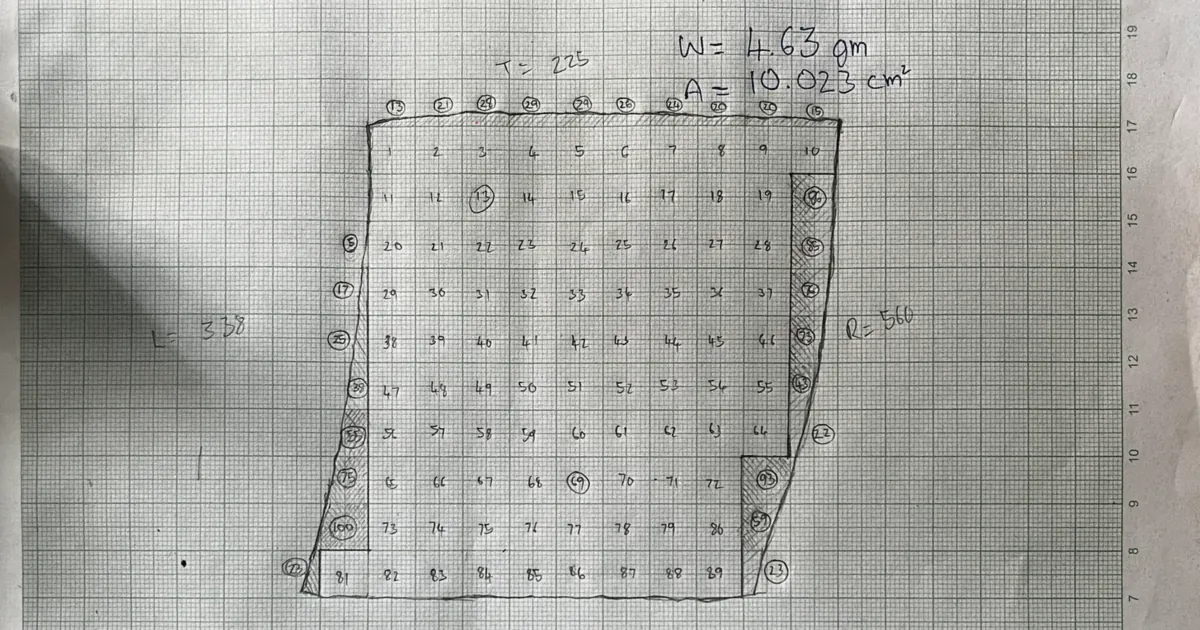
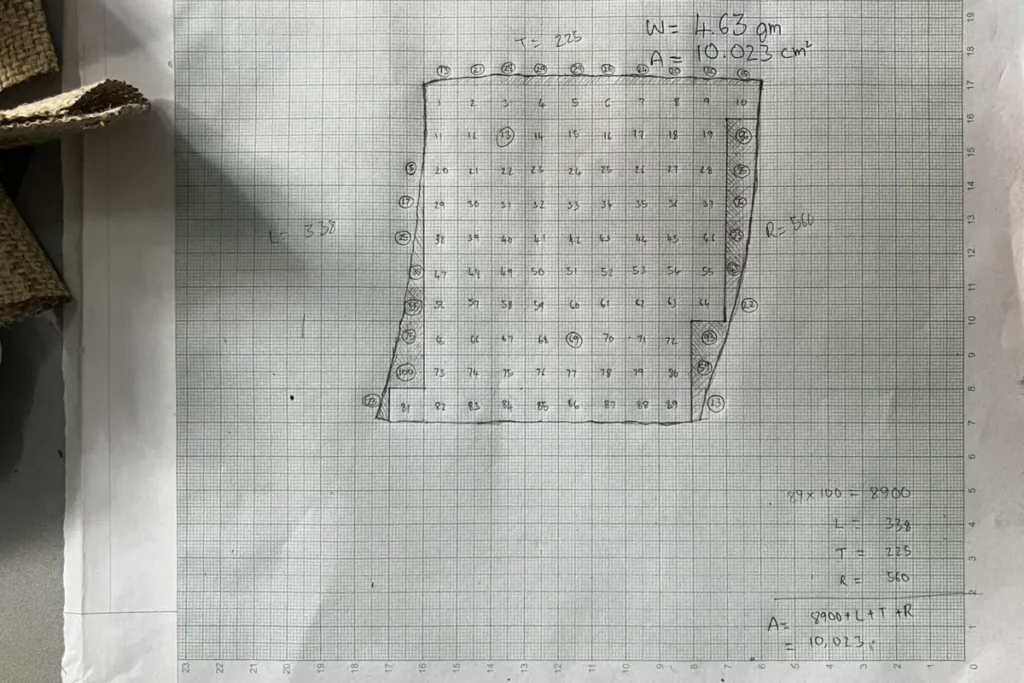
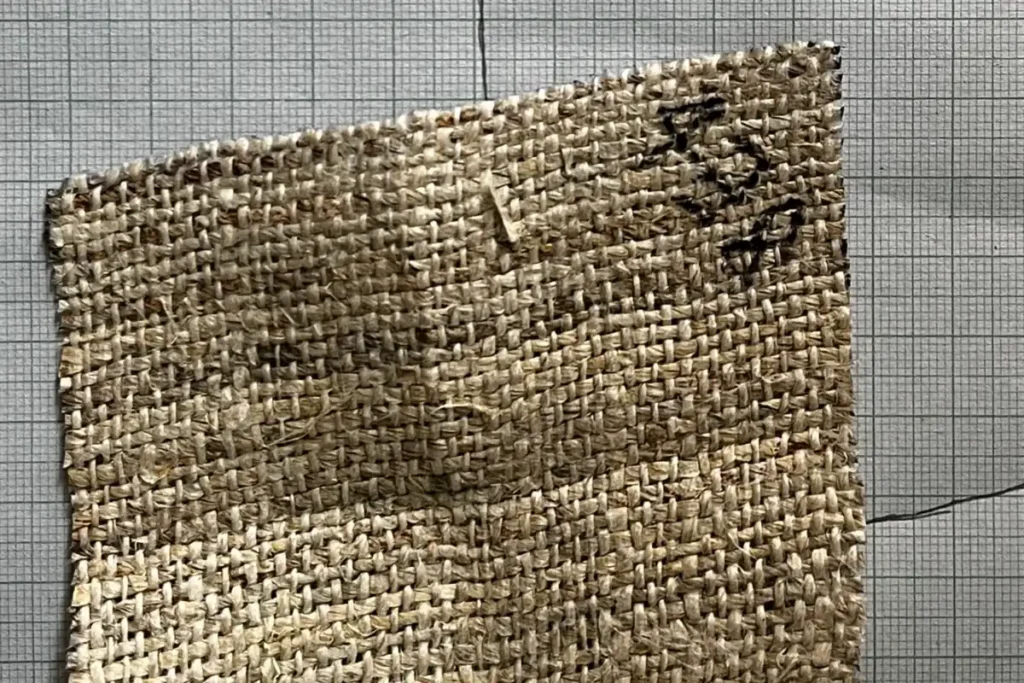
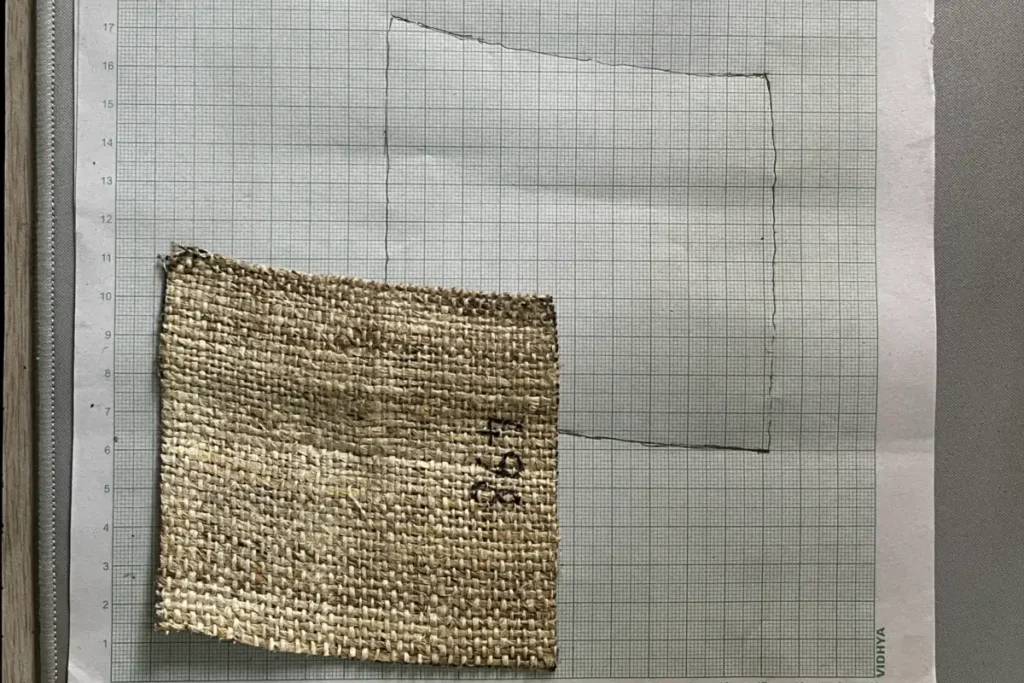
Swatch 1’s outline: 89 whole centimetre squares plus 1,123 mm² of edge strips, 10,023 mm² in all. The sheet’s “10.023 cm²” means 100.23 cm².
Two Metres, ten Squares
Entry 01 left us with one swatch at 439gsm, worked out on an assumed area we knew was too small, and a plan: three to five squares from one batch, averaged, with the range reported.
On the day of V2’s rework (Entry 03), I came away from the workshop with a metre from Master Dai: the same hemp the new cuffs were being cut from. Before testing it, I picked up a metre from the second supplier too.
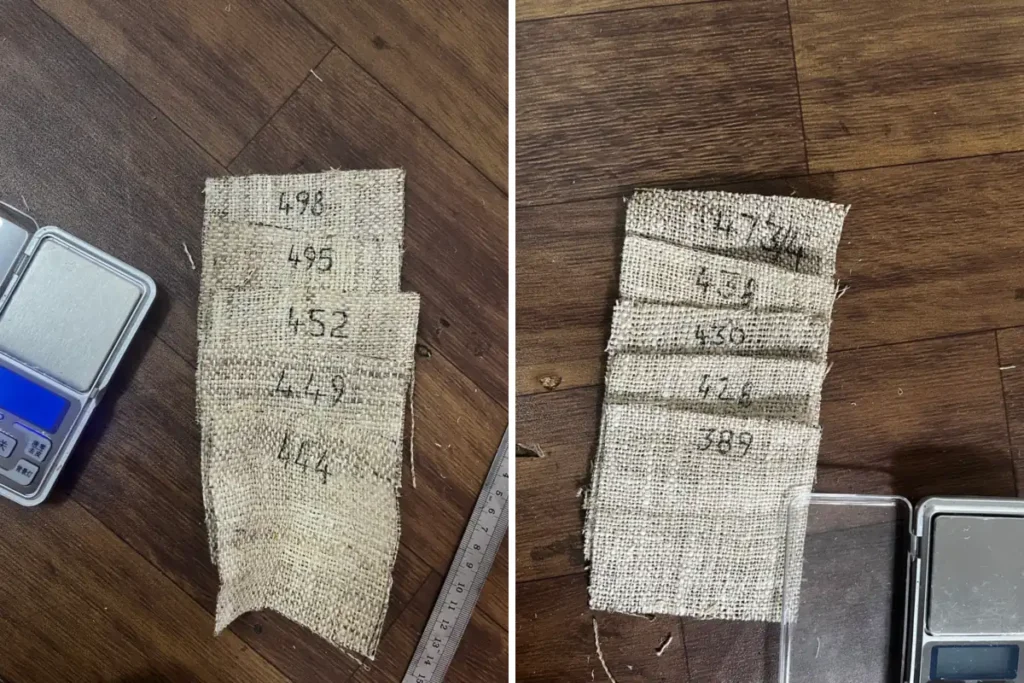
The first attempt: five squares from each metre, marked with a ruler. The workshop’s are on the left, the second supplier’s on the right.
From each metre I cut five squares, as close to 10 cm × 10 cm as I could measure with a ruler, and weighed each on the same 0.01 g scale as Entry 01. GSM means grams per square metre, and a 10 cm square is a hundredth of one, so the shortcut is weight in grams × 100.
Both metres averaged comfortably above 400gsm. Neither average was precise enough to stand behind.
Why the First Numbers Didn’t Count
The × 100 shortcut only works if each square really is 100 cm². Mine weren’t, for two reasons.
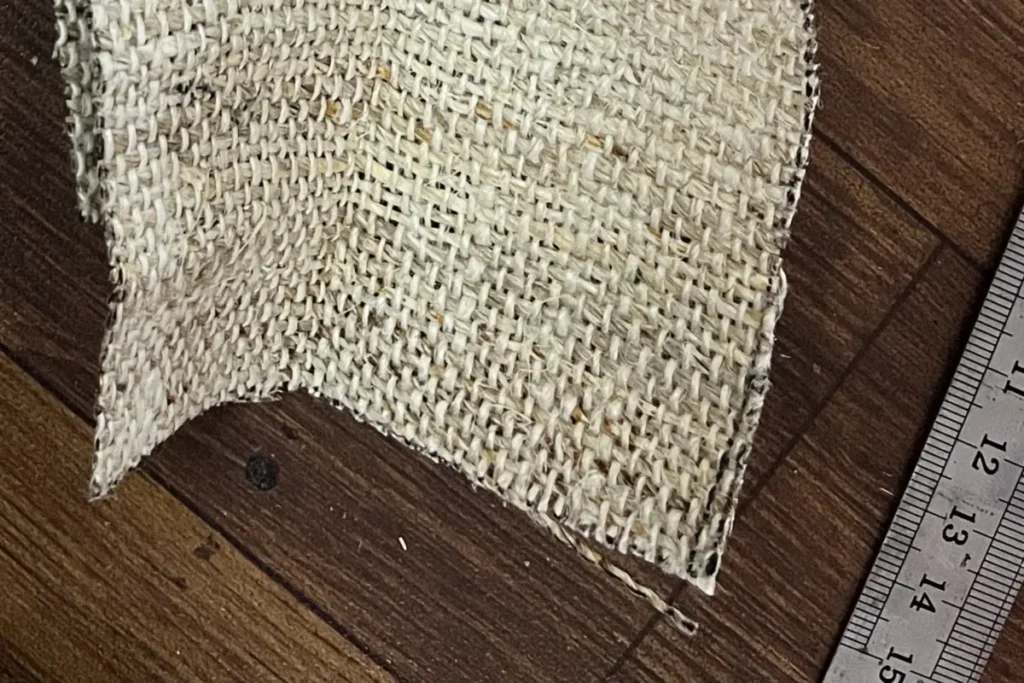
First, the cut. A ruler gives a straight line, but the threads in handwoven cloth don’t run perfectly straight. Cutting along the ruler, I crossed threads at a shallow angle instead of following them, so every edge was a row of cut-through threads, with short ends that can work loose before weighing.
Cut along the ruler, across the threads.
Second, the shape. Handwoven cloth is woven under tension, and not an even one. Cut a piece free and it relaxes into the shape the weave gives it, which isn’t a square. A square drawn at 10 cm on the cloth isn’t 100 cm² by the time it’s on the scale.
Edges like that leave no clean boundary to measure, so the squares needed trimming before anything could be measured properly. I’d skipped buying graph paper, on the theory that an approximate number was fine for a home test. For a number going in this log, it wasn’t.
Doing it Again, Properly
Entry 01’s plan was to cut as close to 10 cm × 10 cm as possible. That turned out to be the wrong target: handwoven cloth won’t reliably hold an exact square, however carefully it’s cut. So the second attempt stopped assuming the area and measured it.
Cut along the threads. Each edge follows a single thread instead of a ruler line, so the threads running alongside it are either fully in the swatch or fully out. This meant trimming the first squares back, so their first weights no longer apply.
Measure the real area. Each trimmed swatch went flat on graph paper and its outline was traced, in whatever shape the cloth had settled into. Whole centimetre squares inside the outline count 100 mm² each; the part-filled strips along the edges are counted square millimetre by square millimetre. Swatch 1 held 89 whole squares (8,900 mm²) and 1,123 mm² of edge strips.
Weigh and divide. Same 0.01 g scale. GSM = weight in grams ÷ area in square metres.
So far, I’ve done this for two of the workshop’s five squares: the heaviest and the lightest from the first attempt, to see the spread at its widest.
Trimmed along a single thread.
The Workshop’s Hemp: 420 to 462GSM
Swatch
Weight (g)
Measured area (mm²)
Area (m²)
GSM
1
4.63
10,023
0.010023
462
2
3.93
9,347
0.009347
420
Average
441
Range
420–462
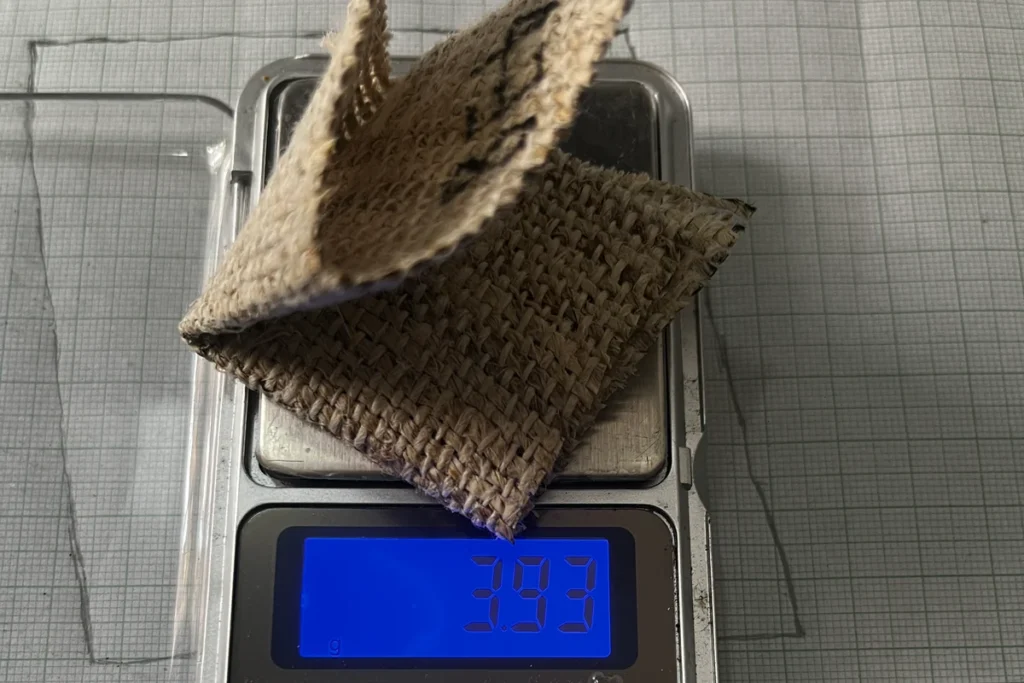
Swatch 1, trimmed along the threads, beside its traced outline: 4.63 g over 0.010023 m², so 462gsm.Swatch 2: 3.93 g over 0.009347 m², so 420gsm.
Swatch 1 came out close to 100 cm², at 100.2. Swatch 2 came out at 93.5, 6.5% short. Left unmeasured, an area error that size moves the result by 27gsm.
Two swatches is fewer than the three to five we set ourselves in Entry 01, so treat this range as provisional.
Even the lighter swatch sits 60gsm above the top of the 300–360gsm we were quoted while sourcing. That figure was never treated as fact, and this is why.
Why are two Swatches From one Metre 42GSM apart?
That’s about 10% of their average, and more than measuring error explains. Misread every edge of a swatch by half a millimetre, all in the same direction, and its GSM moves by about 9. The scale adds about 1. Misreading alone could open a gap of about 20gsm, not 42.
So at least half the gap, and probably most of it, is the cloth itself. Handwoven hemp isn’t machine-even: each row of weft is beaten in by hand, and some stretches of the same metre pack in more thread than others.
It’s also why one swatch, like Entry 01’s, was never going to settle the question.
Two caveats that still stand
Hemp takes up moisture from the air, so the same swatch weighs a little more on a humid day. Lab tests condition fabric at around 20°C and 65% relative humidity before weighing; ours were weighed at room conditions.
We haven’t washed this metre, and Master Dai says the hemp is prewashed before it’s cut. A wash can still change both the size and the weight of hemp cloth, so a finished jacket, washed at home, may not read the same. V2 has since had its first hand wash; how it measures afterwards is the next entry.
What’s still owed
The second supplier’s metre. Its five squares have had the quick test only. They get the same method next.
The workshop’s other three squares. They’re trimmed along the threads and set aside, and may go into a wash and shrinkage test.
Run One’s yardage, once it’s bought. The batch cut for the run may not be the batch tested here, so it gets the same test.
This is Entry 05 of the Run One Build Log: the making of Funcle Yeti’s first batch of handwoven hemp chore jackets, logged in Kathmandu as it happens. Start from Entry 01.
Get on the Run One list
Wish you were here. Or at least on the list.
It’s free, and it commits you to nothing. You’ll hear first about the samples, the final design and the price, and get first access when orders open where you live.
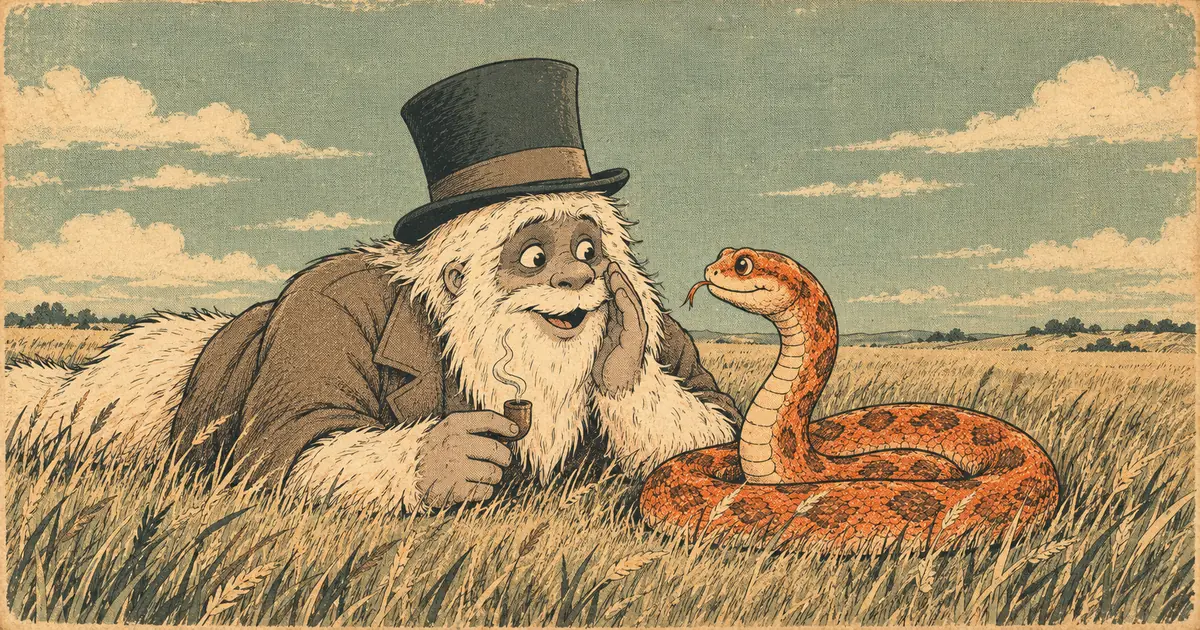
I was very little the first time I looked a big snake in the eye. It was a family trip to the zoo, and the snake section was the best part by a mile. On our way out there was one last enclosure: a big snake in a small cage, almost at ground level. The barricade in front of it was built for adults. For a kid my size, it was more of a suggestion.
So I walked under it. I wasn’t scared, not even slightly. I had watched a man in khaki shorts do this on TV more times than I could count, and he always looked like he was having the best day of his life. The snake lifted its head and looked straight at me, and for one perfect second we were just two curious creatures sizing each other up.
Then a hand grabbed me from behind. My brother or my mother, I honestly can’t remember which. What I do remember is the scolding, and how little sense it made to me. In my head, Steve would have crouched down next to me and told me exactly why she was gorgeous.
Every kid remembers the hand on the collar.
The short version: Steve Irwin, The Crocodile Hunter, was the rare grown-up on ’90s and 2000s television who loved things out loud and wanted money out loud, and never seemed embarrassed by either. To the kids watching, from Queensland to small-town Kerala, he was a kind of adult nobody else was showing us. Most of us grew up and forgot he was an option.
Who Was Steve Irwin, and Why Did a Kid in Kerala Care?
Steve Irwin (1962–2006) was an Australian wildlife expert and conservationist who ran Australia Zoo in Queensland with his wife, Terri. The Crocodile Hunter started as a pilot in 1996, ran as a series from 1997 to 2004, and became Animal Planet’s highest-rated show at the time. It was syndicated around the world. Animal Planet launched in India in March 1999, in English, years before it had a Hindi feed, and that’s how a sunburned Australian ended up in our living room.
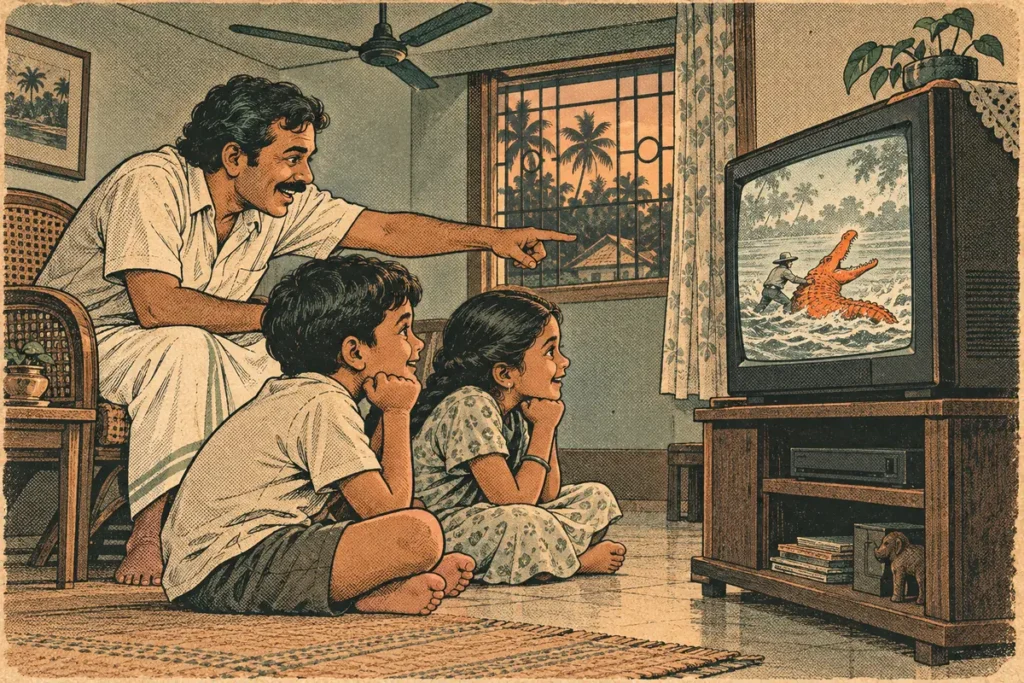
Nobody in my house had any business caring about Queensland. We cared anyway. My parents loved him. They would point at the TV to make sure I didn’t miss whatever insane, wonderful thing he was doing, and if I got a little too cocky about my own bravery, someone would dare me to go catch a crocodile, then. For the record, I never got the chance.
Prime time in a Kerala living room, and nobody blinked.
The closest I came was a snake in a roadside gutter. Snakes were rare where I grew up, so this was an event. I stopped, crouched, and kicked a pebble near it to see what it would do, and a passing adult yelled at me to leave it alone. Fair enough. I was a small idiot poking a snake. But notice the pattern: every time I got close to the thing Steve loved, a grown-up showed up to pull me back.
Loud Was a Bad Word
I was a loud kid. Loud voice, loud opinions and, since we’re being honest, a mouth that swore far more than any schoolkid’s should. When an adult overheard me once and made a point of correcting it, I wanted the floor to swallow me. Looking back, they were right. That is exactly what a responsible grown-up is supposed to do.
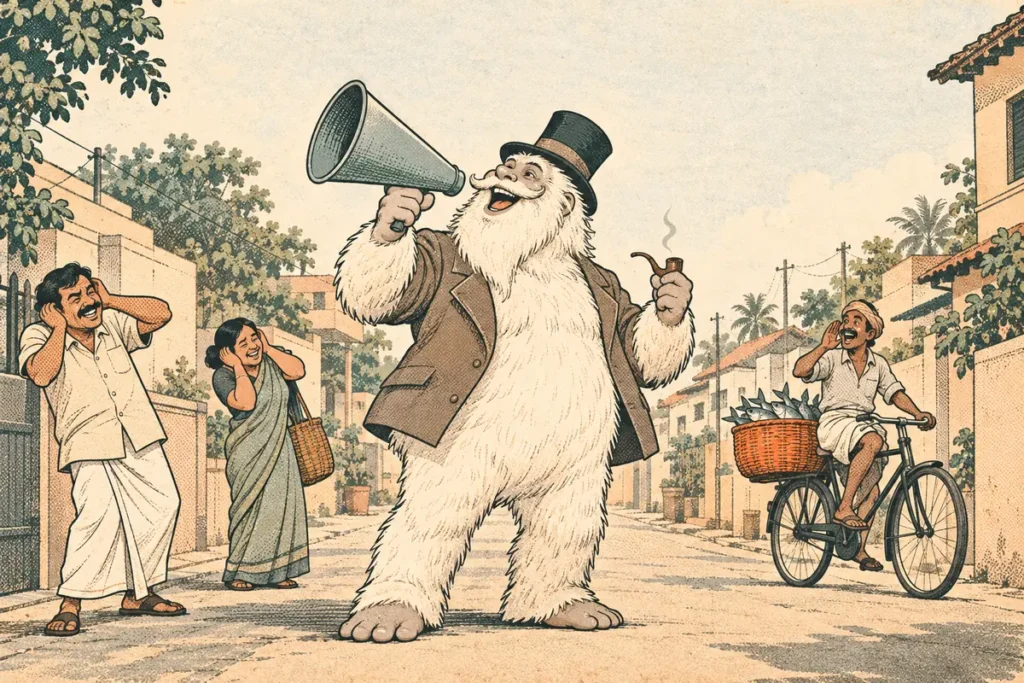
The volume got corrected too, just less kindly. Friends used to make fun of my voice, comparing me to the fish sellers who walk the roads shouting out the day’s catch. Kids are brutal like that, and it works. You turn yourself down a notch, then another, until you’re no longer sure where the dial started.
Loud was a bad word. The fish seller never got the memo.
I didn’t have role models growing up, not really. There were people I thought were cool or strong, but I never wanted to be them. Mostly, the grown-ups around me taught me who not to become. The biggest lesson that I learned as a kid was that you don’t get to be an asshole to people just because you can. I took that one so seriously that I overshot it, straight into people-pleasing, which is just another way of making yourself quieter.
Here’s what I didn’t clock as a kid. Steve Irwin was the loudest man on television, and he was never an asshole. He got things wrong in public sometimes (holding his month-old son during a crocodile feeding in 2004 drew fair criticism worldwide), but cruelty was never his thing. He didn’t give a single fuck about looking cool, and he was generous with everything in front of him: the snake, the viewer, even the comedians who spent years mocking his accent and his shorts. Loud and kind. Nobody else on our screens was showing us those two could live in the same person.
“I Can’t Get Enough Money”: The Steve Irwin Clip That Says It All
In 2004, Charles Wooley sat down with Steve for Australia’s 60 Minutes, and the conversation turned to money. Most famous people do a modest little shrug at this point. Steve did not shrug. Money’s great, he said, more or less, and he couldn’t get enough of it. Did Wooley want to know what he was going to do with it? Buy wilderness. “Every single cent I get goes straight into conservation.”
He meant it. Over the years he bought large tracts of land in Australia, Vanuatu, Fiji and the United States, and treated them like his own national parks.
That clip turns up on my feed every so often, and it’s the real reason this post exists. It’s my mindset too. It just took me a long time to say so without flinching.
Why Wanting Money Loudly Isn’t Greed
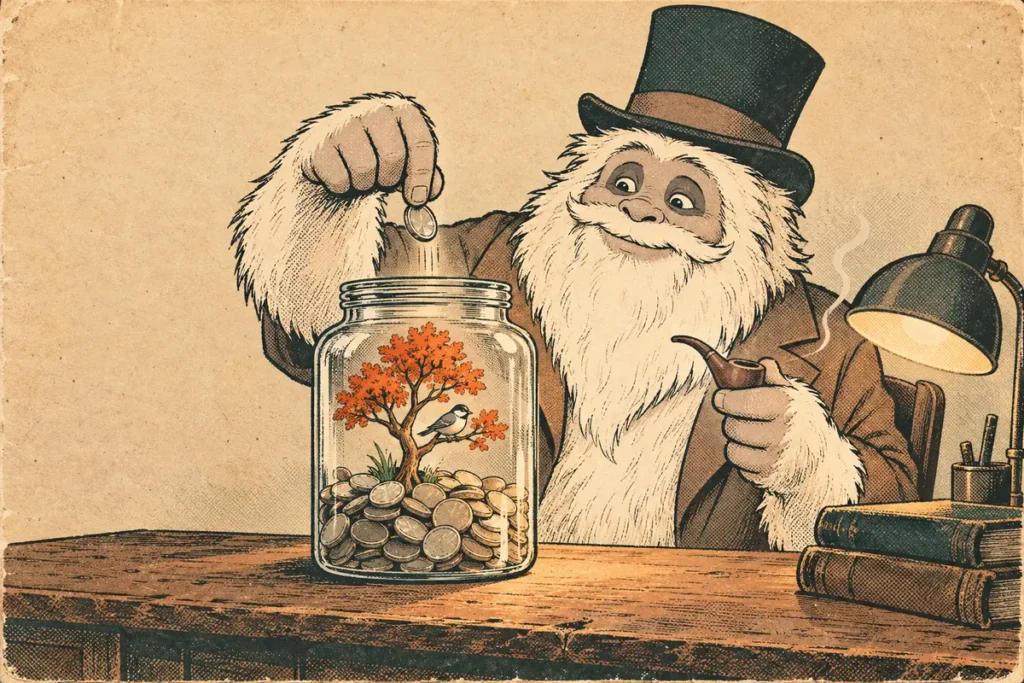
Saving for the tree, not the coins.
I grew up knowing money mattered, mostly because there was rarely an abundance of it. When that’s your normal, you pick up a particular skill: you dream smaller, and you get very good at being happy with what you choose. That worked fine as long as the only person I was responsible for was me. For the last five or six years I’ve lived as a digital nomad, building a life I actually like, and I made myself a deal. I had until 35 to make it financially, and I didn’t need to take money seriously until 30 or 31.
Then life moved faster than the plan. I decided to slow the role and got a place of my own, and money quietly changed category, from a want to a need. You start to notice that most families are one medical emergency away from being financially wrecked, and that dreaming small was a luxury of being responsible for nobody. So I started before my own deadline, because life was moving fast and the money wasn’t.
Here’s the thing, though. When I picture having a lot of money, I don’t picture a car. I picture abundance I get to share: buying things for the people I love without checking my balance first. And past that, a longer list. Old people who have no one. Orphans. Autistic people, including adults on the milder end of the spectrum who, in India, often can’t even get a proper diagnosis. That’s my version of buying wilderness.
Adults are taught to be embarrassed about two things: loving stuff too much, and wanting money. Steve did both at full volume, and the whole trick is that the wanting served the loving. Money was never the point. It was the fuel. The same goes for the grown-up who drops a few hundred on a Lego set. Buying back a piece of what you loved isn’t childish, and wanting the money to do it isn’t greedy.
It’s also how I think businesses should work, the ridiculously large ones most of all. Profit is fine. Profit that never reaches the people doing the work is not. Funcle Yeti is small, but it’s built on that idea. Our first jacket is made from hemp cloth handwoven in Kathmandu by women working with the bare minimum of infrastructure, and as the brand starts making money, the plan is for those benefits to reach everyone who makes it, not just me. So I’ll say it loudly: I want this to make a lot of money. I know exactly what I’d do with it.
The Day It Went Quiet
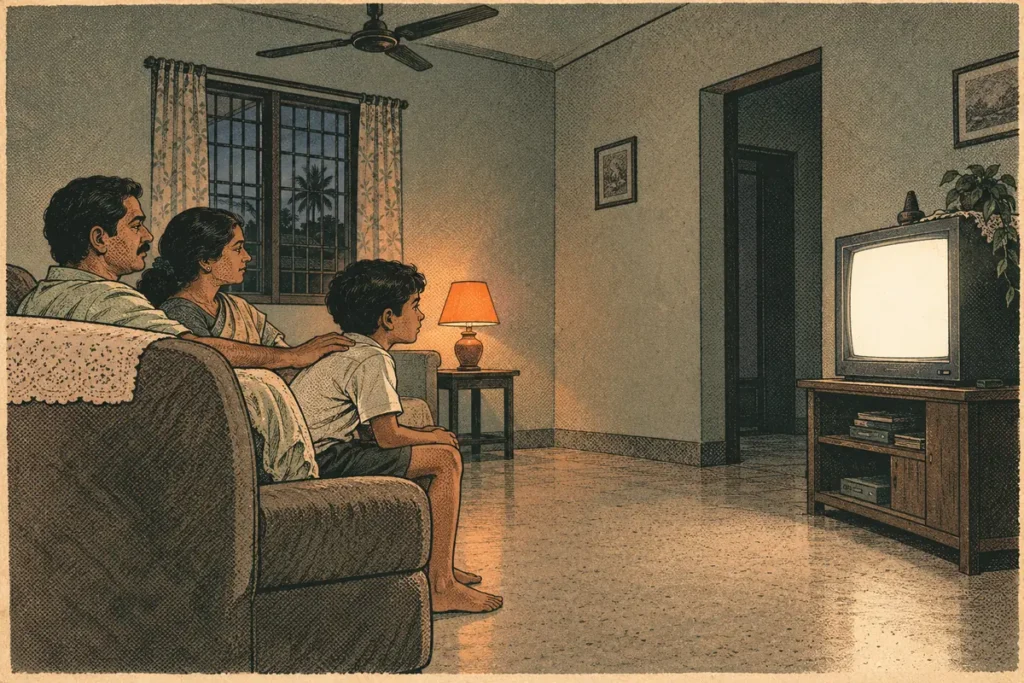
Some evenings, nobody needs to say anything.
On September 4, 2006, Steve Irwin died while filming at Batt Reef, off the coast of Queensland. He was 44, and he was out in the water with the animals he loved. That’s as much as needs saying.
I was in sixth grade. I saw it on the TV news, and I didn’t tell anyone or make a big deal of it. It was a silent kind of grief, the strange sort you feel for someone you’ve only ever met through a screen, and I’m fairly sure my parents felt it too. Nobody in our house said much. Nobody needed to.
Plenty of people grieved quietly like that. His memorial was seen by an estimated 300 million people around the world. When Australia’s prime minister and Queensland’s premier offered a state funeral, the family declined, and his father said Steve would have wanted to be remembered as an “ordinary bloke.”
These days his face still turns up in my feed every few months, and it does something odd to me. It reminds me of a good time and, in the same breath, of the fact that he’s gone. Nostalgia is like that. It rarely arrives alone.
The Grown-Up We Could Still Become
Be the grown-up who crouches down, not the one who pulls you back.
Steve wasn’t my role model. I didn’t have any. But looking back, he was the only grown-up on my screen showing me a version of adulthood I hadn’t been warned off: loud, kind, obsessed with the thing he loved, and completely unembarrassed about wanting the money to protect it.
So here’s the permission, from one grown-up to another. Love your thing out loud. Want the money to do it properly. Be loud about both, and don’t be an asshole about either. That’s the whole Steve Irwin school of adulthood, and as far as I can tell, enrollment is still open.
What did you get corrected out of loving? Tell someone. Loudly.
Crikey.
— The Funcle Yeti
Get the next postcard
Wish you were here. Or at least on the list.
It’s free, and it commits you to nothing. You’ll get new letters from the archive when they’re ready, plus first word on Run One, the hemp jacket we’re making with weavers in Kathmandu.
— Funcle Yeti
Funcle Yeti13First run
Frequently Asked Questions
What did Steve Irwin say about money?
In a 2004 60 Minutes interview with Charles Wooley, Steve Irwin said money was great and he couldn’t get enough of it, because “every single cent” went into conservation. He used it to buy wilderness land in Australia, Vanuatu, Fiji and the United States.
Why was Steve Irwin so popular?
Steve Irwin was popular because his excitement about animals was genuine, loud and contagious. The Crocodile Hunterbecame Animal Planet’s highest-rated show and was syndicated worldwide, reaching kids as far from Australia as small-town India.
Was The Crocodile Hunter shown in India?
Yes. The Crocodile Hunter aired in India on Animal Planet, which launched there in March 1999. The channel ran in English for its first years; a Hindi feed was added in 2008.
When did Steve Irwin die?
Steve Irwin died on September 4, 2006, at Batt Reef in Queensland, Australia, at age 44. His memorial service on September 20, 2006 was seen by an estimated 300 million people.
What is Steve Irwin’s legacy?
Steve Irwin’s legacy includes Australia Zoo, the Wildlife Warriors conservation charity, and the land he bought to protect. For the kids who grew up watching him, it’s also proof that an adult can love things loudly, want money for a good reason, and stay kind about both.
Sources
Steve Irwin, Wikipedia: Australia Zoo, January 2004 incident, land purchases, Wildlife Warriors
The Crocodile Hunter, Wikipedia: 1996 pilot, 1997–2004 run, Animal Planet’s highest-rated series
Death of Steve Irwin, Wikipedia: date, place, age, memorial, state funeral, “ordinary bloke”
Varun writes about nostalgia, hobbies, and the things we loved before we learned to be embarrassed about loving them. He started Funcle Yeti after noticing how many adults around him were quietly rebuilding the collections they’d given up at fifteen — and how few could explain why it helped.
He trained as a mechanical engineer (with a diploma in automobile engineering), so he likes to test things before he recommends them. He is not a psychologist. Where a post leans on research, the sources are linked inline; everything else is his own experience and opinion, and he says so.
Every sample of our handwoven hemp chore jacket is now measured the same way: hung for 24 hours, laid flat and buttoned, then measured at 19 fixed points, each one photographed with the tape in frame. Its construction gets checked too: weave density, stitches per inch, seams and reinforcement. The numbers are published here.
V2, the reworked first sample, is the first to go through it. It measures 100.0 cm around the chest, 80.0 cm from shoulder to hem and 46.5 cm across the shoulders, plus 16 more points from sleeve to pocket flap. Those numbers are the baseline that the next two samples, and eventually Run One, get checked against.
Why Measure Every Sample?
The first sample came back wrong because the measurements it was meant to be cut from, taken months earlier, were lost in a handoff between people at the workshop. It was cut from judgment instead, and the sleeves missed. V2 fixed some of that in one sitting, and not all of it.
A measurement kept in one person’s notes can go missing again. One that’s written down, photographed and published is much harder to lose, and whoever makes the next sample works from the same sheet.
How Was V2 Measured?
The jacket hung for 24 hours before anything was measured, so it was measured settled rather than straight off the machine. Then it was laid flat, buttoned, and measured at 19 fixed points: nine for the body, sleeves and collar, and ten for the pockets and flap. The protocol has three more points for an interior pocket; V2 doesn’t have one.
Two points are measured across the flat jacket and then doubled, so they read as the full way round: the chest, measured pit to pit (straight across from one underarm seam to the other), and the hem sweep, measured edge to edge along the bottom. Every other point is a single flat measurement.
Flat measurements describe the garment, not the person wearing it. That’s what makes them comparable between samples and between makers: anyone can lay a sample on a table and check it against the numbers below.
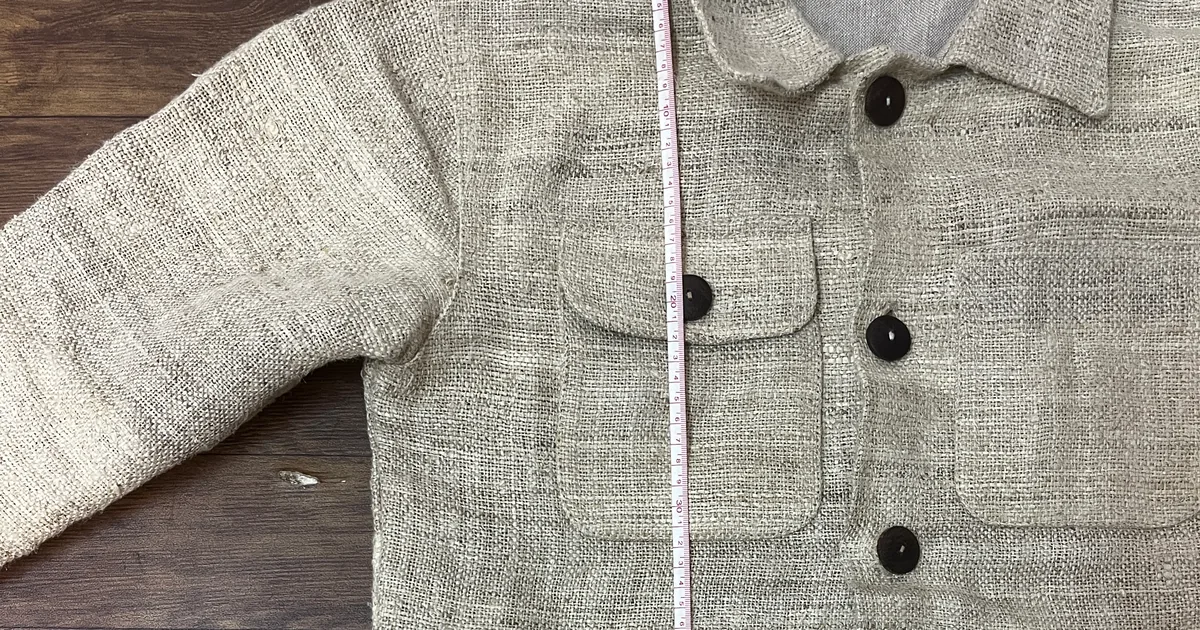
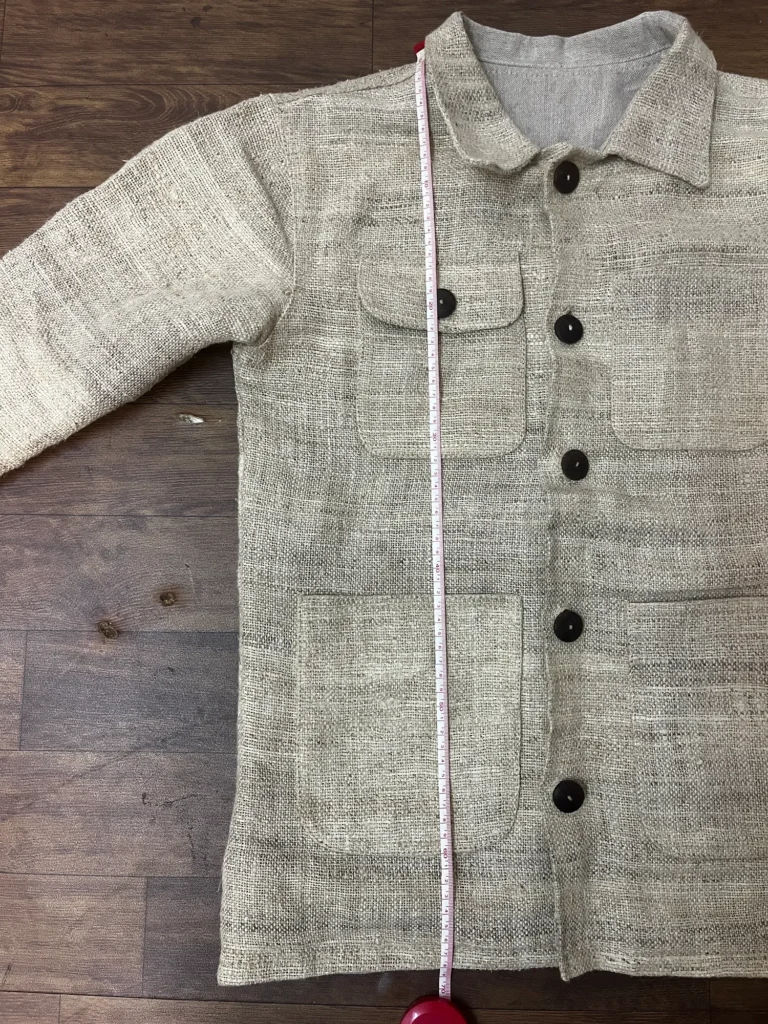
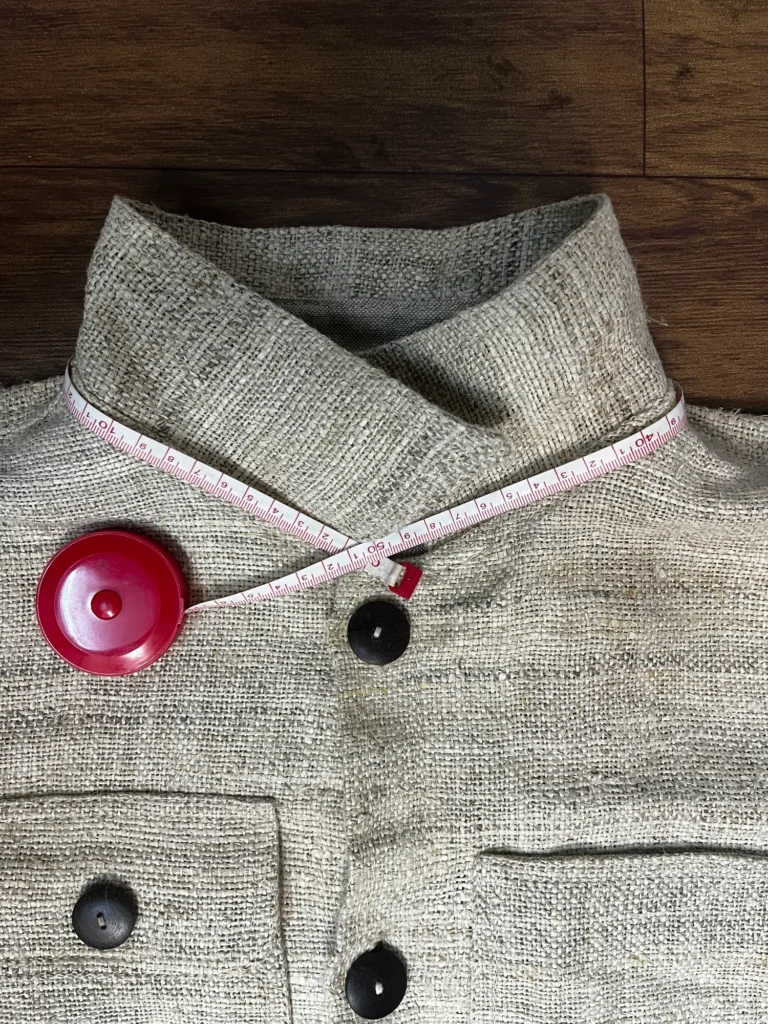
V2 laid flat for measuring, after a 24-hour hang.Collar length: 50.0 cm, point to point along the neck seam.
V2’s Measurements
V2, measured flat on 24 September 2026, before its first wash. All values in centimetres, recorded to the millimetre.
Point
How it’s measured
V2 (cm)
Tolerance, later samples (± cm)
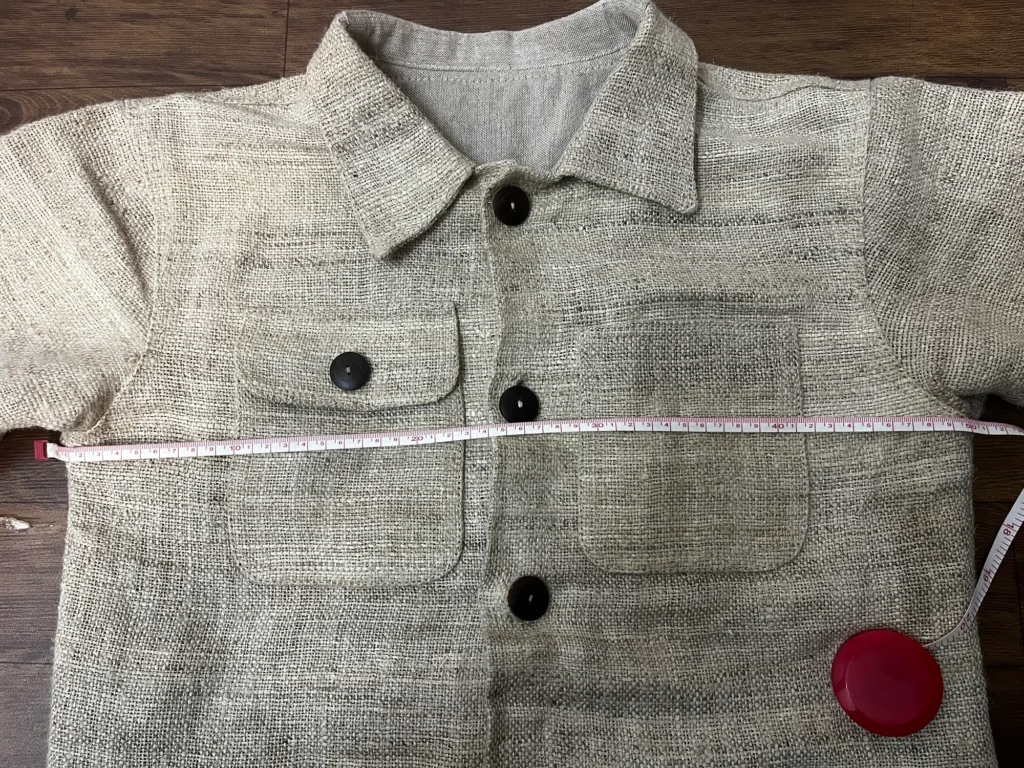
Chest
Pit to pit, doubled
100.0
1.0
Shoulder
Seam to seam across the back
46.5
0.5
Sleeve
Shoulder seam to cuff edge
58.0
1.0
Body length
High point of the shoulder to hem
80.0
1.0
Hem sweep
Edge to edge, doubled
103.8
1.0
Cuff opening
Buttoned, flat
12.8
0.5
Armhole
Straight line, seam to seam
21.5
0.5
Collar height
Centre back, stand plus fall
6.5
0.3
Collar length
Point to point along the neck seam
50.0
0.5
Open chest pocket, width
Across the opening, edge to edge
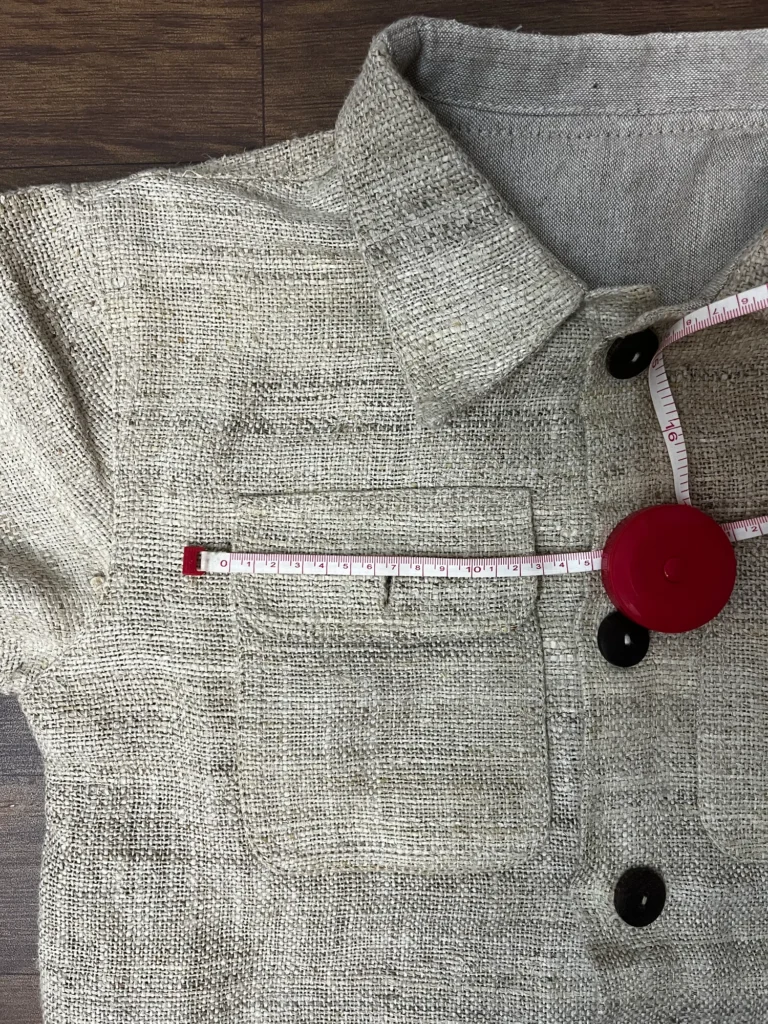
12.3
0.3
Open chest pocket, depth
Opening to bottom seam
13.9
0.3
Flap chest pocket, width
Across the opening, edge to edge
12.5
0.3
Flap chest pocket, depth
Opening to bottom seam
13.7
0.3
Flap, width
Edge to edge
12.6
0.3
Flap, depth
Top seam to bottom edge
6.2
0.3
Lower pocket, left, width
Across the opening, edge to edge
16.2
0.3
Lower pocket, left, depth
Opening to bottom seam
18.0
0.3
Lower pocket, right, width
Across the opening, edge to edge
16.5
0.3
Lower pocket, right, depth
Opening to bottom seam
18.2
0.3
Measured by hand, a sewn jacket rarely gives the same number twice to the millimetre. We record to the millimetre anyway, and the tolerance column sets how far a later sample can land from V2’s number: ±1 cm on the largest dimensions, ±0.5 cm on the shoulder, cuff, armhole and collar length, and ±0.3 cm on collar height and the pockets.
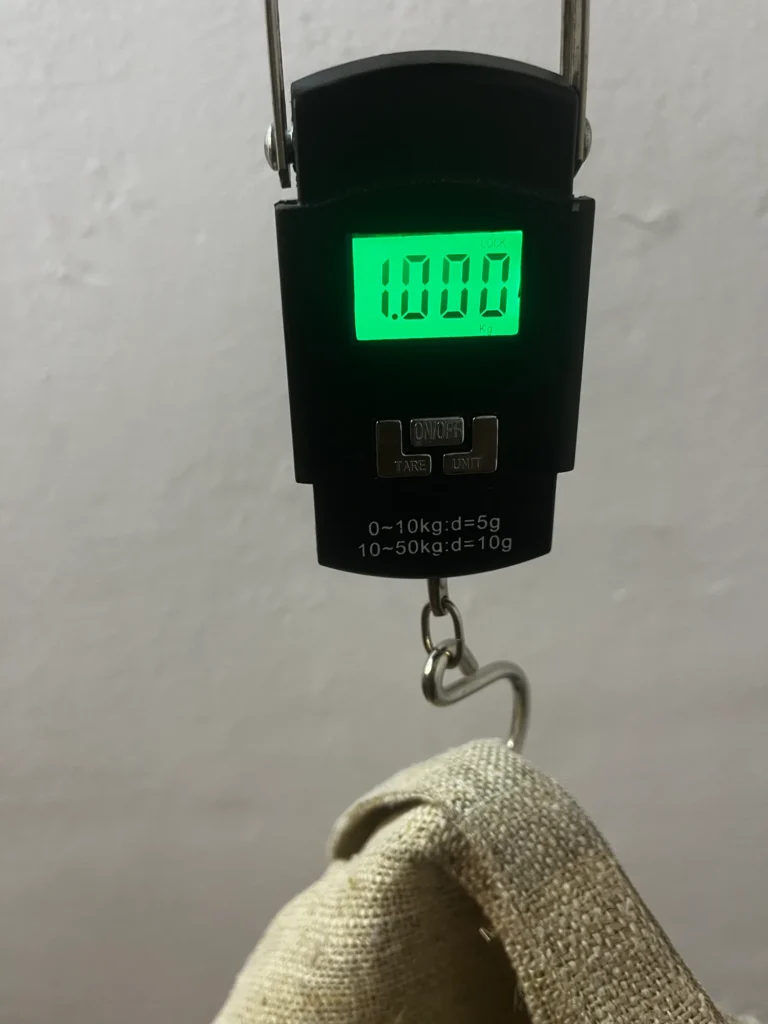
Whole, hung from a luggage scale that reads in 5 g steps, V2 weighs 1,000 g dry.
V2, whole and dry: 1,000 g.
How Is V2 Put Together?
The tape covers size. A second set of checks covers construction: how densely the cloth is woven, how densely it’s sewn, and what holds the stress points together.
Check
V2
Thread count
6 warp and 6 weft threads per cm
Stitches per inch
6, at the side seams, armholes, shoulders, hem and cuffs
Seams
Plain at the sides, [double] at the armholes
Seam allowance
10 mm
Bartacks
None. Not at the pocket corners, pocket bags, sleeve plackets or other stress points
Interlining
Sewn in, not fused
Cuffs
Unlined
Elbow patch
Added after sewing, not built in
Buttons
Coconut shell
Chest pocket flap
Closes with a button
Buttonholes
2 cm longer than the buttons they close
Thread count is the number of threads in a centimetre of cloth, counted separately along its length (warp) and across it (weft). Stitches per inch is how many stitches a seam puts into an inch of its length; it’s counted in inches even here, because that’s how the trade counts it.
Three of these are worth watching. V2 has no bartacks anywhere: the short, dense bars of stitching usually sewn across pocket corners and other stress points to stop them tearing. Every seam runs at 6 stitches per inch. And each buttonhole is 2 cm longer than its button. None of these is a verdict yet. Whether any of them shows up as wear, or as a button that won’t stay done up, is what the wash and wear tests are for.
What Do V2’s Numbers Show?
On its own, this list is a baseline, not a verdict. There’s nothing earlier to hold it against: V1 was never measured this way, and the measurements it should have been cut from are gone.
A few things show even so. The body is close to straight: 100.0 cm around the chest and 103.8 cm around the hem, a difference of 3.8 cm over 80 cm of length.
Flap chest pocket, width: 12.5 cm, edge to edge.Chest: 50.0 cm pit to pit, doubled to 100.0 cm.
The lower pockets aren’t a perfect pair: the right one measures 16.5 by 18.2 cm and the left 16.2 by 18.0 cm, so the right is 3 mm wider and 2 mm deeper.
And the list doesn’t yet measure the part of V2 we know is wrong. It records the cuff opening, but not the sleeve’s width at the bicep or the forearm. That’s where V1 went wrong, and where V2 is still narrow toward the wrist.
Where Do the Numbers Go Next?
Two more samples get measured the same way, at the same points: a third sample from the first supplier (V3), and the second supplier’s first. Both are checked against a written spec, version 1.0, built from these numbers, with one exception: the sleeve goes with its correction, not as a copy of V2.
V2 itself gets measured again. It’s the test jacket for washing and wear, so the same points, and its dry weight, are taken again after its 1st, 3rd, 5th and 10th wash. Two thread markers are tacked onto it as well, each sewn exactly 20.0 cm tack to tack, one running vertically and one horizontally, so shrinkage can be read along the length and across the width separately. If the hemp shrinks or relaxes, it will show up as a change against the numbers above, not as an impression.
Either way, every sample from here starts from written numbers, not memory.
GSM: The cloth itself has been weighed properly too, square by square; that’s Entry 05.
This is Entry 04 of the Run One Build Log: the making of Funcle Yeti’s first batch of handwoven hemp chore jackets, logged in Kathmandu as it happens. Start from Entry 01.
Get on the Run One list
Wish you were here. Or at least on the list.
It’s free, and it commits you to nothing. You’ll hear first about the samples, the final design and the price, and get first access when orders open where you live.
From a very young age, we have been taught to view adulthood as a race—the race to chase larger titles, higher credit limits, bigger cars, and even bigger homes. But if you look closely at the daily life of the modern-day young adult, the true reality is one of quiet containment—confined to our corporate cubes and concrete boxes where attendance is not optional but mandatory. Most of us spend our mornings trapped inside the digital glass of our phones, our afternoons navigating the never-ending grids of corporate spreadsheets, and our evenings trying to keep our living spaces looking presentable, organized, and “mature.”
Beneath the aesthetic demands of keeping a home looking proper, a quiet crisis is arising—one where our spatial identity is defined by our peers, our family, or society. For many of us, the dream of an entire dedicated room or a detached backyard studio is locked behind the gatekeepers of modern real estate. The reality is often a desk tucked into a bedroom corner in a shared flat, or a single table carved out of a high-rent apartment in an expensive, concrete jungle we call “the city.”
But the true boundary isn’t measured in sprawling square footage; it is measured in raw, uncompromised autonomy. The human spirit simply requires absolute control over whatever small perimeter it manages to claim.
Key Takeaways
You don’t need a spare room to have a sanctuary at home; one desk or table that you fully control is enough.
A personal desk setup isn’t defined by the absence of work but by the presence of you: objects tied to your interests, history, and goals.
“Kidult” guilt fades once you stop seeking outside approval. It’s a space you contribute to and owe to no one.
Physical objects such as die-cast cars, model kits, and small figures give your brain a tactile break from weightless digital work.
Autonomy is contagious: personalizing a desk at the office often encourages colleagues to do the same.
The Reality of the Bedroom Desk Setup: Building Space in a Tight Corner
There is a common misconception that a functional work desk and your deeply personal sanctuary cannot exist on the same piece of wood. We are often sold the idea that a remote workspace must be a sterile laboratory optimized solely for ergonomics, productivity, and how clinical your background looks on a video call. The only exceptions are typically given to YouTubers, influencers, and streamers, while the average corporate or white-collar worker has to stick to a boring desk setup.
But a personal desk setup isn’t defined by the absence of work; it is defined by the presence of you. It is a physical defense system built right into your day.
Whether you are working from a bedroom corner in a shared flat or sitting in a bustling, cubicled corporate office, the psychological necessity remains the same: we require a perimeter where the rules of the rigid adult world are quietly negotiated. The good news is that you don’t need a separate room to achieve this. However, you do need to have the confidence and audacity to claim whatever little space you have to make it your own. There’s some research behind this: in a University of Exeter experiment, people who could arrange their own workspace got roughly 30% more done than people in a bare one (Knight & Haslam, 2010). The hard truth is that the autonomy you want can be claimed in centimeters, right under the nose of a spreadsheet.
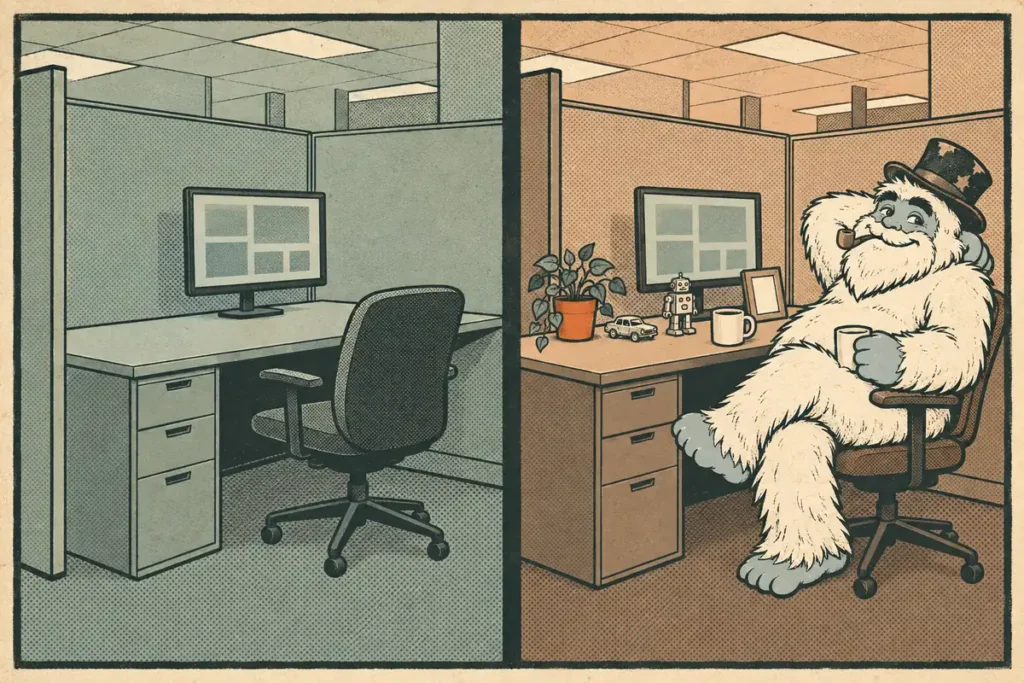
Clinical Workstation vs. Personal Desk Setup: The Evolution of the Square Meter
The Clinical Workstation
The Personal Desk Setup
Optimized for corporate productivity, client compliance, and clean video backgrounds.
Carved out for individual autonomy, creative hobbies, and personal history.
Feeds weightless digital stress via metrics, spreadsheets, and emails.
Offers tactile decompression via physical objects you can touch, roll, and feel.
Conceals the self to fit a manufactured mold of what an “adult worker” should look like.
Establishes a subtle anchor—a reminder of who you are before, during, and after the log-in hours.
Same square meter, two very different jobs.
For me, living and working where I’m constantly observed—whether by flatmates, family, or colleagues behind a Zoom lens—is draining in a very specific way. It keeps me in a kind of “performance mode.”
When I had a conventional office job, I refused to let that clinical energy dictate my sanity. I optimized my desk for comfort and creativity. I brought in a few Hot Wheels cars, some old Happy Meal toys, and a small plant to sit alongside my work monitors.
Initially, I wondered if I should keep my inner world entirely private from colleagues. If you aren’t comfortable revealing that side of yourself to your team, the strategy is simple: keep your personal anchors just outside the camera’s line of sight, or let a soft background blur protect your perimeter during meetings. A tiny die-cast car sitting right below your monitor doesn’t need to be part of the company agenda; it is there entirely for your baseline sanity.
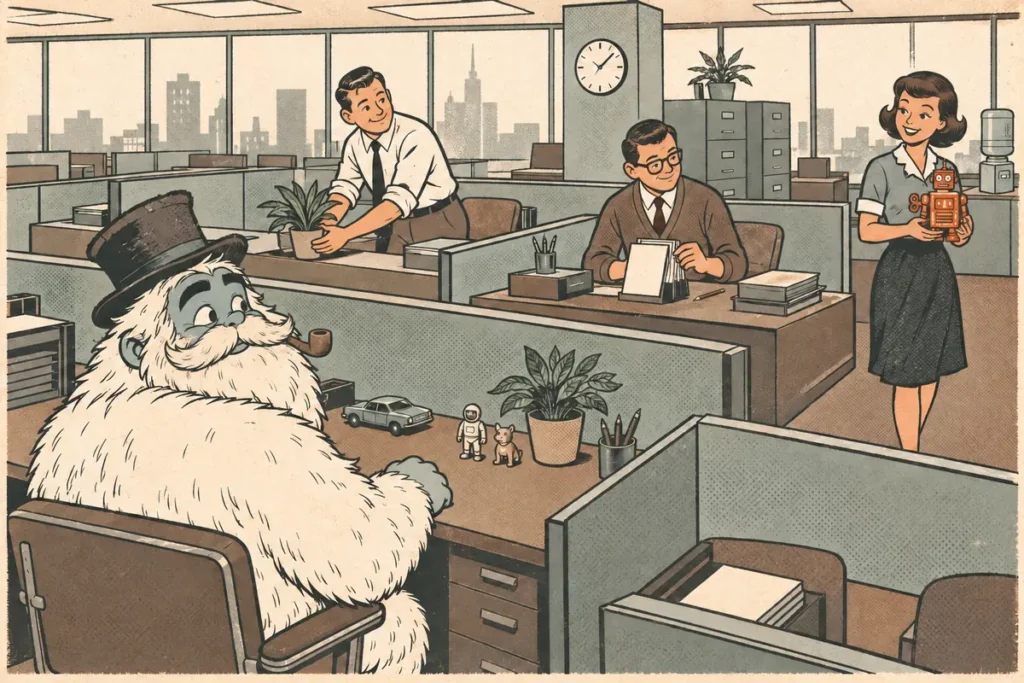
However, I chose to leave my pieces visible, and a quiet magic happened. Not only did my colleagues love the items, but I watched a fascinating shift occur in the office culture. Within a few weeks, the people sitting around me started quietly bringing in their own collectibles, plants, and desk toys. They began personalizing their own spaces simply because someone else had broken the ice. I realized then that when you dare to personalize your space in a corporate environment, you aren’t just decorating—you are signaling. Autonomy is contagious.
Autonomy is contagious: one personalized desk gave the whole row permission.
Is a Desk Full of Toys “Childish”? Navigating the Kidult Stigma With Intentional Living
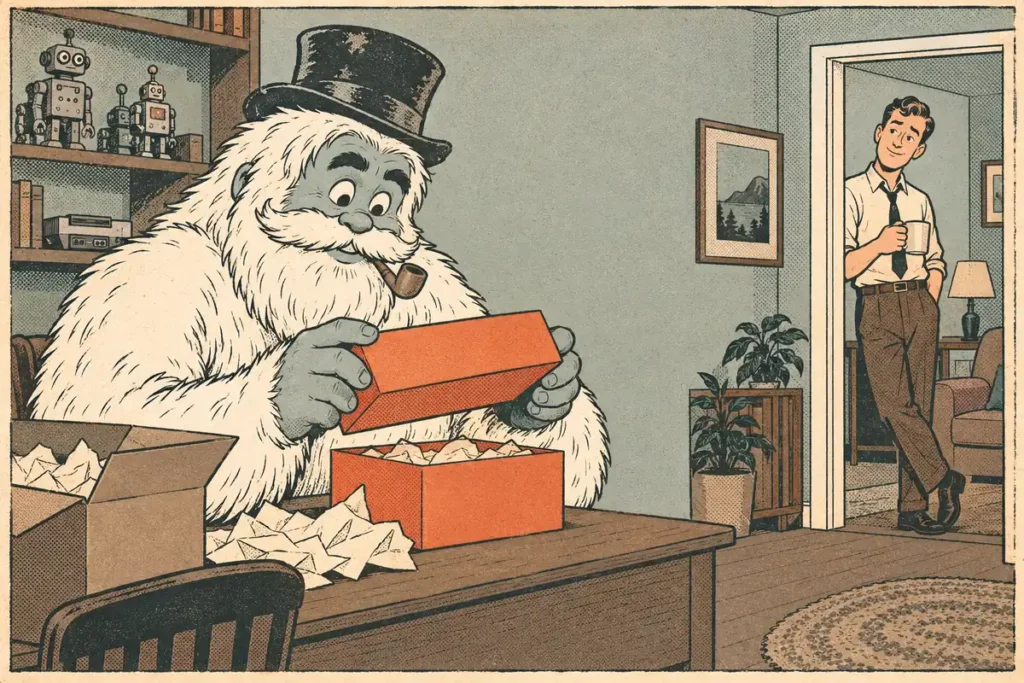
Claiming a table as an adult inevitably creates a strange, subtle friction with the domestic world. When you choose to decorate your one square meter of autonomy with a Gundam helmet, action figures, a retro console, or raw consumer electronics instead of minimalist, neutral vases, people notice. Even the most understanding partners, parents, or roommates will occasionally drop a well-meaning joke. They ask when you’re going to “grow out” of the plastic, or laugh gently at the sight of a grown adult carefully unboxing a collectible.
The well-meaning joke lands. The unboxing continues.
The real issue is that modern households have very little space free to be completely dominated by any single person at all times. Because of this, even silly, harmless jokes can cause you to get into your own head and introduce a layer of “kidult” guilt.
An adult sanctuary isn’t a spatial luxury; it is a vital psychological defense system—one where you use things you are familiar with to give yourself a break from the mundane life while still grounding yourself to reality.
The only way to get over the stigma of having what most consider toys decorating your workspace is to stop seeking external validation and simply do it for yourself. It feels far less guilty when you realize that this is a space you owe to no one. You contribute to the home, you pay the rent, and other people’s opinions of your table are entirely irrelevant regardless of how flashy it looks.
My workspace is a mini-laboratory for my honest, unvarnished interests. It isn’t childish, because a personal desk goes way beyond assembling Lego sets. It can be an art station, a tech layout, a mini workshop, or a toy train setup. The sky is the limit, and how it looks varies entirely based on what grounds your baseline sanity.
Tactile Breaks: Why Physical Objects Matter on a Digital Worktable
When you spend your entire working life staring at a computer screen, your brain undergoes a specific type of weightless exhaustion. The stress of digital work is algorithmic, technical, and empty. You solve a digital problem, and your reward is simply more digital noise. Passive scrolling isn’t much of a break either. In one experiment, people who use Facebook passively felt worse afterwards than those who used it actively (Verduyn et al., 2015), and in my own experience it leaves me both overstimulated and empty.
This exhaustion happens because the digital world lacks friction. In his book Non-things: Upheaval in the Lifeworld, the Korean-born, Berlin-based philosopher Byung-Chul Han notes:
“Today, we are in the transition from the age of things to the age of non-things. It is not things, but information that determines the living world.”
Han argues that when we lose our relationship with physical objects, we lose our anchoring in reality. Information doesn’t possess a body; it floats, demands constant attention, and never truly satisfies the senses.
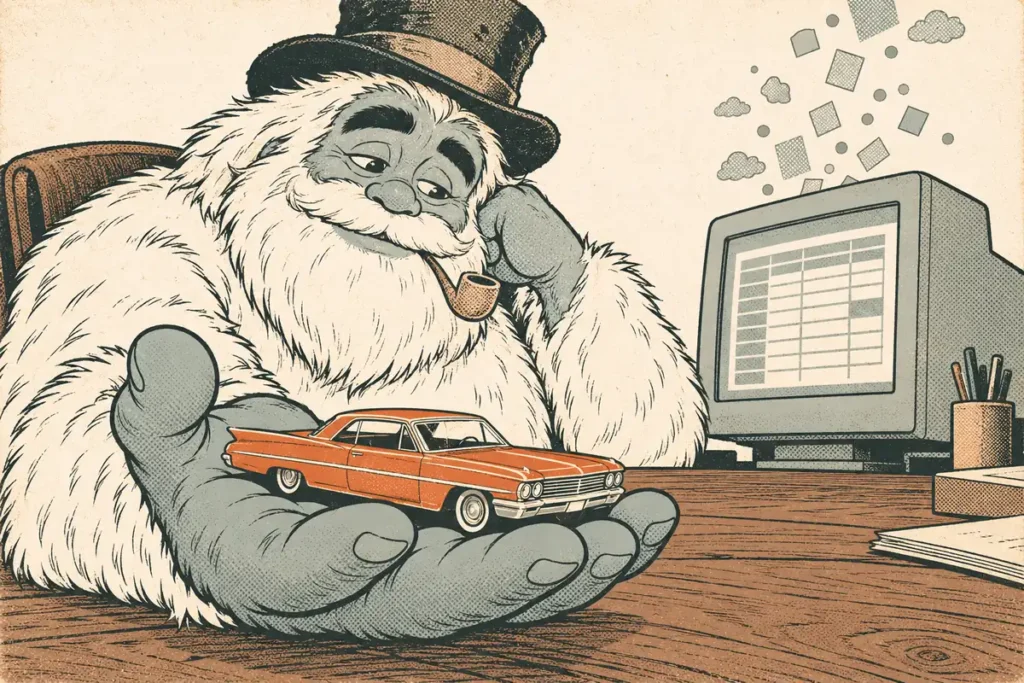
Information floats. A die-cast car has weight.
This is where the physical items resting on my desk graduate from being mere decorations to functioning as literal mental anchors, philosophical reminders, and real-time relief valves. They are what the philosopher Martin Heidegger, in Being and Time (1927), called ready-to-hand—objects that possess a tactile reality that pulls us out of our heads and back into our bodies. When I place raw, tactile materials in my immediate workspace, I give my brain an analog escape hatch:
Small anchors, within arm’s reach.
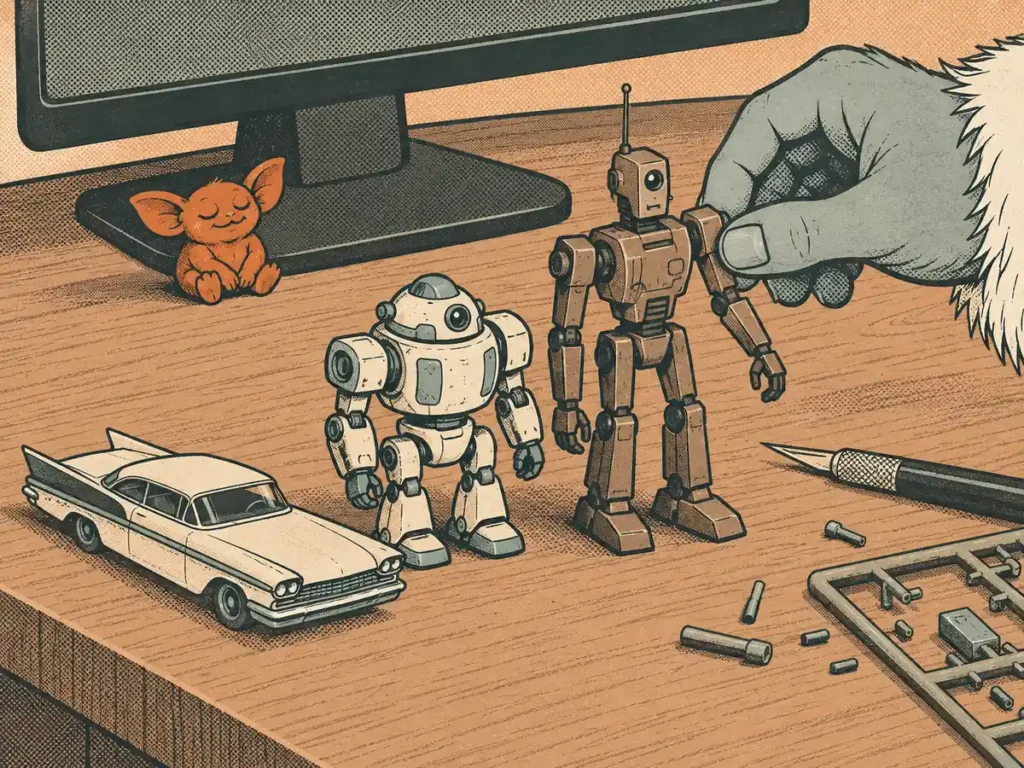
The 1:64 Scale Chevy Impala Die-Cast: Keeping a classic muscle car—painted in a deep gloss finish and resting right on the wood grain of your desk—acts as a vital visual bridge. It isn’t just a toy car; it is a physical manifestation of a long-term aspiration, a mechanical piece of history you plan to own in full scale someday. Rolling or simply just looking at the cool, weighted metal across your palm offers an instant, tactile break from a weightless day of spreadsheets, grounding your current labor in a tangible future goal. Furthermore, this is the perfect way to get started on reclaiming your space whether it is at work or home without the inconvenience of losing the limited space on your desk.
The Master Grade (MG) Gunpla Model Kits: Having a classic Gundam RX-78-2 standing shoulder-to-shoulder with its iconic red rival, the MS-06S Zaku II, introduces a deep layer of creative history to a tight workspace. Because these aren’t just bought—they are painstakingly built, sanded, and snapped together by your own hands—their presence on a small table is a testament to un-optimized, patient craftsmanship. Not to mention the memories such pieces evoke from the cartoons and anime you used to watch in awe as a child.
The Cubone Figure: A small Pokémon figure sitting quietly beneath your monitor base. In the vast landscape of modern animation subcultures, Cubone stands out as a symbol of resilience, quiet solitude, and carrying one’s history openly. Having this small entity resting on your desk injects a distinct, silent jolt of childhood nostalgia into a dull corporate afternoon slump. It serves as a reminder of who you were before the log-in hours began.
In today’s world, an adult sanctuary isn’t a spatial luxury anymore; it is a vital psychological defense system where a human can freeze their professional duties and personal responsibilities even for a little while. By keeping these objects within arm’s reach, we resist the weightless drift of the digital screen. We remind ourselves that we are creatures of muscle, bone, and memory—not just processors of data.
Frequently Asked Questions About Personal Desk Setups
What is a personal desk setup?
A personal desk setup is a workspace arranged around who you are, not just around productivity. It can hold your work monitor alongside objects tied to your interests and history, such as die-cast cars, model kits, figures, or plants, so the same table works as both a workstation and a small sanctuary.
Can you create a personal sanctuary at home without a spare room?
Yes. Personal space is measured in autonomy, not square footage. A desk in a bedroom corner, a table in a shared flat, or a single surface in a small city apartment can become an adult sanctuary as long as it is genuinely yours to arrange.
Is it childish to keep toys and collectibles on your desk as an adult?
No. Many adults, often called kidults, keep collectibles, figures, and retro items nearby because they ground them. A personal desk can just as easily be an art station, a tech layout, a mini workshop, or a toy train setup. What matters is that it reflects your honest interests rather than other people’s expectations.
How do you personalize a work desk without it showing on video calls?
Keep your personal anchors just outside the camera’s line of sight, such as below the monitor or to one side, or use background blur during meetings. The objects are there for your own baseline sanity, not for the company agenda.
Why do physical objects help with screen fatigue?
Digital work is weightless: it produces information but gives the senses very little to hold on to. Physical objects you can see, touch, or roll in your palm offer a tactile break that pulls you out of your head and back into your body, an idea explored by philosophers Byung-Chul Han and Martin Heidegger.
What is the easiest way to start personalizing a small desk?
Start with one small object that means something to you. A single 1:64-scale die-cast car fits under a monitor, takes up almost no desk space, and works just as well at the office as it does at home.
A space you owe to no one.
Sources and Further Reading
Han, Byung-Chul. Non-things: Upheaval in the Lifeworld. Translated by Daniel Steuer. Polity, 2022 (originally published in German as Undinge, Ullstein, 2021). Library catalogue record
Han, Byung-Chul. “I Practise Philosophy as Art.” ArtReview. Read the interview
Whyman, Tom. “Ghost of the Jukebox” (review of Non-things). Literary Review. Read the review
Wrathall, Mark. “Martin Heidegger.” Stanford Encyclopedia of Philosophy, first published 31 January 2025 (see section 2.1 on readiness-to-hand). Read the entry
Heidegger, Martin. Being and Time (1927).
Knight, Craig, and S. Alexander Haslam. “The Relative Merits of Lean, Enriched, and Empowered Offices.” Journal of Experimental Psychology: Applied 16, no. 2 (2010). Study summary
Verduyn, Philippe, et al. “Passive Facebook Usage Undermines Affective Well-Being: Experimental and Longitudinal Evidence.” Journal of Experimental Psychology: General 144, no. 2 (2015): 480–488. Abstract
Sonnentag, Sabine, and Charlotte Fritz. “The Recovery Experience Questionnaire.” Journal of Occupational Health Psychology 12, no. 3 (2007): 204–221. Record
Routledge, Clay, et al. “The Past Makes the Present Meaningful: Nostalgia as an Existential Resource.” Journal of Personality and Social Psychology 101, no. 3 (2011): 638–652. Record
Varun · Founder, Funcle Yeti
Varun writes about nostalgia, hobbies, and the things we loved before we learned to be embarrassed about loving them. He started Funcle Yeti after noticing how many adults around him were quietly rebuilding the collections they’d given up at fifteen — and how few could explain why it helped.
He trained as a mechanical engineer (with a diploma in automobile engineering), so he likes to test things before he recommends them. He is not a psychologist. Where a post leans on research, the sources are linked inline; everything else is his own experience and opinion, and he says so.
Illustrations generated with AI in the Funcle Yeti house style.