Two squares of Supplier 2’s plain, undyed handwoven hemp, cut along the threads and traced on graph paper, came in at 379gsm and 457gsm. The midpoint is about 418gsm, or 12.3 oz per square yard. The heavier square sits within a few grams of Supplier 1’s heaviest. The lighter one doesn’t: the gap between Supplier 2’s two squares is 78gsm, nearly twice the 42gsm gap in Supplier 1’s.
Same method as Entry 05
Entry 05 started with five squares cut from a metre of each supplier’s cloth, but only Supplier 1’s were finished with the traced method. This entry finishes Supplier 2’s.
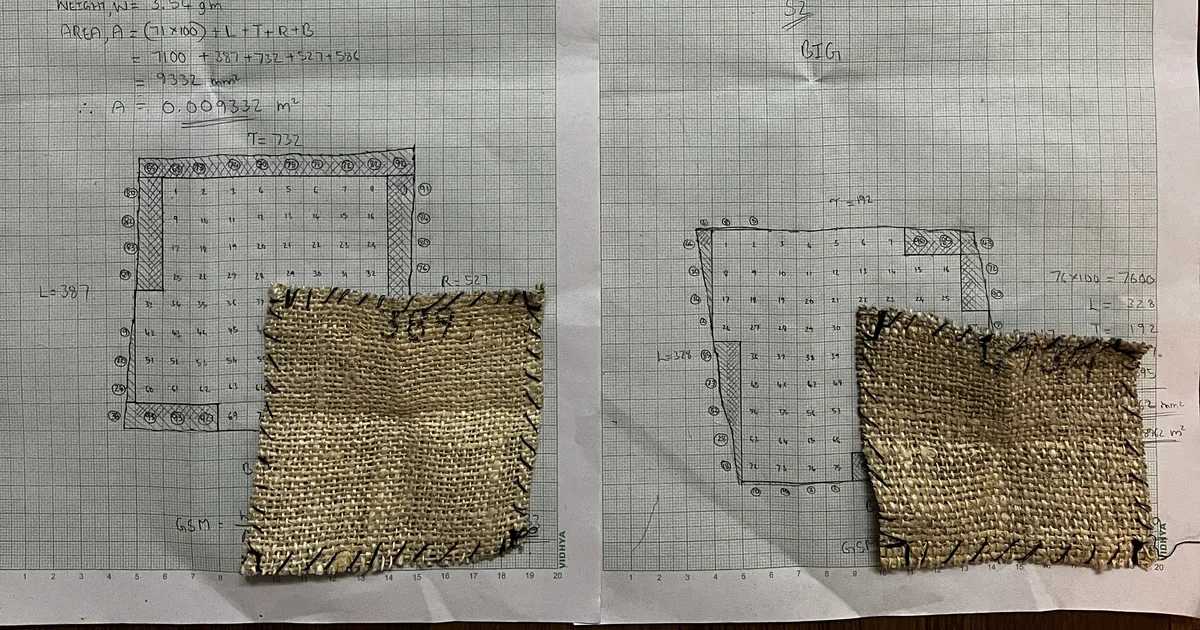
The method is unchanged. From the five first-cut squares, I took the heaviest and the lightest, trimmed each along the threads, and traced its outline flat on 1 mm graph paper. Whole square centimetres were counted first. Along the edges, I counted each millimetre square, pairing part-squares so two halves made one. Each was weighed on the same 0.01 g scale, and the area was worked out by hand and checked against the spreadsheet.
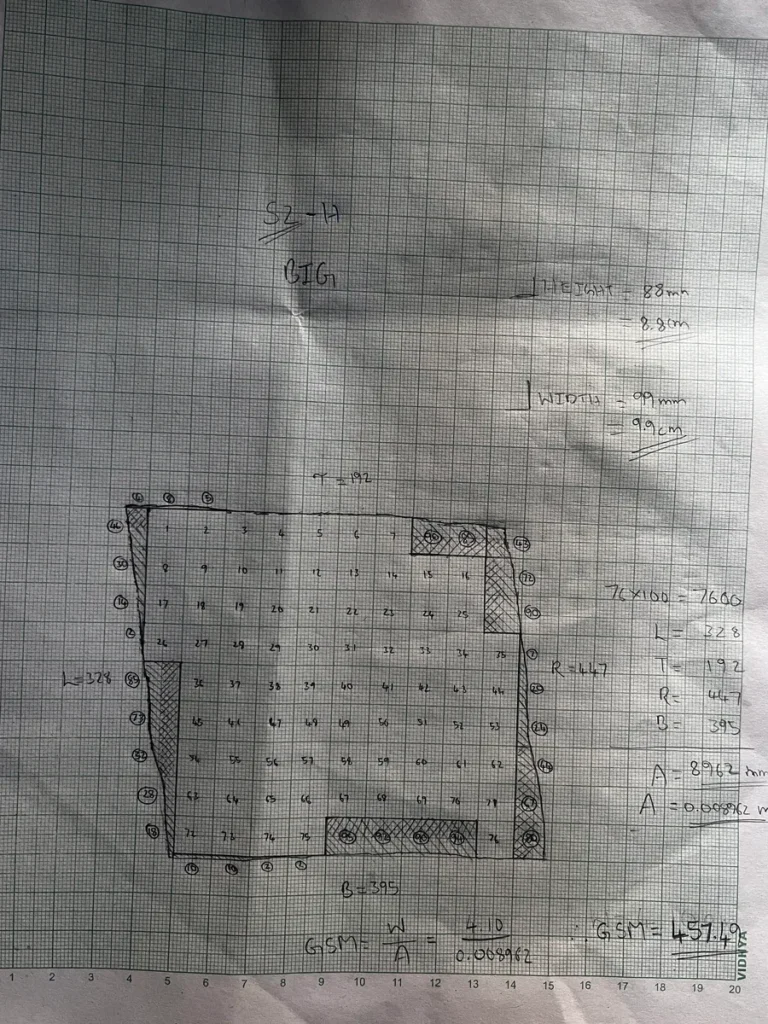
How the area was counted for Supplier 2's heavier square: 76 whole square centimetres, plus the four edge strips at 328, 192, 447 and 395 mm². That's 8,962 mm², or 457gsm at 4.10 g.
Square
First-cut reading, gsm
Traced area, mm²
Weight, g
Traced GSM
Supplier 2, heaviest
474
8,962
4.10
457
Supplier 2, lightest
389
9,332
3.54
379
The other three first-cut squares read 438, 430 and 428gsm. They weren’t traced, so they stay as first-cut numbers only.
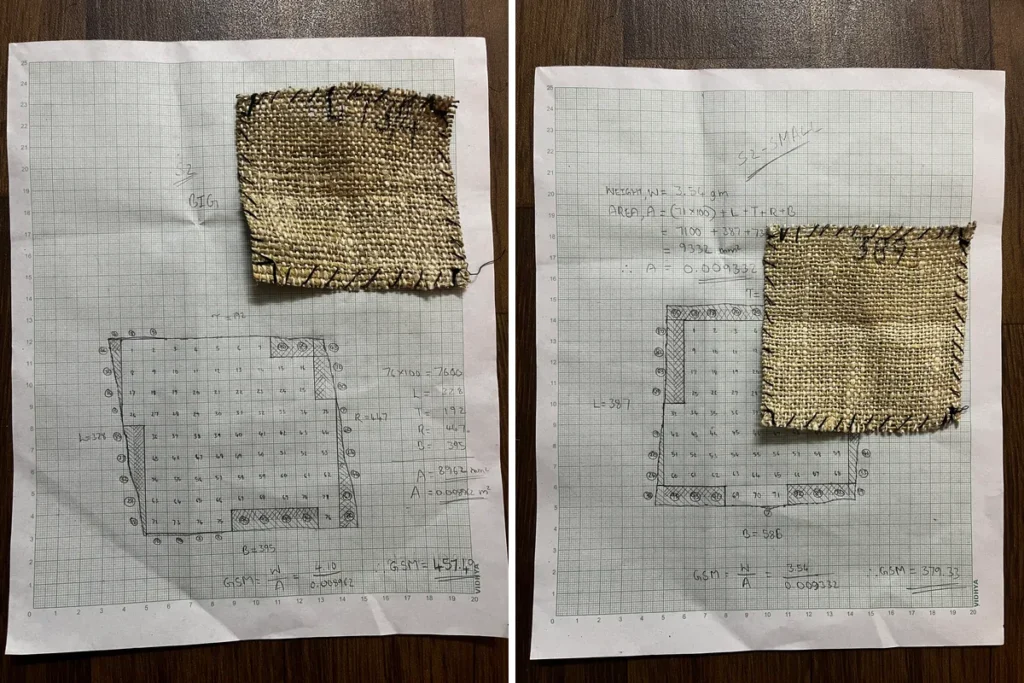
Left: the heavier square, still marked 474 from the first cut: 8,962 mm², 4.10 g, 457gsm. Right: the lighter, marked 389: 9,332 mm², 3.54 g, 379gsm. The edge stitching went on after weighing.
Side by side with Supplier 1
Supplier 1
Supplier 2
Heaviest square, gsm
462
457
Lightest square, gsm
420
379
Midpoint, gsm
441
418
Gap between the two, gsm
42 (about 10%)
78 (about 19%)
Weight the supplier stated
300–360, quoted verbally while sourcing
None given
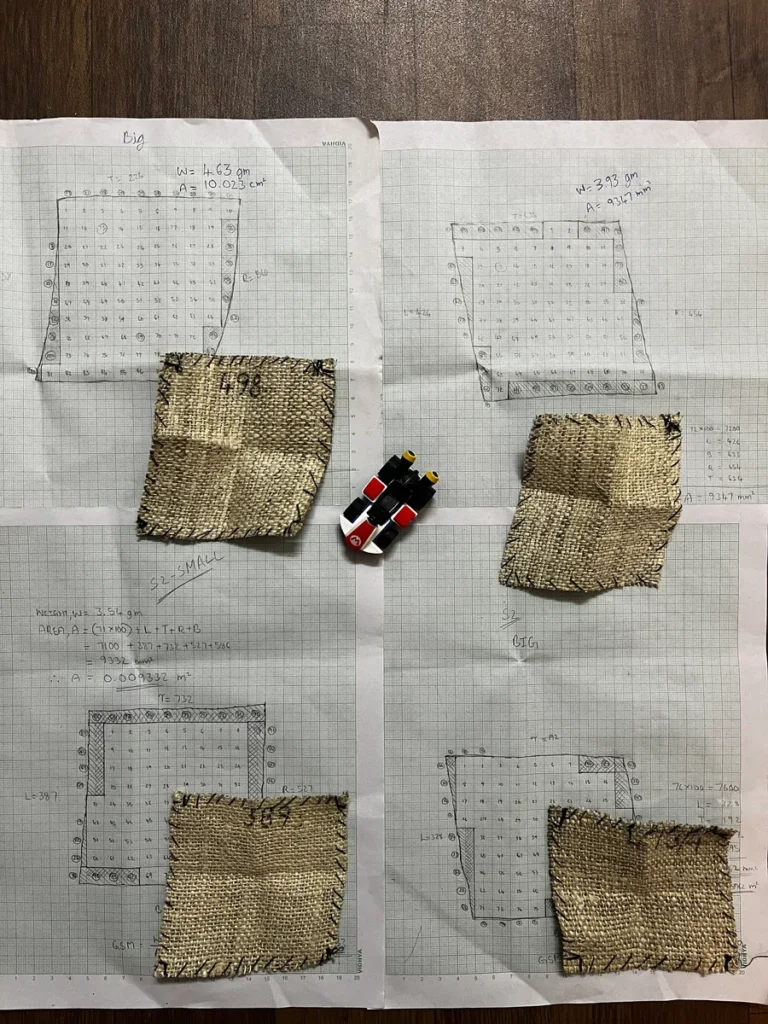
Supplier 1's two squares from Entry 05 at the top, Supplier 2's two below. All four were edge-stitched after weighing, ready for the wash.
The heavy ends nearly match. The difference is all at the light end.
That difference is real cloth, not measuring error. Tracing and weighing together carry an uncertainty of about ±2% per square, or roughly 8 to 10gsm at these weights. A 78gsm gap is far outside that.
One smaller difference I can’t explain yet: Supplier 2’s first-cut readings landed about 2.5 to 3.5% above the traced ones, while Supplier 1’s ran 6 to 8% high. With two squares each, it may not mean anything.
What this does and doesn't tell us
These are the two extremes of five squares from one metre of each supplier’s cloth. That’s a spread across one metre, not an average for a batch or a verdict on what each supplier usually weaves.
Our working target is 440gsm, set from Supplier 1’s cloth, with a ±5% tolerance. Supplier 2’s heavier square is inside it. The lighter square is about 14% under.
Spread matters for a jacket because its panels are cut from different stretches of the same cloth. The wider the spread, the more one panel can differ in weight and hand from the next. That makes consistency one point against Supplier 2’s cloth on this test.
It’s one criterion among several. Shrinkage, construction and how the cloth takes a repair are still to be tested for both suppliers.
What happened to these squares
Both Supplier 2 squares went into the jacket’s first machine wash, along with Supplier 1’s two, to measure how the cloth itself shrinks. After all the weighing, I overcast their edges in black thread to stop them fraying. That’s the stitching in the photos; the thread was never weighed. They weren’t marked for warp and weft, and they went in loose. They didn’t survive the tumble dryer. The readings above were all taken before the wash and stand. The shrinkage test is being redone with fresh squares, and the wash itself is the next entry.
This is Entry 07 of the Run One Build Log: the making of Funcle Yeti’s first batch of handwoven hemp chore jackets, logged in Kathmandu as it happens. Start from Entry 01.
 EST. 2025