

I never owned a Game Boy.
What my brother and I had was a box from a festival market in a small church town in Tamil Nadu, in the south of India, where our family went every year. We saved for it the way kids save for anything: badly, and then all at once. Every rupee of pocket money we had been given for the trip went into one pile, and the pile came to about 500 rupees. That was the price of the cheapest video game console on the stalls.
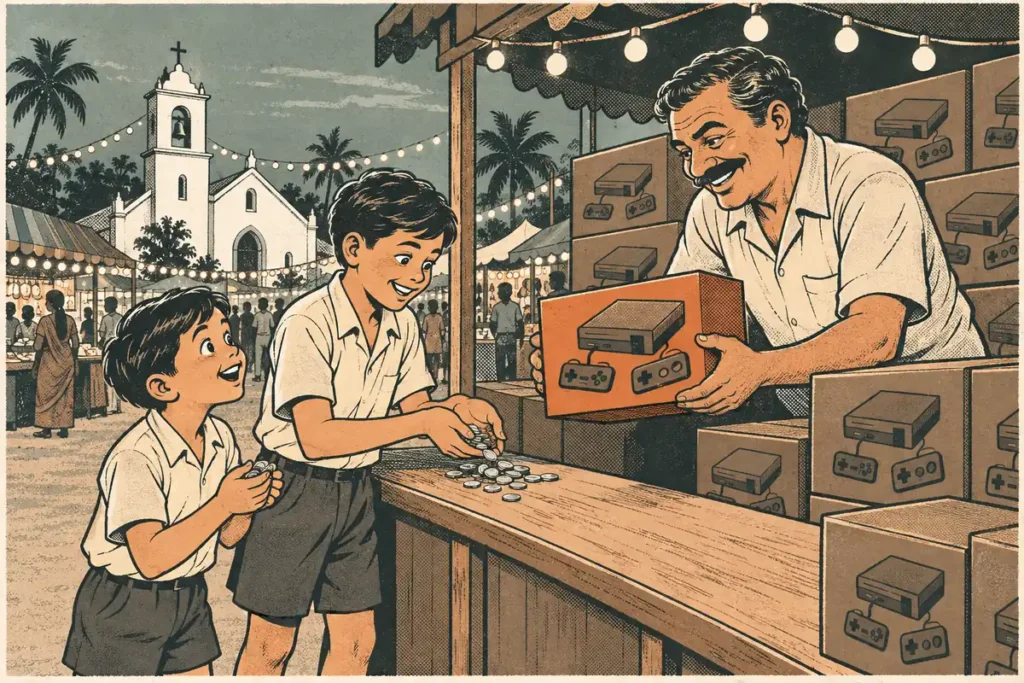
Neither of us can remember a brand name. Inside the box were a plain plastic console, a pair of wired controllers, a light gun, and a cartridge about the size of a cassette tape that promised hundreds of games on its label. In practice it was the same dozen or so — Mario, Contra, a high-jump game, a handful of sports games — repeated under different names to make up the number. It was almost certainly an unlicensed copy of Nintendo’s home console (the NES, sold in Japan as the Famicom), one of the millions of “Famiclones” sold at markets and fairs across Asia, Eastern Europe and Latin America. It was supposed to be junk.
The game everyone wanted was Duck Hunt. You pointed a plastic gun at the television, pulled the trigger, and a duck flying across the screen dropped out of the sky. For a room full of kids at the time, it was the closest thing to virtual reality any of us had ever seen. When the dog popped up out of the grass holding two ducks at once, the whole room went mad.
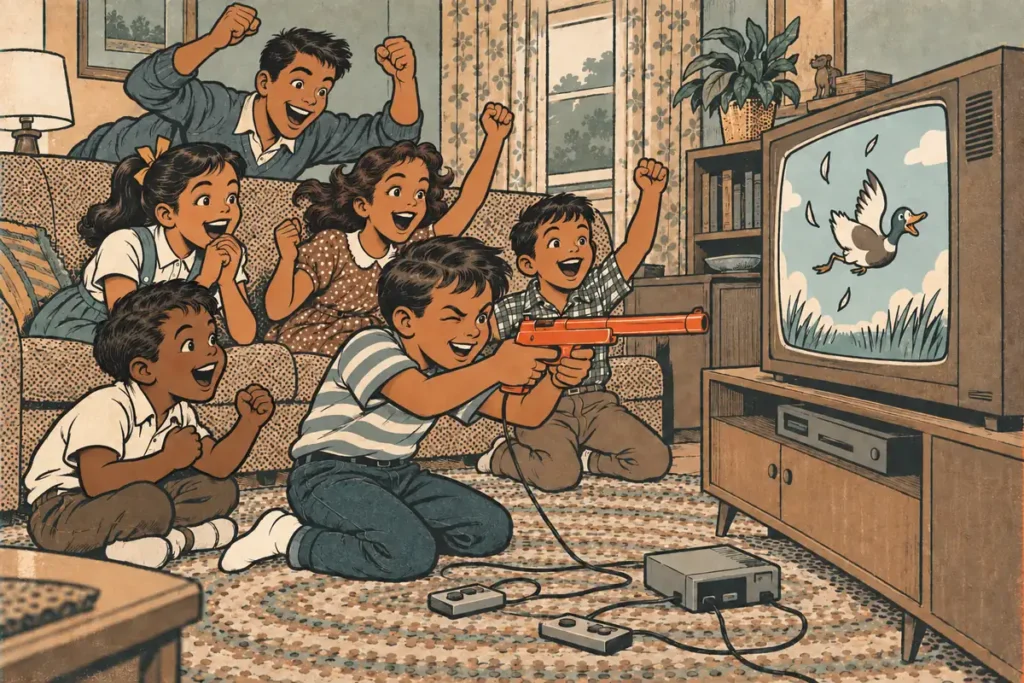
We were never allowed to play alone, and never for long. After a couple of hours, a parent or our grandfather would call time — unless it was Sunday, when the whole gang of cousins got a few extra hours and we tried to beat each other’s scores in Mario.
That cheap, flimsy, unbranded box lasted for years.
Meanwhile, in lofts, drawers and shoeboxes at parents’ houses all over the world, there are grey bricks that belonged to the kids who did get a Game Boy. They are heavier than you remember. The D-pad is worn smooth in one corner, there is the faint ghost of a sticker on the back, and the battery cover is held on with tape because the little plastic tab snapped off sometime around 1997. Put four AA batteries in one, slide the switch, and it does the thing. The Nintendo logo drops down the screen, there is that small, bright ping, and Tetris is right there where you left it. Thirty-odd years later, it just works.
Now go and find the phone you retired three years ago. You know the one. It is in the kitchen drawer with the takeaway menus and the spare keys. Charge it overnight and it might boot. It might even hold a charge until lunch. But half its apps will not install, the battery has the stamina of a hangover, and it has quietly become an object you keep only because you feel bad throwing it away.
One of these things was built by a company that wanted you to keep it. The other was built by a company that needs you to replace it. That difference is what this whole corner of Funcle Yeti is about. And the 500-rupee box from the festival market, it turns out, has something to add.
The short answer: most original Game Boys still work because Nintendo built them simply: a thick plastic shell, a basic processor, four AA batteries from any shop, games that lived on cartridges, and screws you could undo. Modern phones are sealed, glued and dependent on software updates that eventually stop. Even a cheap clone console, built the same simple way, could last for years if someone looked after it.
Why Does the Original Game Boy Still Work?
The original Game Boy launched in Japan on 21 April 1989, in North America on 31 July 1989, and in the UK and Europe on 28 September 1990 at £69.99. Even then, it was not the most impressive handheld on the shelf. Its rivals had colour screens and backlights. The Game Boy had a greenish, unlit display that you had to angle towards a lamp like you were reading under the duvet.
But Nintendo had made a deliberate set of choices. Instead of chasing the fanciest screen or the fastest chip, the Game Boy put its money into the things that actually mattered to a kid. It was cheap enough for parents to say yes to. It ran for up to 30 hours on four AA batteries. And it was tough enough to survive being dropped, sat on, thrown in a rucksack and left in the back of a car all summer.
Look at how it was put together and the durability makes sense:
- Simple parts. A thick ABS plastic shell, a handful of buttons, a basic processor and a screen. Fewer things to fail.
- Batteries from any corner shop. When the power ran out, you did not need a charger, a cable or an appointment. You needed four AAs, and a coin to open the cover if the tab had gone.
- Generous tolerances. Nothing was engineered to the edge of what was physically possible. There was room inside for things to flex, heat up and cool down.
- No software to expire. The game lived on the cartridge. There were no updates to download, no account to log into, no server that could be switched off. The Game Boy you bought in 1990 is, in every way that matters, the same Game Boy today.
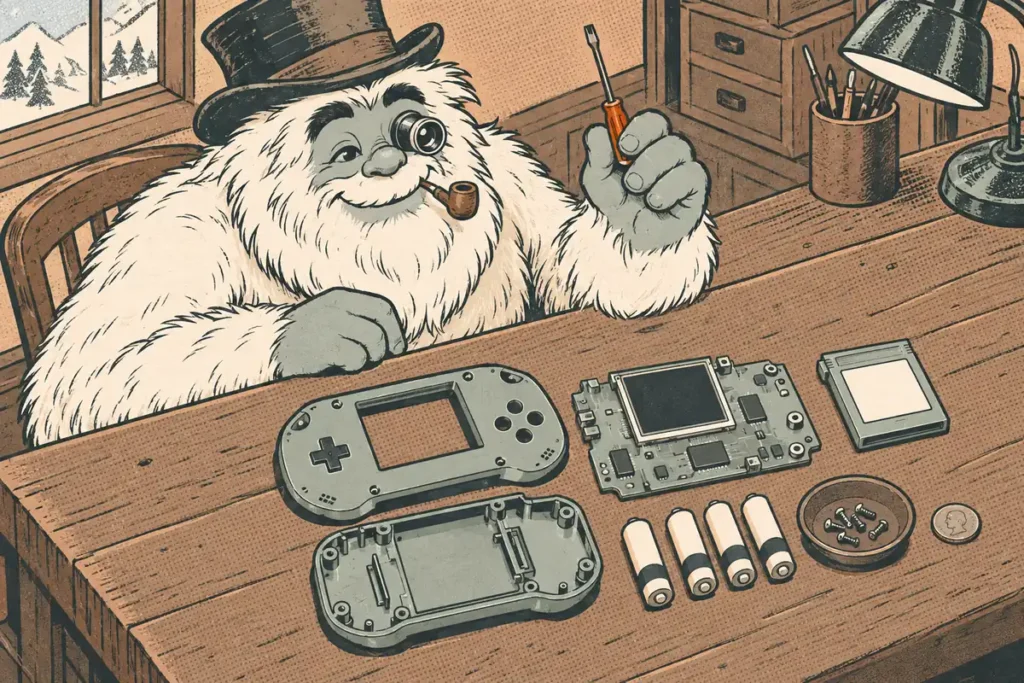
Our clone shared most of these virtues, mostly by accident. It had no screen of its own to crack; it borrowed the family TV. There was nothing to update and nothing to log into. Everything it would ever do was already on the cartridge.
Then there is the Game Boy that became a legend. In early 1991, during the Gulf War, an Iraqi Scud missile hit the barracks where a US Army nurse named Stephan Scoggins had left his Game Boy. The fire destroyed nearly everything. The Game Boy came out with its front scorched and blistered and its buttons partly melted. And it still switched on.
Nintendo gave him a replacement and kept the burnt one, putting it on display at its New York store, playing Tetris, for years. It was the most convincing advert the company ever had, and they did not have to write a word of it. In 2023, Nintendo Life reported that it had been taken off display and returned to Nintendo of America’s headquarters in Redmond, Washington, but the point had long been made.
So Why Doesn’t My Phone Last Like That?
It would be easy to say “they don’t make things like they used to” as if companies simply forgot how. That is not what happened. Manufacturers today can build to tighter tolerances, with better materials, than anything available in 1989. The capability is there. What changed was the business model around it. It even has a name: planned obsolescence, the practice of designing products to need replacing sooner than they have to.
A modern smartphone is designed to be thin, sealed and glued. The battery, the one component guaranteed to wear out, is usually locked inside a body you are not supposed to open. The device depends on software updates that eventually stop, and on apps that eventually refuse to run on old versions of that software. When the battery fades or the updates end, the phone does not fail so much as get politely retired.
Sometimes it is less polite than that. In December 2017, Apple admitted that its software updates had been slowing down older iPhones with worn batteries. The company said it was to stop them shutting down unexpectedly, and that may well be true, but in 2020 it agreed to pay up to $500 million to settle a US class action, plus $113 million to more than 30 US states. Whatever the intention, a lot of people replaced phones that only needed a new battery.
None of this is new, either. In the 1920s, the world’s biggest lightbulb makers formed what became known as the Phoebus cartel and agreed to cap bulb life at around 1,000 hours. Built-in expiry dates are almost a century old. The Game Boy just happened to come from a moment, and a company, where durability was the thing being sold.
The phones of that era came from the same school of thought. The first mobile I ever held was my father’s Nokia, the kind with a green, pixelated screen, and the only thing I was allowed to do on it was play Snake. I dropped it once. I remember the half-second of pure terror — not for the phone, but because it was my father’s — and then the relief when it carried on as if nothing had happened. I had no idea those phones were built like a rock. By the time I got a phone of my own, at sixteen or so, screens had colour, Android was arriving, and Snake had become a bright, curving thing that was far more than a line of pixels. It looked a lot better. Whether it would have survived the same drop is another question.
Was It All a Swindle?
Here is where it is worth being fair, because the lazy version of this essay is just an old man shouting at an iPhone.
The phone in your pocket does an absurd amount more than a Game Boy ever could. It is a camera, a map, a bank, a library, a record collection and a way to hear your mum’s voice from the other side of the world. The trade-offs that made phones fragile — thinner bodies, sealed cases, constant updates — also made them waterproof, powerful and secure. Not every one of those decisions was a con.
We should be honest about survivorship bias, too. The Game Boys still working today are the ones that survived. Plenty of 90s electronics were cheaply made and are long gone, which is exactly why nobody writes nostalgic essays about them. Nostalgia has a habit of remembering only the winners.
But my own childhood complicates that in a way I did not expect. My cousins had the same kind of cheap console we did — theirs was a slightly pricier version that folded open like a tiny laptop, with its own small screen, so it could come along on every family trip, even the dull ones to the church town. The picture was terrible. Nobody cared.
My brother and I were not careful owners. We dropped ours, banged it about, and yanked its wires out of the back of the VCR every time we wanted to play. It survived a few years of that before we had well and truly battered it. My cousins looked after theirs properly. It lasted at least five.
Similar machines, similar prices, two very different lifespans. The difference was not the factory. It was us.
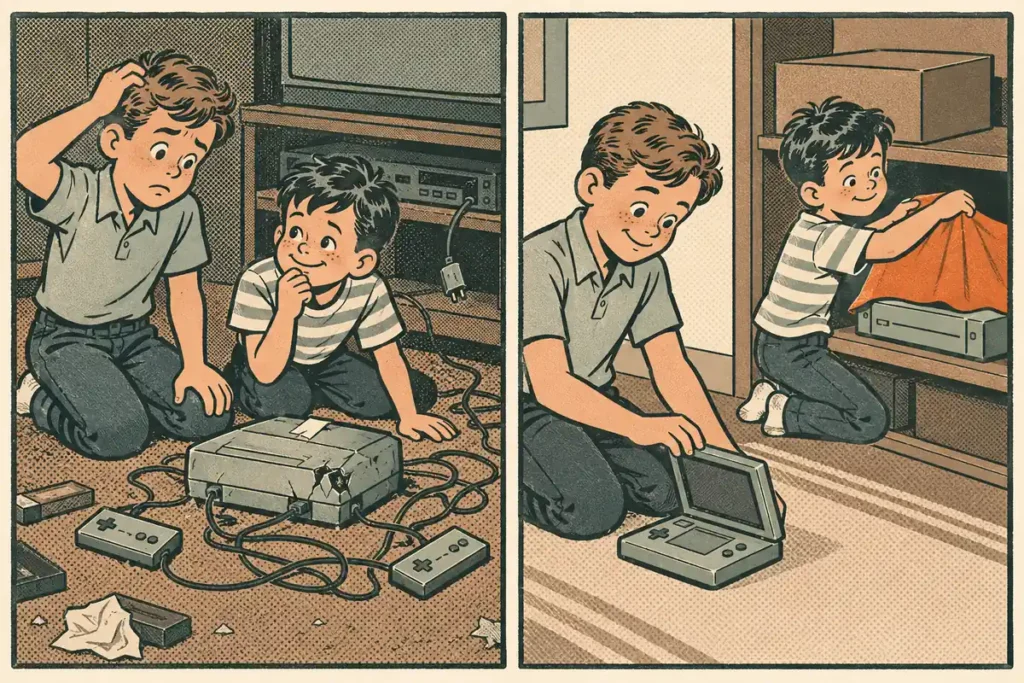
That is the part the survivorship argument misses. How long something lasts is decided partly by how it was built and partly by how it is treated — and the second only counts if the first allows it. A cheap console with simple parts could reward a bit of care with years of extra life. A sealed phone with a glued-in battery mostly cannot, however gently you hold it.
So even after all the fair caveats, something real is left over. The Game Boy proves it was possible to make a mass-market electronic device, sell it cheaply to children, and have it still work three decades later. The fact that we mostly stopped doing that was a choice, not a law of physics.
Things Last When You’re Allowed to Fix Them
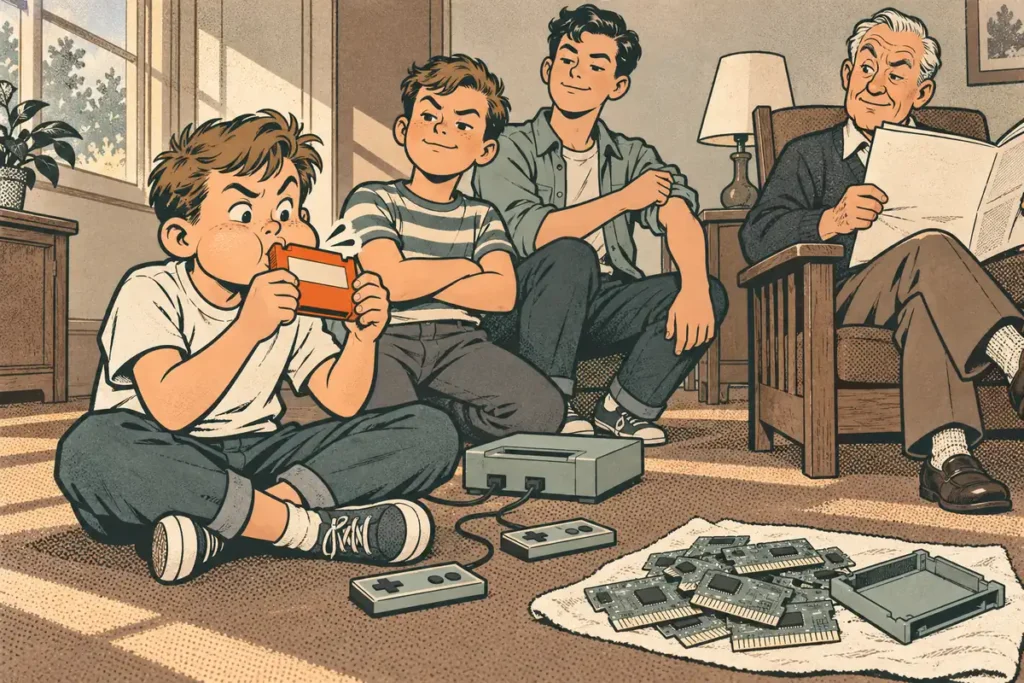
In our house, repairs had a chain of command. When the console played up — and it was almost always the cartridge — the first fix was the one every kid of that generation knew: pull it out, blow into it, push it back in. It worked nearly every time. (It probably was not the blowing. Taking the cartridge out and putting it back reseated the contacts, and Nintendo’s own small print said as much: “Do not blow into your Game Paks or systems. The moisture in your breath can corrode and contaminate the pin connectors.” Nobody told us, and it would not have stopped us.) If that failed, my brother took over. If he failed, it went up to our older cousin, who was the final authority on anything with wires.
At some point we got curious and cracked a cartridge open. I remember how surprised we were. Inside that big plastic shell was one small, thin circuit board and a lot of empty space. After that, we stopped bothering with the shells and kept a little pile of bare boards, which looked terrible and worked fine.
None of us would have called that repair. But it was: a machine simple enough that a ten-year-old could see where the game actually lived.
That is the deeper reason so many old Game Boys still work, too. They were tough, but more importantly, when something did go wrong, you could do something about it.
Take the cartridges. Games like Pokémon Red and Blue saved your progress using a tiny coin-cell battery inside the cartridge, and after fifteen or twenty years those batteries die and take your save file with them. For a lot of people, that was a genuinely upsetting discovery. But the fix is a new coin cell, a few minutes with a soldering iron and some patience. A whole community of people do exactly this, and their tutorials are free online.
The same goes for the Game Boy’s most common fault: the dead vertical lines that creep across the screen as the ribbon connection wears out. It looks terminal. It is usually a fixable connection, not a dead machine. Screws, not glue. Standard parts, not proprietary ones. That is the whole secret.
There are signs this thinking is finding its way back. Since June 2025, EU rules have required phone makers to keep spare batteries and screens available for at least seven years after a model stops being sold, and to make batteries either replaceable with basic tools such as a screwdriver or, in water-resistant phones, durable enough to keep 80% of their capacity after 1,000 charges. It took legislation to force it, but the idea is the same one Nintendo built into a grey plastic brick in 1989.
What an Old Console Teaches You About Owning Things
Our console never really died. It was replaced by curiosity. My father brought home a second-hand computer for his office, and almost overnight the console was old news; we spent our energy trying to persuade the woman who worked there to let us play when he was out. There was a gaming centre nearby, too, with a PlayStation and Spider-Man, but it charged by the hour, and the money always ran out long before the fun did. Nothing about that hour was ours to keep. We grew up and went chasing newer, better things. Or so we thought.
Years later, I bought one of those little retro handhelds that come loaded with the old games. Last October, On the flight home from China, I played my way back through the lot — Mario, Contra, Mortal Kombat, and the Pokémon game my brother and I used to play on that old office computer — and managed to evolve a Pokémon before we landed. It was wicked — the good kind of nostalgia — and it took me straight back to a room full of cousins shouting at a duck.

And holding it, I understood what Game Boy owners mean when they talk about theirs. An old console does not feel like a gadget. It feels like an object, one of the physical things that keep you grounded in a screen-heavy life. It has a history. The scuffs are yours. The worn patch on the D-pad is from your thumb, specifically, over hundreds of hours. Nothing about it is waiting to be replaced.
That is the feeling this part of Funcle Yeti is chasing. Built to Last is where we write about things that were made simply, made to be repaired and made to outlive the moment they were bought in: the Game Boys, the Nokias, the cast-iron pans, the boots and jackets that got handed down. Not because everything old was better — it was not — but because the things that lasted have something to teach us about what we choose to bring into our lives now.
The Game Boy was never the most powerful machine in the room. Neither was a 500-rupee box from a festival stall. They just refused to quit, for as long as someone was willing to look after them. There are worse things to aspire to.
Frequently Asked Questions
Does the original Game Boy still work?
Many do. Original Game Boys from 1989 and 1990 often still switch on and play today, because the hardware is simple, runs on four AA batteries and has no software that can expire. The most common faults, such as dead lines on the screen or flat save batteries in cartridges, can usually be repaired.
How long does a Game Boy run on batteries?
The original Game Boy ran for up to 30 hours on four AA batteries. Because it used standard batteries from any shop, a flat Game Boy never needed a charger, a cable or a replacement battery pack.
Why did old electronics last longer than modern phones?
Old devices like the Game Boy were built simply, with thick shells, few parts, standard batteries and screws you could undo. Modern phones are thin, sealed and glued, and depend on software updates that eventually stop. Manufacturers didn’t forget how to build durable things; the business model changed.
Did blowing into game cartridges actually help?
Not really. Taking the cartridge out and pushing it back in reseated the metal contacts, which is what usually fixed the problem. Nintendo warned against blowing, because the moisture in your breath can corrode the pin connectors over time.
What is a Famiclone?
A Famiclone is an unlicensed copy of Nintendo’s NES or Famicom console. Cheap Famiclones were sold at markets and fairs across Asia, Eastern Europe and Latin America, often bundled with controllers, a light gun and a multi-game cartridge that repeated the same games under different names.
Do EU rules require replaceable phone batteries?
Partly. Since June 2025, phones sold in the EU must have spare batteries and screens available for at least seven years after a model is discontinued. Batteries must be replaceable with basic tools, unless they keep 80% of their capacity after 1,000 charge cycles and the phone is rated IP67 for water and dust resistance.
Sources
- Famiclone — Wikipedia. Where NES clones were sold and how many.
- Game Boy — Wikipedia. Launch dates, UK price and battery life.
- A Game Boy Survived an Iraqi Bombing During the Gulf War — Blake Stilwell, Military.com.
- Nintendo Has Apparently Retired Its Gulf War Game Boy — Nintendo Life, July 2023.
- Apple Agrees To Pay $113 Million To Settle ‘Batterygate’ Case Over iPhone Slowdowns — NPR, 18 November 2020.
- The Great Lightbulb Conspiracy — Markus Krajewski, IEEE Spectrum, 24 September 2014.
- Blowing on Cartridges Didn’t Help Them, It Hurt Them — Luke Plunkett, Kotaku, 25 September 2012.
- Smartphones and Tablets — European Commission, Energy Efficient Products.
- Analysis: Overlapping EU regulations fueled confusion over smartphone batteries — Cherry Lai and Crystal Chow, Annie Lab, 8 June 2026.
Varun · Founder, Funcle Yeti
Varun writes about nostalgia, hobbies, and the things we loved before we learned to be embarrassed about loving them. He started Funcle Yeti after noticing how many adults around him were quietly rebuilding the collections they’d given up at fifteen — and how few could explain why it helped.
He trained as a mechanical engineer (with a diploma in automobile engineering), so he likes to test things before he recommends them. He is not a psychologist. Where a post leans on research, the sources are linked inline; everything else is his own experience and opinion, and he says so.
Illustrations generated with AI in the Funcle Yeti house style.