
Logged 4 October 2026, Kathmandu.
Two swatches of the workshop’s plain, undyed handwoven hemp, cut along the threads and measured on graph paper, came in at 420gsm and 462gsm. That’s an average of 441gsm, about 13 oz per square yard, and well above the 300–360gsm we were quoted verbally while sourcing. Getting there took two attempts; the first was too rough to trust.
Two Metres, ten Squares
Entry 01 left us with one swatch at 439gsm, worked out on an assumed area we knew was too small, and a plan: three to five squares from one batch, averaged, with the range reported.
On the day of V2’s rework (Entry 03), I came away from the workshop with a metre from Master Dai: the same hemp the new cuffs were being cut from. Before testing it, I picked up a metre from the second supplier too.
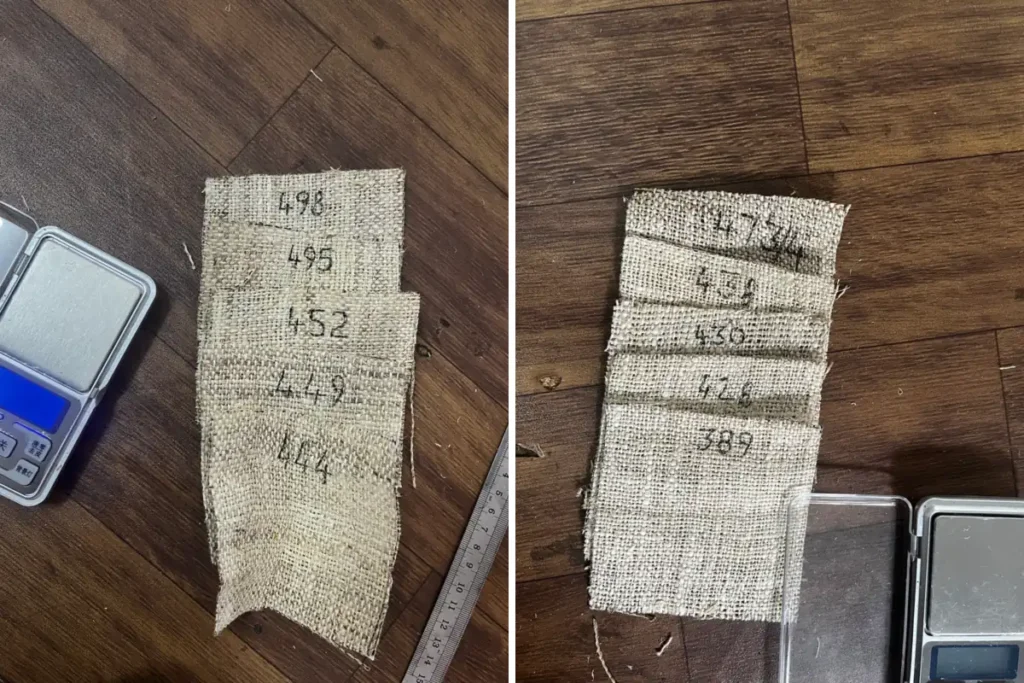
From each metre I cut five squares, as close to 10 cm × 10 cm as I could measure with a ruler, and weighed each on the same 0.01 g scale as Entry 01. GSM means grams per square metre, and a 10 cm square is a hundredth of one, so the shortcut is weight in grams × 100.
Both metres averaged comfortably above 400gsm. Neither average was precise enough to stand behind.
Why the First Numbers Didn’t Count
The × 100 shortcut only works if each square really is 100 cm². Mine weren’t, for two reasons.
First, the cut. A ruler gives a straight line, but the threads in handwoven cloth don’t run perfectly straight. Cutting along the ruler, I crossed threads at a shallow angle instead of following them, so every edge was a row of cut-through threads, with short ends that can work loose before weighing.
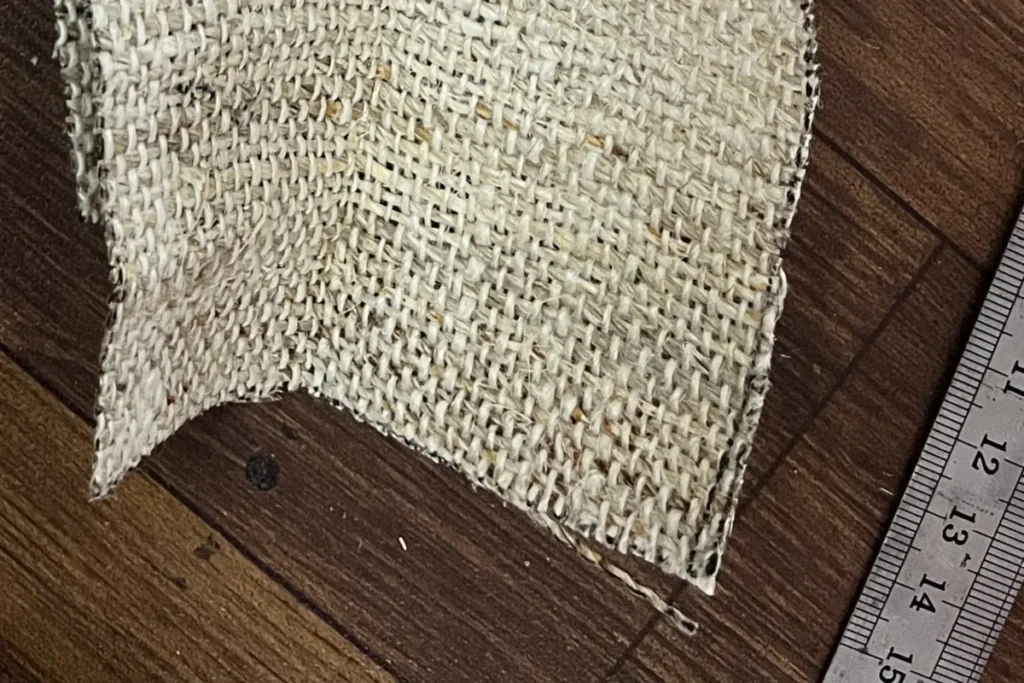
Second, the shape. Handwoven cloth is woven under tension, and not an even one. Cut a piece free and it relaxes into the shape the weave gives it, which isn’t a square. A square drawn at 10 cm on the cloth isn’t 100 cm² by the time it’s on the scale.
Edges like that leave no clean boundary to measure, so the squares needed trimming before anything could be measured properly. I’d skipped buying graph paper, on the theory that an approximate number was fine for a home test. For a number going in this log, it wasn’t.
Doing it Again, Properly
Entry 01’s plan was to cut as close to 10 cm × 10 cm as possible. That turned out to be the wrong target: handwoven cloth won’t reliably hold an exact square, however carefully it’s cut. So the second attempt stopped assuming the area and measured it.
- Cut along the threads. Each edge follows a single thread instead of a ruler line, so the threads running alongside it are either fully in the swatch or fully out. This meant trimming the first squares back, so their first weights no longer apply.
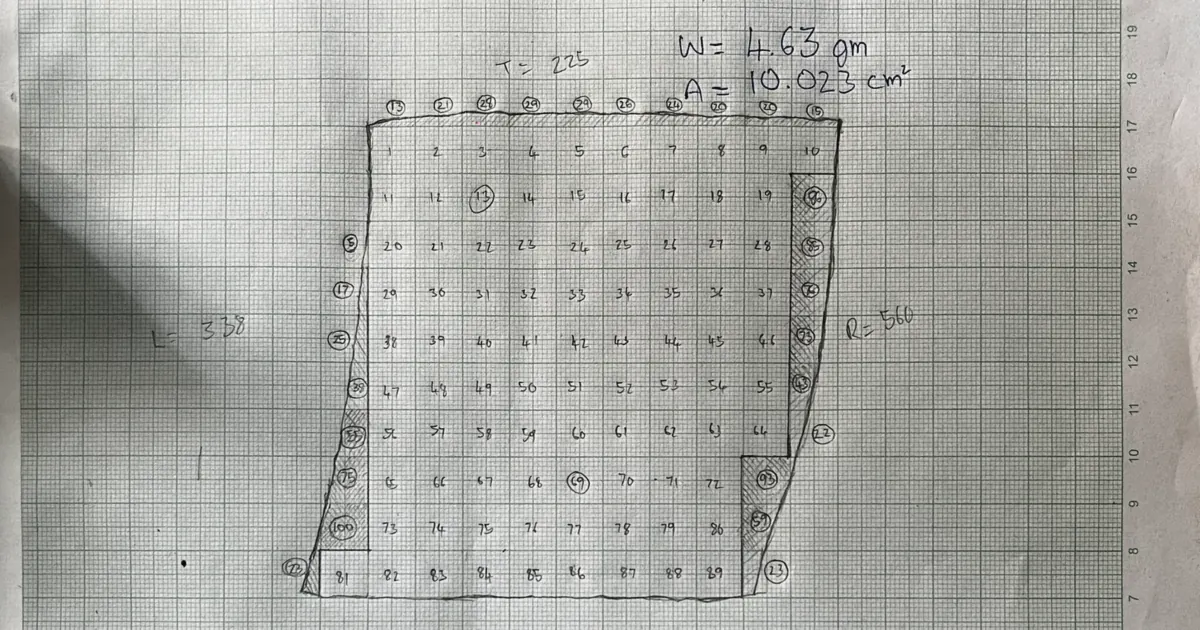
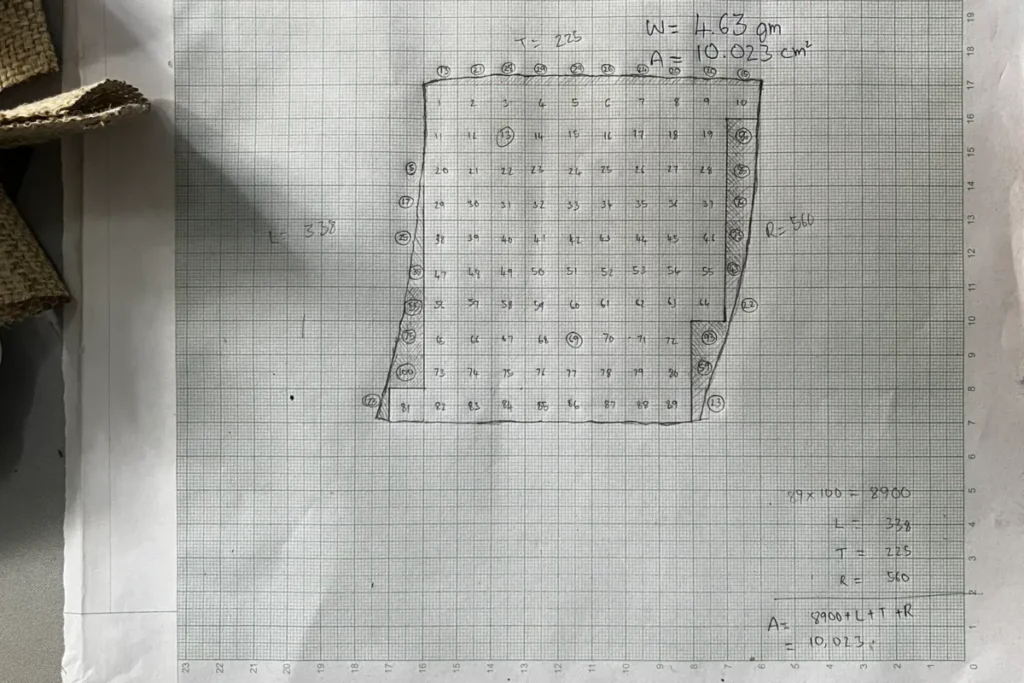
- Measure the real area. Each trimmed swatch went flat on graph paper and its outline was traced, in whatever shape the cloth had settled into. Whole centimetre squares inside the outline count 100 mm² each; the part-filled strips along the edges are counted square millimetre by square millimetre. Swatch 1 held 89 whole squares (8,900 mm²) and 1,123 mm² of edge strips.
- Weigh and divide. Same 0.01 g scale. GSM = weight in grams ÷ area in square metres.
So far, I’ve done this for two of the workshop’s five squares: the heaviest and the lightest from the first attempt, to see the spread at its widest.
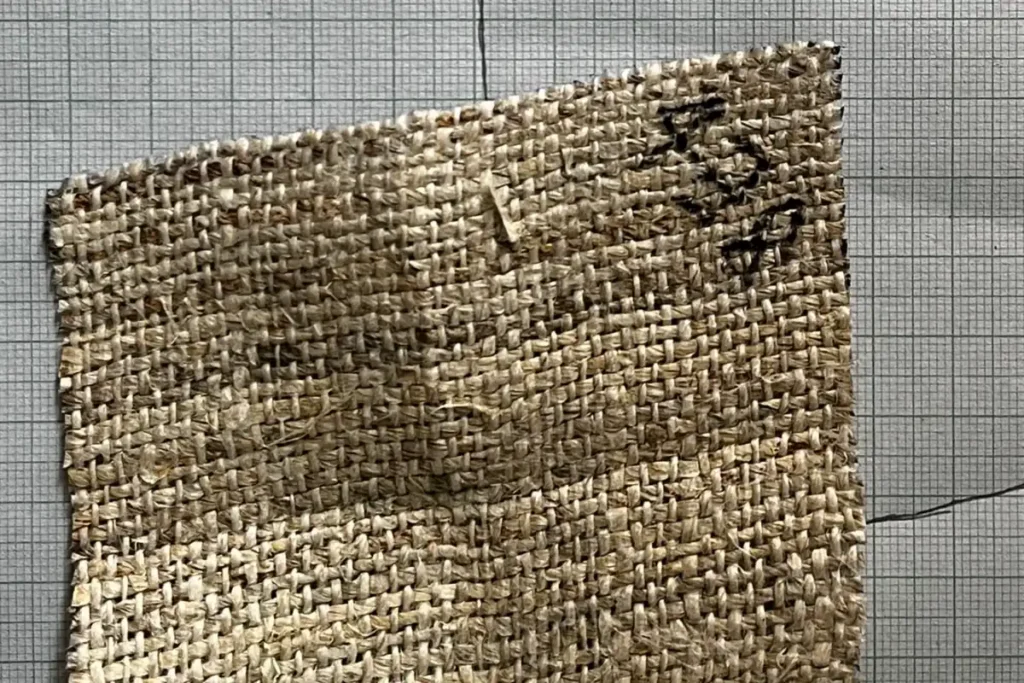
The Workshop’s Hemp: 420 to 462GSM
| Swatch | Weight (g) | Measured area (mm²) | Area (m²) | GSM |
|---|---|---|---|---|
| 1 | 4.63 | 10,023 | 0.010023 | 462 |
| 2 | 3.93 | 9,347 | 0.009347 | 420 |
| Average | 441 | |||
| Range | 420–462 |
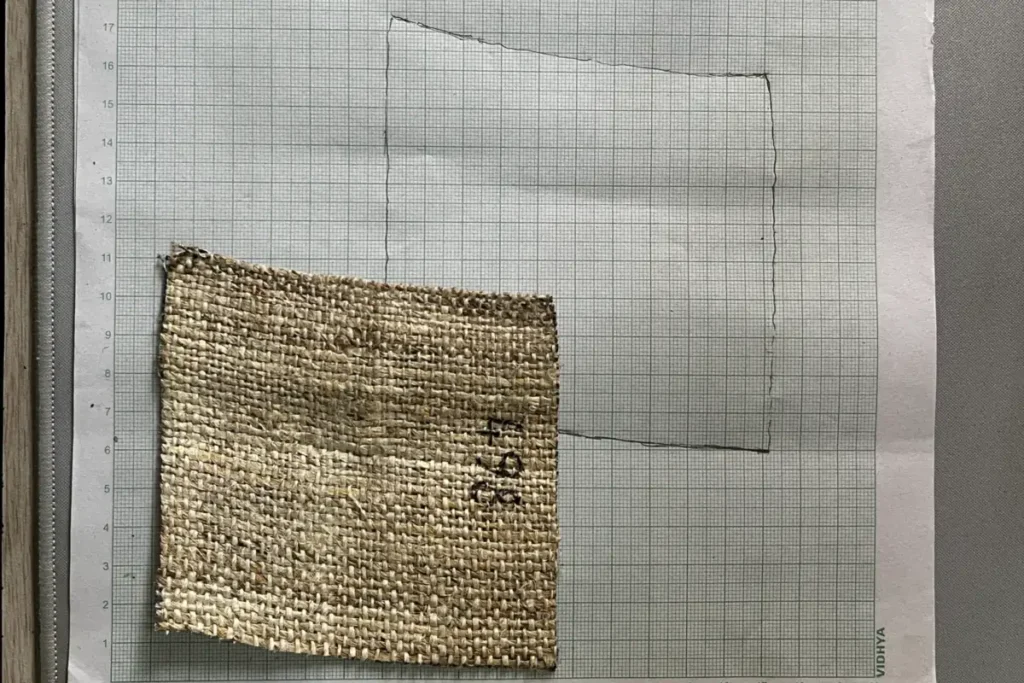
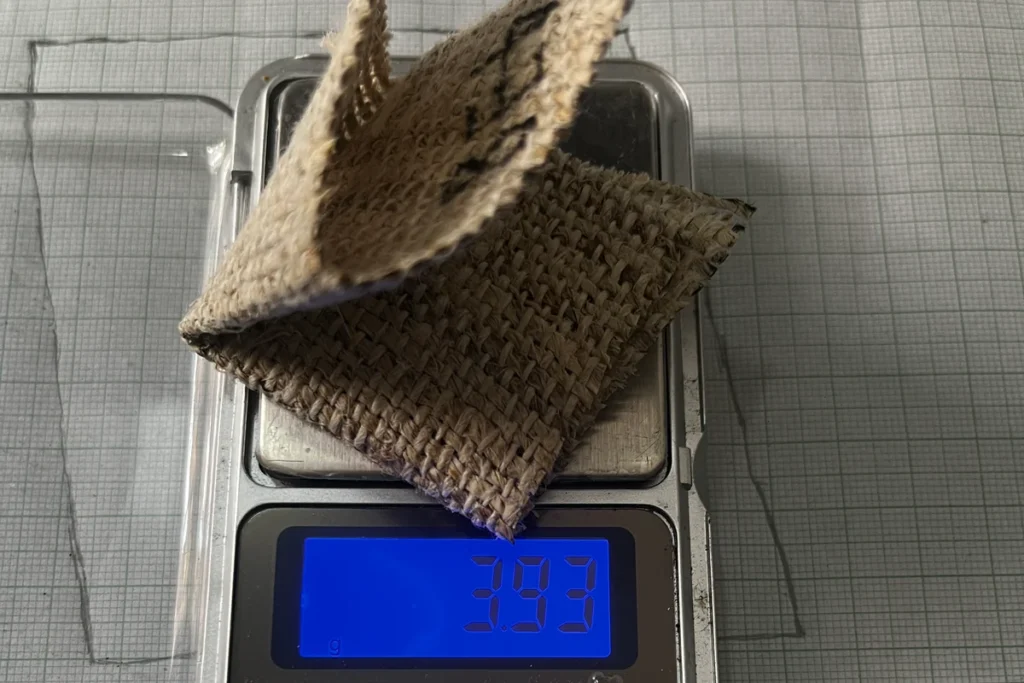
Swatch 1 came out close to 100 cm², at 100.2. Swatch 2 came out at 93.5, 6.5% short. Left unmeasured, an area error that size moves the result by 27gsm.
Two swatches is fewer than the three to five we set ourselves in Entry 01, so treat this range as provisional.
Even the lighter swatch sits 60gsm above the top of the 300–360gsm we were quoted while sourcing. That figure was never treated as fact, and this is why.
Why are two Swatches From one Metre 42GSM apart?
That’s about 10% of their average, and more than measuring error explains. Misread every edge of a swatch by half a millimetre, all in the same direction, and its GSM moves by about 9. The scale adds about 1. Misreading alone could open a gap of about 20gsm, not 42.
So at least half the gap, and probably most of it, is the cloth itself. Handwoven hemp isn’t machine-even: each row of weft is beaten in by hand, and some stretches of the same metre pack in more thread than others.
It’s also why one swatch, like Entry 01’s, was never going to settle the question.
Two caveats that still stand
Hemp takes up moisture from the air, so the same swatch weighs a little more on a humid day. Lab tests condition fabric at around 20°C and 65% relative humidity before weighing; ours were weighed at room conditions.
We haven’t washed this metre, and Master Dai says the hemp is prewashed before it’s cut. A wash can still change both the size and the weight of hemp cloth, so a finished jacket, washed at home, may not read the same. V2 has since had its first hand wash; how it measures afterwards is the next entry.
What’s still owed
- The second supplier’s metre. Its five squares have had the quick test only. They get the same method next.
- The workshop’s other three squares. They’re trimmed along the threads and set aside, and may go into a wash and shrinkage test.
- Run One’s yardage, once it’s bought. The batch cut for the run may not be the batch tested here, so it gets the same test.
This is Entry 05 of the Run One Build Log: the making of Funcle Yeti’s first batch of handwoven hemp chore jackets, logged in Kathmandu as it happens. Start from Entry 01.
Get on the Run One list
Wish you were here.
Or at least on the list.
It’s free, and it commits you to nothing. You’ll hear first about the samples, the final design and the price, and get first access when orders open where you live.
— Funcle Yeti