
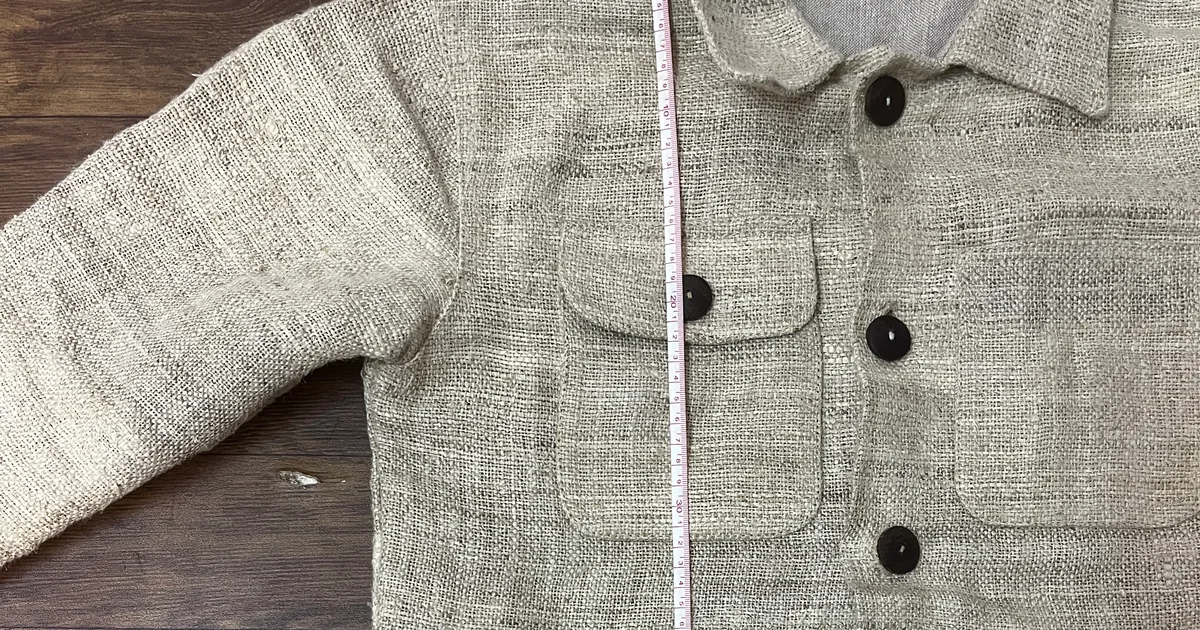
Every sample of our handwoven hemp chore jacket is now measured the same way: hung for 24 hours, laid flat and buttoned, then measured at 19 fixed points, each one photographed with the tape in frame. Its construction gets checked too: weave density, stitches per inch, seams and reinforcement. The numbers are published here.
V2, the reworked first sample, is the first to go through it. It measures 100.0 cm around the chest, 80.0 cm from shoulder to hem and 46.5 cm across the shoulders, plus 16 more points from sleeve to pocket flap. Those numbers are the baseline that the next two samples, and eventually Run One, get checked against.
Why Measure Every Sample?
The first sample came back wrong because the measurements it was meant to be cut from, taken months earlier, were lost in a handoff between people at the workshop. It was cut from judgment instead, and the sleeves missed. V2 fixed some of that in one sitting, and not all of it.
A measurement kept in one person’s notes can go missing again. One that’s written down, photographed and published is much harder to lose, and whoever makes the next sample works from the same sheet.
How Was V2 Measured?
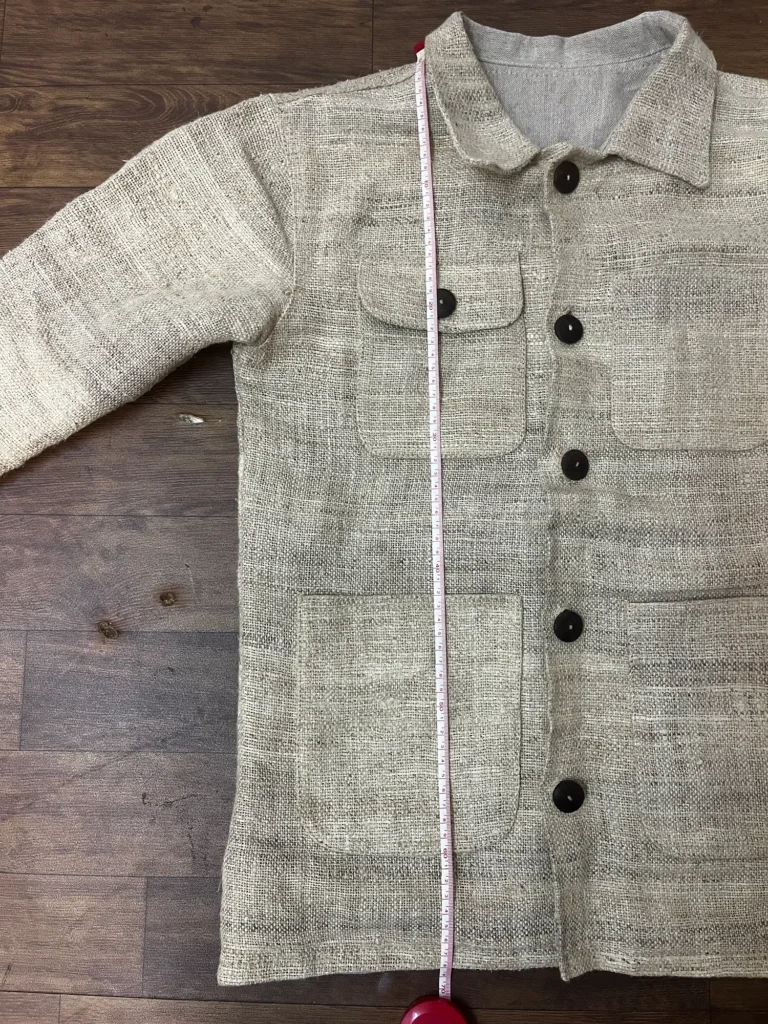
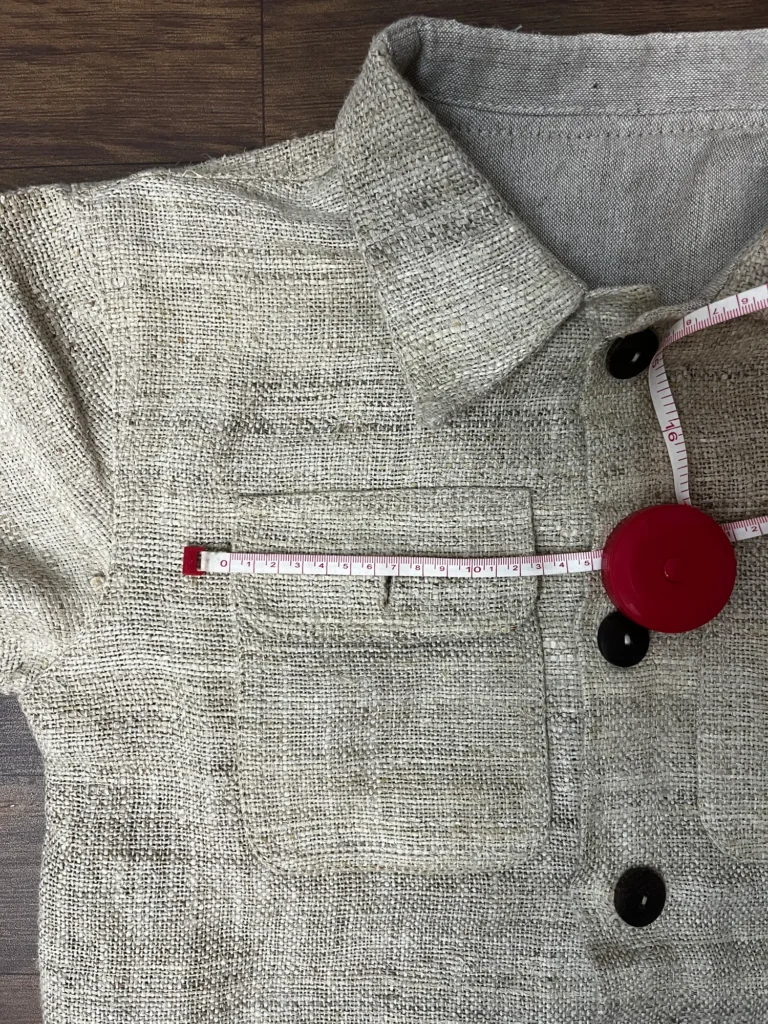
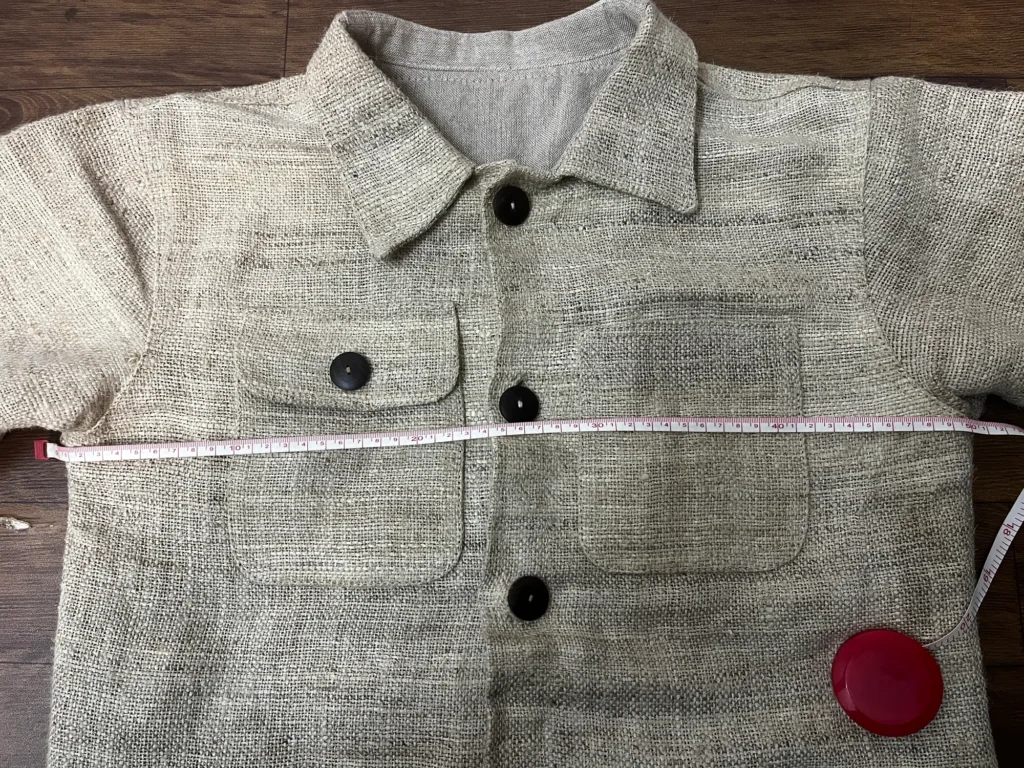
The jacket hung for 24 hours before anything was measured, so it was measured settled rather than straight off the machine. Then it was laid flat, buttoned, and measured at 19 fixed points: nine for the body, sleeves and collar, and ten for the pockets and flap. The protocol has three more points for an interior pocket; V2 doesn’t have one.
Two points are measured across the flat jacket and then doubled, so they read as the full way round: the chest, measured pit to pit (straight across from one underarm seam to the other), and the hem sweep, measured edge to edge along the bottom. Every other point is a single flat measurement.
Flat measurements describe the garment, not the person wearing it. That’s what makes them comparable between samples and between makers: anyone can lay a sample on a table and check it against the numbers below.
V2’s Measurements
V2, measured flat on 24 September 2026, before its first wash. All values in centimetres, recorded to the millimetre.
| Point | How it’s measured | V2 (cm) | Tolerance, later samples (± cm) |
|---|---|---|---|
| Chest | Pit to pit, doubled | 100.0 | 1.0 |
| Shoulder | Seam to seam across the back | 46.5 | 0.5 |
| Sleeve | Shoulder seam to cuff edge | 58.0 | 1.0 |
| Body length | High point of the shoulder to hem | 80.0 | 1.0 |
| Hem sweep | Edge to edge, doubled | 103.8 | 1.0 |
| Cuff opening | Buttoned, flat | 12.8 | 0.5 |
| Armhole | Straight line, seam to seam | 21.5 | 0.5 |
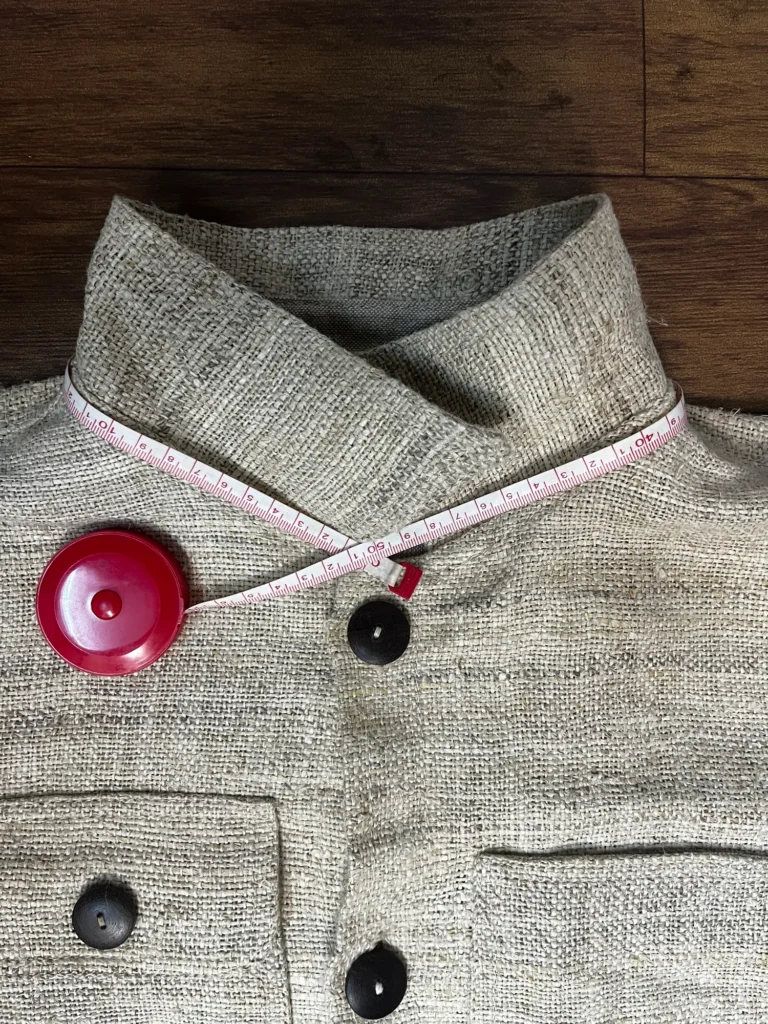
| Collar height | Centre back, stand plus fall | 6.5 | 0.3 |
| Collar length | Point to point along the neck seam | 50.0 | 0.5 |
| Open chest pocket, width | Across the opening, edge to edge | 12.3 | 0.3 |
| Open chest pocket, depth | Opening to bottom seam | 13.9 | 0.3 |
| Flap chest pocket, width | Across the opening, edge to edge | 12.5 | 0.3 |
| Flap chest pocket, depth | Opening to bottom seam | 13.7 | 0.3 |
| Flap, width | Edge to edge | 12.6 | 0.3 |
| Flap, depth | Top seam to bottom edge | 6.2 | 0.3 |
| Lower pocket, left, width | Across the opening, edge to edge | 16.2 | 0.3 |
| Lower pocket, left, depth | Opening to bottom seam | 18.0 | 0.3 |
| Lower pocket, right, width | Across the opening, edge to edge | 16.5 | 0.3 |
| Lower pocket, right, depth | Opening to bottom seam | 18.2 | 0.3 |
Measured by hand, a sewn jacket rarely gives the same number twice to the millimetre. We record to the millimetre anyway, and the tolerance column sets how far a later sample can land from V2’s number: ±1 cm on the largest dimensions, ±0.5 cm on the shoulder, cuff, armhole and collar length, and ±0.3 cm on collar height and the pockets.
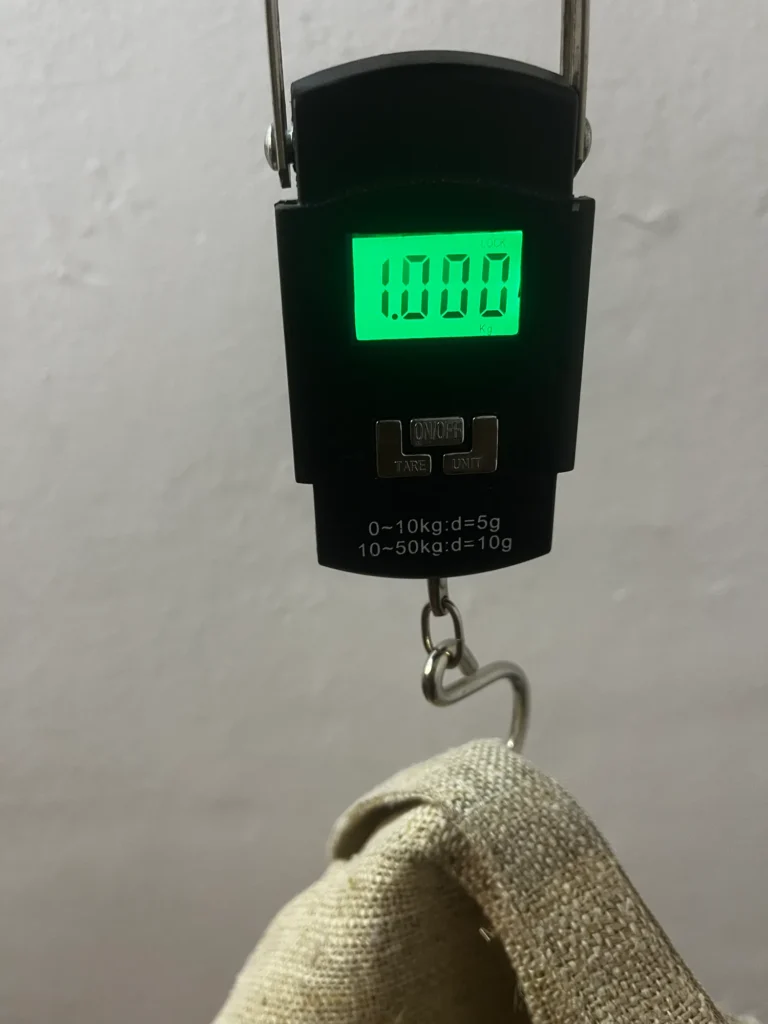
Whole, hung from a luggage scale that reads in 5 g steps, V2 weighs 1,000 g dry.
How Is V2 Put Together?
The tape covers size. A second set of checks covers construction: how densely the cloth is woven, how densely it’s sewn, and what holds the stress points together.
| Check | V2 |
|---|---|
| Thread count | 6 warp and 6 weft threads per cm |
| Stitches per inch | 6, at the side seams, armholes, shoulders, hem and cuffs |
| Seams | Plain at the sides, [double] at the armholes |
| Seam allowance | 10 mm |
| Bartacks | None. Not at the pocket corners, pocket bags, sleeve plackets or other stress points |
| Interlining | Sewn in, not fused |
| Cuffs | Unlined |
| Elbow patch | Added after sewing, not built in |
| Buttons | Coconut shell |
| Chest pocket flap | Closes with a button |
| Buttonholes | 2 cm longer than the buttons they close |
Thread count is the number of threads in a centimetre of cloth, counted separately along its length (warp) and across it (weft). Stitches per inch is how many stitches a seam puts into an inch of its length; it’s counted in inches even here, because that’s how the trade counts it.
Three of these are worth watching. V2 has no bartacks anywhere: the short, dense bars of stitching usually sewn across pocket corners and other stress points to stop them tearing. Every seam runs at 6 stitches per inch. And each buttonhole is 2 cm longer than its button. None of these is a verdict yet. Whether any of them shows up as wear, or as a button that won’t stay done up, is what the wash and wear tests are for.
What Do V2’s Numbers Show?
On its own, this list is a baseline, not a verdict. There’s nothing earlier to hold it against: V1 was never measured this way, and the measurements it should have been cut from are gone.
A few things show even so. The body is close to straight: 100.0 cm around the chest and 103.8 cm around the hem, a difference of 3.8 cm over 80 cm of length.
The lower pockets aren’t a perfect pair: the right one measures 16.5 by 18.2 cm and the left 16.2 by 18.0 cm, so the right is 3 mm wider and 2 mm deeper.
And the list doesn’t yet measure the part of V2 we know is wrong. It records the cuff opening, but not the sleeve’s width at the bicep or the forearm. That’s where V1 went wrong, and where V2 is still narrow toward the wrist.
Where Do the Numbers Go Next?
Two more samples get measured the same way, at the same points: a third sample from the first supplier (V3), and the second supplier’s first. Both are checked against a written spec, version 1.0, built from these numbers, with one exception: the sleeve goes with its correction, not as a copy of V2.
V2 itself gets measured again. It’s the test jacket for washing and wear, so the same points, and its dry weight, are taken again after its 1st, 3rd, 5th and 10th wash. Two thread markers are tacked onto it as well, each sewn exactly 20.0 cm tack to tack, one running vertically and one horizontally, so shrinkage can be read along the length and across the width separately. If the hemp shrinks or relaxes, it will show up as a change against the numbers above, not as an impression.
Either way, every sample from here starts from written numbers, not memory.
GSM: The cloth itself has been weighed properly too, square by square; that’s Entry 05.
This is Entry 04 of the Run One Build Log: the making of Funcle Yeti’s first batch of handwoven hemp chore jackets, logged in Kathmandu as it happens. Start from Entry 01.