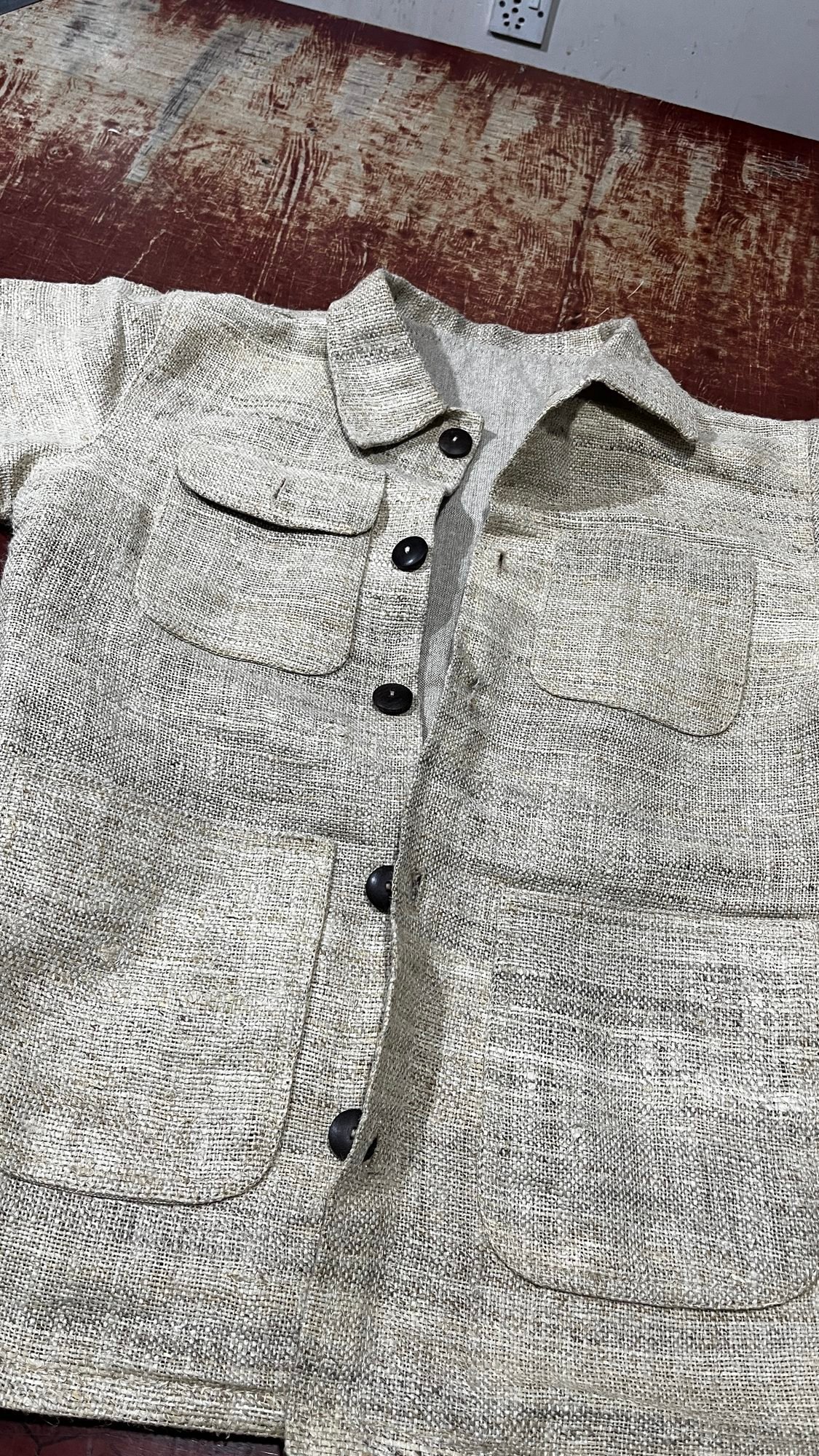
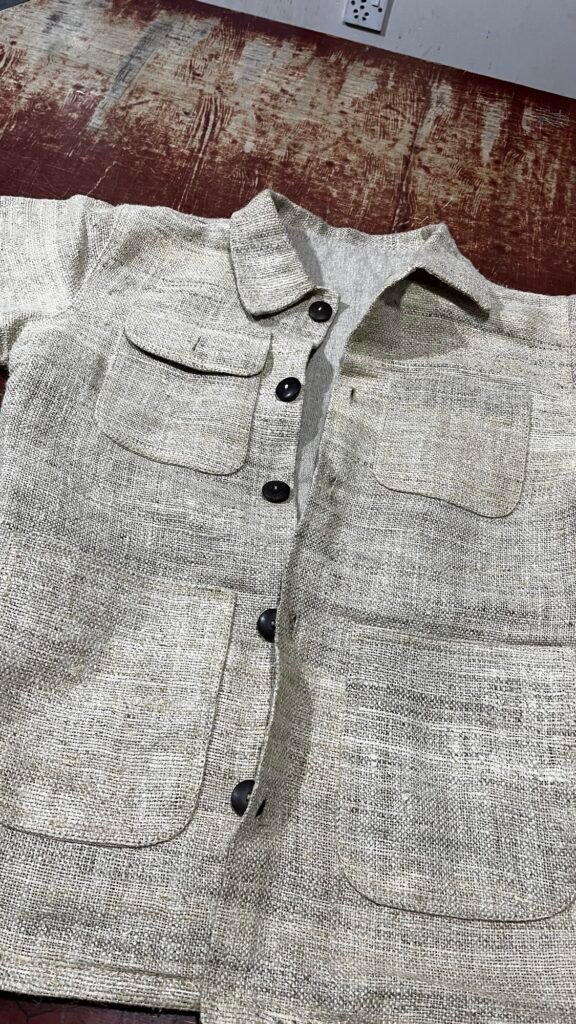
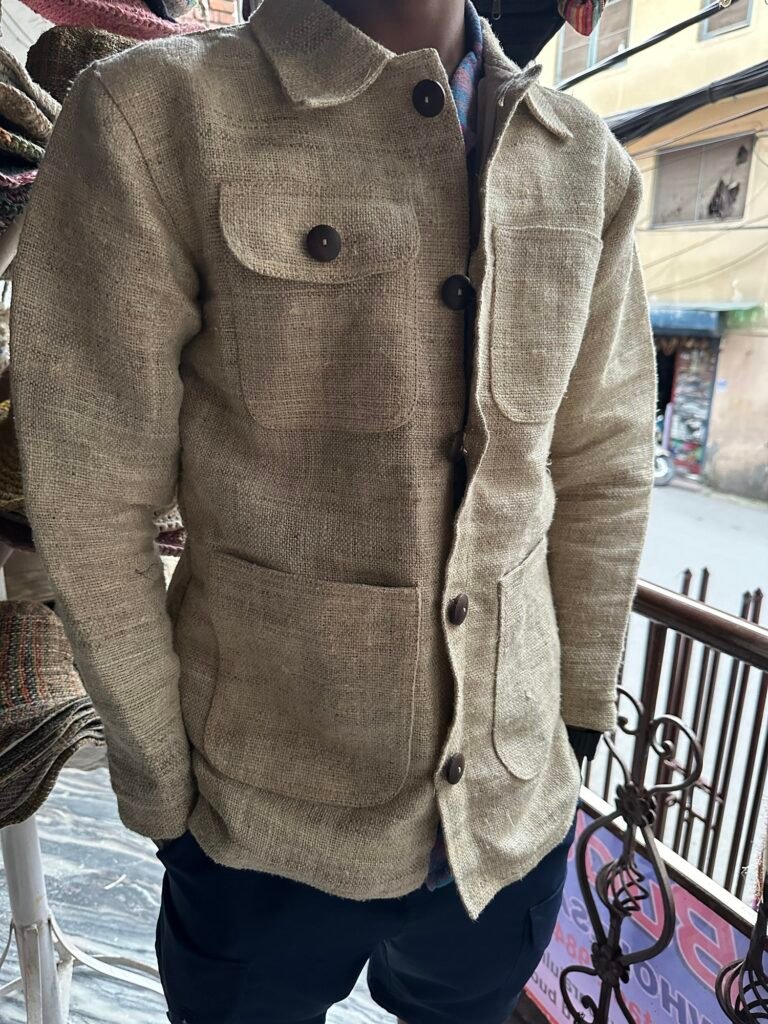
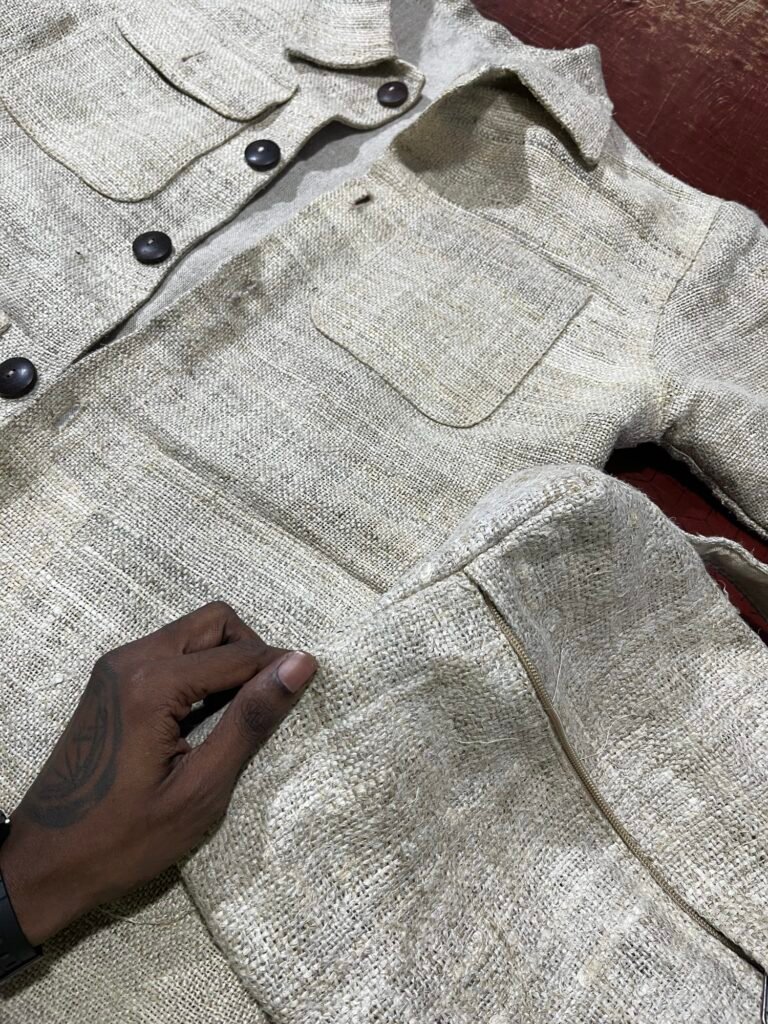
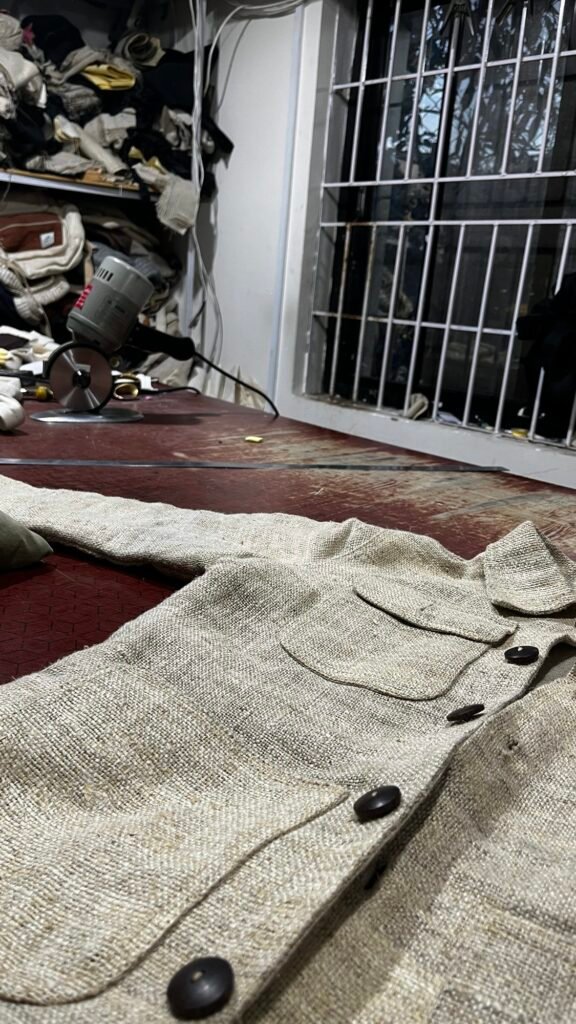
The first sample of the Funcle Yeti chore jacket was made in Kathmandu from handwoven hemp, and it did not pass.
What Was Specified
The brief asked for foldable cuffs and cotton liner patches at the neck and elbows — the two places a jacket gives out first on anyone who actually wears one. Reinforce them at the start and you’re patching in year eight instead of replacing in year three.
What Came Back
First fitting. Sleeve short at the cuff, wide through the bicep, over-tapered.
No foldable cuffs. No liner patches at the neck or elbows.
The fit was closer than it had any right to be, and there’s a reason for that. My measurements had been taken months earlier and left with the workshop, and by the time the sample was cut they’d gone missing. The Master Dai worked from judgment instead. Master is the title for the lead tailor; Dai means elder brother — what you call a man whose read on the work outranks yours.
He got the torso right by eye, which is a genuinely impressive thing to do. The sleeves he did not. Too short at the cuff, too wide through the bicep, and tapered hard enough that you notice it on the first wear rather than the tenth.
The One Thing That Was Right
Cotton liner matched close to the hemp, to avoid dye transfer through years of washing.
He lined it in a cotton matched close to the hemp. I thought it looked dull. He was thinking about dye transfer onto undyed cloth over ten years of washing, which is the correct thing to be thinking about. The liner stays.
What Happens Next
The sample went back for rework. V2 is in progress. If it holds, the same spec goes to a second workshop — with the measurements taken fresh, on the day, by someone who doesn’t have to guess.
Seeing the thing exist in cloth for the first time was a good day, for the record. It just wasn’t a finished jacket.
We spent a few weeks walking into hemp shops across Kathmandu to see what was already being made. Almost all of it was the same jacket: a zip, a hood, a winter cut. Very little of it was pure hemp — most was a blend, usually with cotton, sometimes without saying so.
Nobody was making a chore jacket in handwoven hemp. That gap is the reason Run One exists.
What the Shops Said About Weight
One shop owner told us pure handwoven hemp runs at least 300gsm, and realistically 350–360. That’s secondhand, from a retailer rather than a weaver, and we’ve treated it as a starting point rather than a number.
The Swatches
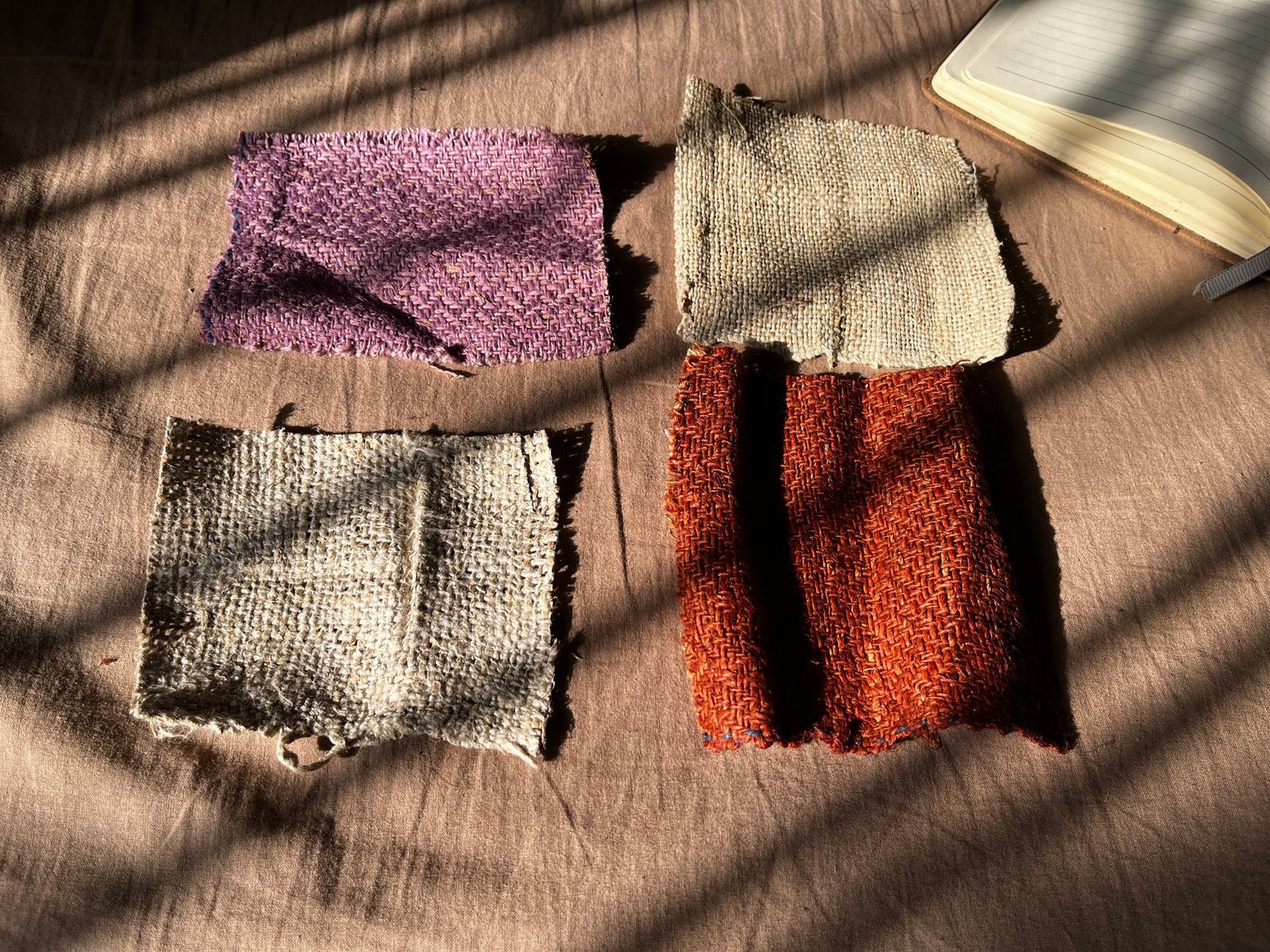
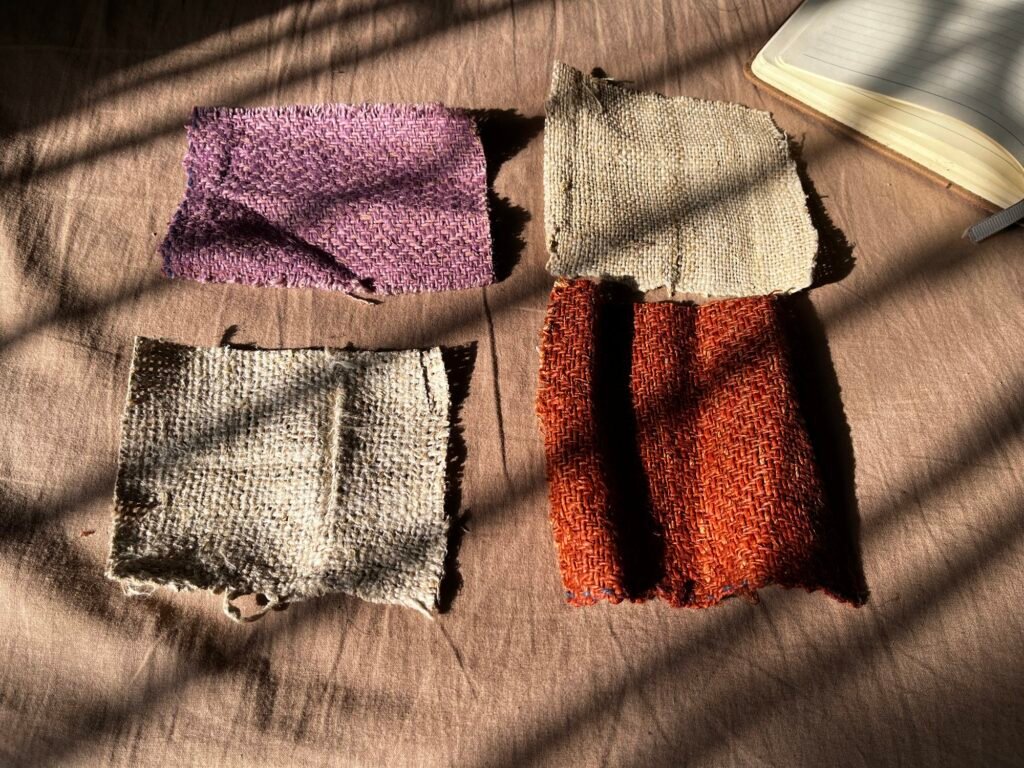
Shop 1 gave us four options: two dyed, in a pattern they call “zigzag weave” — visually it reads closest to a twill or herringbone, though the shopkeeper’s English wasn’t enough to confirm the exact technical term, so we’re not stating that as fact. And two undyed in plain weave, one of which is wood-ash treated. It basically means that these wild harvested hemp from the mountain is boiled in wood ash to make it softer.
The supplier confirmed the ash treatment directly — it’s genuinely part of their process, not something we’re guessing at. It’s noticeably softer in the hand, entirely handwoven and costs more due to the additional processes and labor intensive production.
We’re using the plain, untreated, undyed option for Run One. No dye, because it’s a step that adds cost, adds a thing that can fade, and hides what the fibre actually looks like. Not the ash-treated version either, for now — we don’t yet understand enough about what the treatment does to the fibre over time to build it into a ten-year claim, and that’s a question for the next visit, not a guess we’re comfortable publishing.
Top left/Bottom right: dyed zigzag-weave swatches, purple and rust. Bottom left: undyed plain weave, wood-ash treated — confirmed by the supplier, softer to the touch. Top right: undyed plain weave, untreated — the one we’re using.
The First GSM Test, and why We’re not Quoting the Number
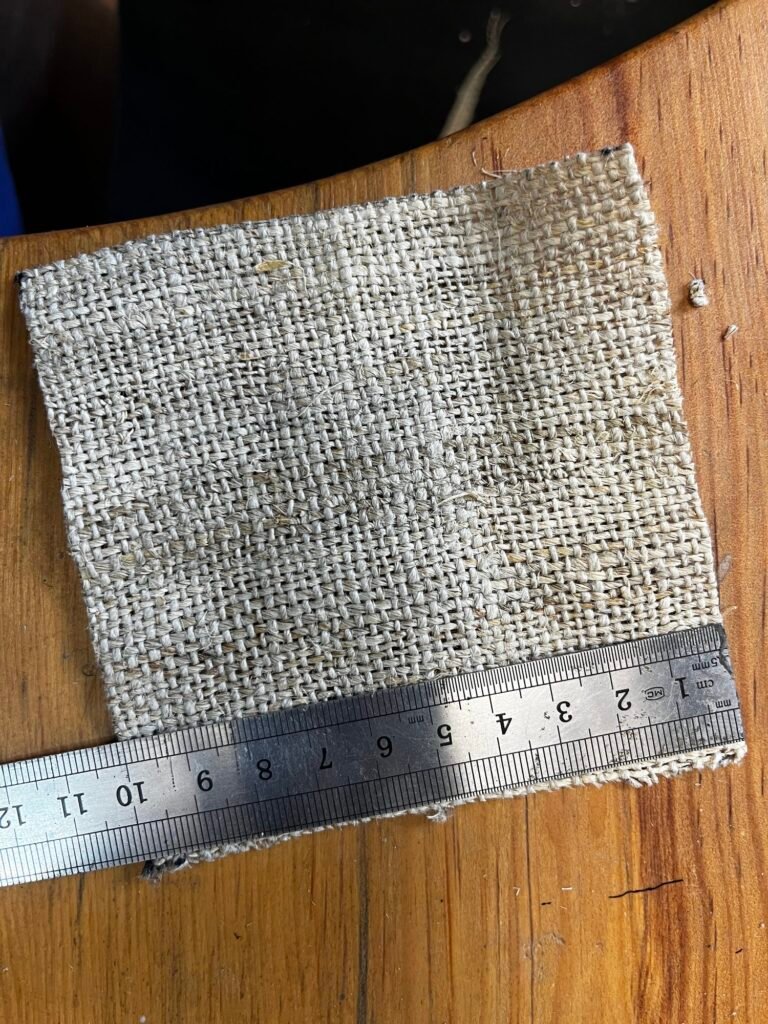
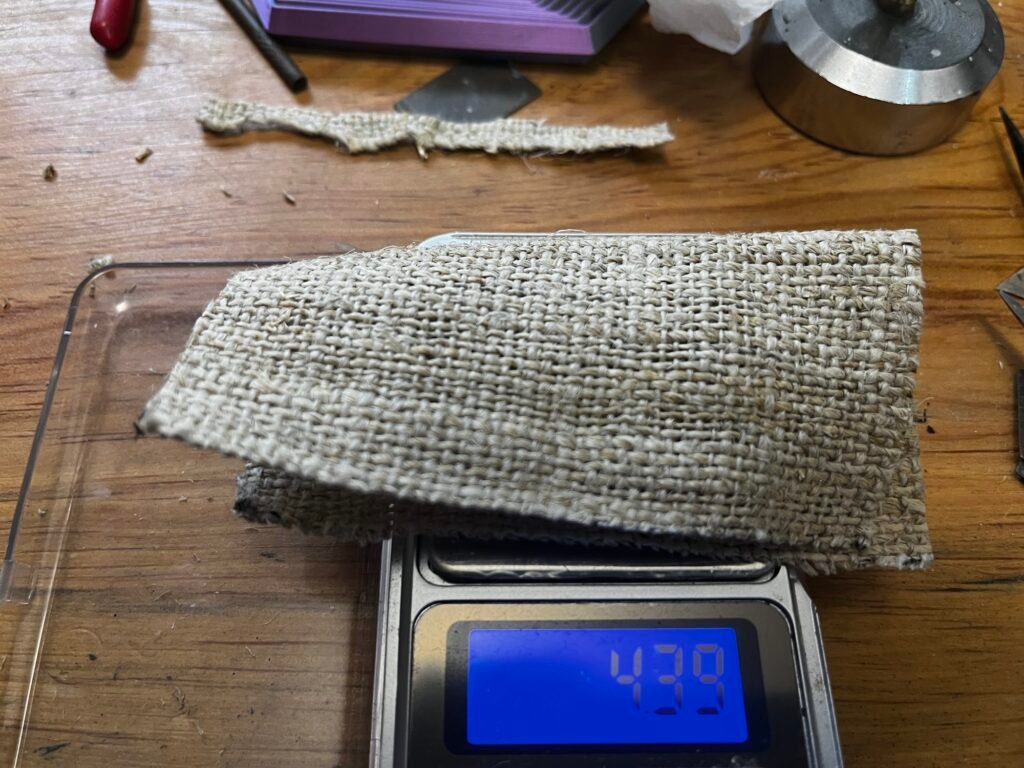
We ran a rough check at home on a 0.01g scale: the swatch weighed 4.39g. Assuming a clean 10cm × 10cm square, that works out to about 439gsm — well above what the shop had quoted.
The swatch on hand wasn’t a clean 10cm square — the first sign this test needed redoing properly.First GSM reading (4.39gm) — from an irregular cut, so treated as inconclusive rather than final.
We don’t trust that number, and the reason is visible in the photo: the swatch wasn’t actually 10cm square. It ran past that mark on one edge, which means the true area was larger than we assumed — and the same weight over a larger area means a lower real GSM. The 439 figure is almost certainly too high; we just don’t know by how much yet.
There’s a second reason to be cautious, one that would apply even to a perfectly cut square: hand-tensioned weaving means density drifts across a bolt, so one square only ever tells you about that square.
The proper version takes several squares from different parts of the same batch, averaged, with the spread reported alongside. We’ll run that for both suppliers once we have swatches from each, and publish the range as well as the average — the variation is a real property of hand-woven cloth, not an error to hide.
One thing we can’t solve: the batch we test may not be the batch that gets cut. Hemp moves through these workshops faster than a sample takes to approve. So the test tells you what this workshop’s cloth typically runs, and we’ll test the actual Run One yardage separately once it’s bought.
Where This Goes Next
Supplier 2 has been visited once, briefly. No swatches yet.
Supplier 1 has the brief and is making the first sample.
Welcome to WordPress. This is your first post. Edit or delete it, then start writing!
Lorem Ipsum is simply dummy text of the printing and typesetting industry.
Lorem Ipsum is simply dummy text of the printing and typesetting industry. Lorem Ipsum has been the industry’s standard dummy text ever since the 1500s, when an unknown printer took a galley of type and scrambled it to make a type specimen book. It has survived not only five centuries, but also the leap into electronic typesetting, remaining essentially unchanged. It was popularised in the 1960s with the release of Letraset sheets containing Lorem Ipsum passages, and more recently with desktop publishing software like Aldus PageMaker including versions of Lorem Ipsum.
Loved overpowered anime characters as a kid? You may have been using them as a coping mechanism.
Is it just me, or does everyone have this memory? You’re a kid, goofing around with your cousins, and some uncle or aunt wanders over to tell you to enjoy it while it lasts, because being a child is the best time of your life.
I never gave it much thought back then. Looking back, I think they were already feeling the weight of adulthood, the same crushing pile of responsibilities that’s landing on us now.
But for a lot of us, childhood wasn’t the easy part. And if you grew up quietly obsessed with overpowered anime characters, that obsession may have been doing more work than you realized.
THE SHORT ANSWER If you were drawn to overpowered (OP) anime characters as a kid, especially calm, untouchable ones like Sesshomaru from InuYasha or Hiko Seijūrō XIII from Rurouni Kenshin, it may have been more than taste. Researchers call the urge to become like a favorite character wishful identification, and research on children and media describes kids using their favorite heroes to shape who they are and to cope with everyday life. For a child with little control at home, a hero who could never be pushed around was a safe place to put that feeling.
When Home Felt Out of Your Control
Childhood is a landscape mapped entirely by other people’s rules. For a long time, you don’t realize you’re powerless; you simply live inside the boundaries you’re handed. But for plenty of kids growing up in the late ’90s and early 2000s, home wasn’t a soft sanctuary. It was a masterclass in navigating instability.
That instability wore different masks depending on the house you lived in.
For some, it was a parent who kept chasing the next get-rich-quick scheme, and the humiliating cycle of watching them ask a grandfather or an uncle to patch over the monthly shortfall. For others, it was absence: both parents working day in and day out, and a quiet, hollow house where a small mind worked out early that survival required loneliness. And for many, it was a high-decibel home, where an alcoholic parent’s verbal routine forced you to shrink into a corner. You learned to wear self-deprecation as armor, because the world outside couldn’t mock you if you’d already made yourself the punchline.
The last of those has a name in public-health research. Experiences like growing up with a parent who misuses alcohol are called adverse childhood experiences (ACEs), and they are far more common than most of us assume. In CDC survey data from 2011 to 2020, 63.9% of US adults reported at least one ACE, and adults aged 25 to 34 were the age group most likely to report four or more: 25.2%, roughly one in four.
Whatever the specific texture of your reality, the result inside your head was the same: a paralyzing loop of script-doctoring. You replayed every confrontation, rewriting your own weakness into endless what-ifs and should-haves.
Looking back, I remember all the times we used to watch SpongeBob or DragonBall Z on TV with the volume down to just the first two blocks. Even without the sound of SpongeBob laughing his high pitched annoying laugh or when Goku screamed himself to become the Super Saiyan, we felt the laughs and the excitement.
Our one ear was always sharpened to our father’s footsteps, ready to run to the TV because the remote was broken perpetually in our house. On some days we used to make it just before he entered the room and on some days, we used to get our asses whooped.
The Blueprints of Stillness: Why Overpowered Anime Characters Felt Safe
When your real world feels out of your control, your mind drifts toward characters with an infinite aura: figures who move through chaos with a cold, untouchable grace. They don’t win by shouting. They win by being impossible to move.
The reality at home
The overpowered sanctuary
What it gave a powerless kid
A parent chasing get-rich-quick schemes; money always running out
Hiko Seijūrō XIII (Rurouni Kenshin)
Discipline and total, quiet control: the steadiness the house didn’t have
Parents always at work; a quiet, empty house
Eightron (DT Eightron)
A way out, and a protector who always came when called
Shouting at home, bullies at school
Sesshomaru (InuYasha)
A boundary nobody could cross, held without ever raising his voice
Sesshomaru (InuYasha): The Boundary That Never Moved
Consider Sesshomaru from InuYasha. He didn’t need to raise his voice to command a room; his presence was the baseline everyone else had to adjust to. To a neurodivergent kid struggling to decode the social groups at school, or a kid who’d had ink splashed across his shirt by a class bully, that kind of calm looked like a superpower in its own right.
Then there’s his sword. In InuYasha: The Final Act, the 2009–10 series that finally finished the story, Sesshomaru manifests Bakusaiga [→ anime swords post · optional], a blade that isn’t inherited or stolen but grows out of his own body, after he has handed the technique he worked so hard to perfect over to his brother’s sword. It was the ultimate daydream weapon. You didn’t want to destroy the world. You just wanted an unyielding boundary against the people who talked down to you, and you wanted it to come from somewhere inside you.
Hiko Seijūrō XIII (Rurouni Kenshin): Stillness in a Room Full of Noise
The same logic applied to Hiko Seijūrō XIII, the thirteenth master of the Hiten Mitsurugi style and Kenshin’s teacher in Rurouni Kenshin (known in some markets as Samurai X). In a world full of frantic, shouting swordsmen, what defined him was how still he stayed. He never looked like he was trying. To a kid watching a parent fumble promise after promise, that looked like the most enviable thing in the world: complete control, and nothing to prove.
DT Eightron: A Way Out of the Empty House
In the more obscure corners of our childhoods sat shows like DT Eightron, a 1998 series from Sunrise, the studio behind Gundam. Its hero, fourteen-year-old Shu, grows up in Datania, a domed city run by a computer program whose “reset system” strips children of their emotions so they’ll work like drones. Shu dreams of seeing the ocean, so he escapes and joins a band of underground rebels, and whenever they’re in immediate danger, an eight-year-old hacker named Dolly can summon Eightron, a powerful, mysterious guardian. For a kid alone in a quiet house, that was the whole fantasy in one premise: a way out, and a protector who always answered.
In those solitary hours, you weren’t a kid hiding from a parent’s fumbled promises or an empty house. You were a warrior in a larval state, waiting for your turn to be invincible.
Was It Really a Coping Mechanism? What the Psychology Says
As far as I know, nobody has studied kids who worshipped Sesshomaru. But you’re not the only one who felt the pull. AnimeTok creator Tony Weaver Jr. told HuffPost that anime gave him characters he “could lean on when I wasn’t strong enough to be myself yet.” Two well-established ideas from psychology explain why that pull was so strong.
The first is wishful identification: the desire to become, or act like, a media character. In 1996, communication researcher Cynthia Hoffner interviewed children aged 7 to 12 about their favorite TV characters. How intelligent a male character seemed predicted how much kids wanted to be like him, and for boys, how strong he seemed predicted how close they felt to him. SAGE’s Encyclopedia of Children, Adolescents, and the Media notes that children pick favorite heroes and use them to shape their own identities, and that how much they lean on those heroes to cope with growing up and everyday life depends on their stage of development.
The second is escapism, and here the research gets genuinely useful. Frode Stenseng, a researcher at the Norwegian University of Science and Technology, splits escapism into two kinds. Self-suppression is running from painful thoughts and feelings. Self-expansion is escaping toward something: new experiences, new sides of yourself. Studies using his model link self-suppression to lower well-being and self-expansion to higher well-being, and he has since applied the same model to gaming and online streaming.
Fans usually call the appeal of OP characters a power fantasy. For a powerless kid, it was closer to a shelter than a fantasy, and most of us were firmly in self-suppression mode. We weren’t building anything; we were getting through the night. The point of looking back as an adult is to turn that same pull into the second kind.
The Shift: From Revenge to Protection
There’s a minor canon event that happens as you grow older: the shift from loving Superman’s built-in invulnerability to understanding Batman’s brutal, self-inflicted discipline. You realize the true hero isn’t the one born without a ceiling. It’s the one who builds his own armor within the limits of being entirely human.
But the real evolution happens when the childhood resentment finally burns off.
When I look back at those late-night anime blocks through a more mature, stoic lens, I don’t see simple escapism. Those overpowered archetypes were a psychological shield that kept our core intact when we had zero real-world leverage to protect ourselves. Even Sesshomaru makes the turn: the demon lord who spends the early series coveting his brother’s sword slowly becomes the quiet protector of Rin, a human orphan who travels with him.
As an adult, that old conditioning morphs into a very functional kind of resilience. It’s the exact muscle memory I call on when I’m grinding through a brutal boxing spar. When I lose a round to a younger, faster, more athletic kid, my ego wants to revert to that childhood powerlessness. Instead, you lock back into the stoic baseline. You check the ego, keep your hands up, and focus on the earned progression of the work. It’s no accident that Hajime no Ippo, a series about a bullied kid who finds boxing and earns every inch of his strength, hit so many of us so hard.
And the daydream changes. You stop wanting the sword for revenge against the past. You want the strength so that no one around you ever has to feel as powerless, or as small, as you once did.
Space to Breathe: Why Adults Still Need Their Own Territory
To maintain that level of internal resilience, you have to protect the environment you build it in. Processing the noise of your past needs physical territory to ground your adult identity, and a lot of it comes down to how much space you can claim in your life, whether that’s a clean desk in the corner of your bedroom or a room where your work stress can’t follow you in.
Without an intentional sanctuary, somewhere you can stop performing, the mind stays adrift. Your escape hatch might be a boxing ring, a messy workbench, or an evening spent snapping bricks together away from a screen. What matters is that it’s a domain where the rigid adult world is switched off for a while.
The Art of Moving Forward: Looking Back Without Living There
There’s a massive temptation in modern culture to treat nostalgia as a permanent residence, a cozy, continuous loop where we can hide from the demands of the present. But looking back endlessly is a stagnation trap.
Used well, nostalgia does the opposite. Research led by psychologists at the University of Southampton has found that nostalgia tends to surface when we feel low or lonely, and that it lifts mood, raises self-esteem and strengthens our sense of connection to other people. Their studies also found that nostalgic memories often follow a redemption arc, where a hard scene gives way to a triumph. That’s the version worth keeping: nostalgia as fuel, not as a hiding place.
The fumbled investments, the empty rooms and the high-decibel arguments happened. The coping mechanisms were necessary to get you across the finish line. But a stoic life requires radical acceptance: you accept the environment that shaped you, you thank the armor that kept you safe, and then you willingly lay it down.
We don’t look back at our childhood heroes to escape today’s reality. We look back to thank the kid who survived the uncertainty, so that we can finally step out of the corner and build something that lasts.
FAQ
Is it normal to have used anime as a coping mechanism as a kid?
It’s a very human response. Children often imagine being like a favorite character, which researchers call wishful identification, and research on children and media describes kids leaning on favorite heroes as they work out who they are and cope with everyday life. For a child dealing with stress at home or bullying at school, a calm, powerful character can offer a feeling of safety and control that real life isn’t providing.
Why do people like overpowered characters?
Overpowered characters offer what fans call a power fantasy: the experience, through someone else, of never being pushed around. Part of the appeal is that they give a feeling of control to viewers who may not have much of it in their own lives. The calm, stoic kind, like Sesshomaru or Hiko Seijūrō, add something extra: control without anger, which can be deeply reassuring to anyone who grew up around shouting.
Is escapism through anime healthy?
It depends on what you’re escaping toward. Norwegian researcher Frode Stenseng’s model separates self-suppression escapism, which avoids painful feelings, from self-expansion escapism, which seeks positive experiences and growth. Studies using the model link self-suppression to lower well-being and self-expansion to higher well-being. Rewatching a favorite show to recharge is different from using it to avoid every hard feeling.
What is wishful identification?
Wishful identification is the desire to become, or act like, a media character. It has mostly been studied in children and teenagers, who look to characters as role models while they’re still working out who they are. In Cynthia Hoffner’s 1996 study of 7- to 12-year-olds, how intelligent a male character seemed predicted how much kids wanted to be like him.
Why do so many anime fans love Sesshomaru?
Sesshomaru pairs overwhelming power with total composure. He rarely raises his voice, never looks rushed, and over the course of InuYasha he slowly becomes protective of Rin, a human orphan who travels with him. That mix of untouchable strength and quiet loyalty is a big part of why he became a fan favorite [→ Morally Grey Characters · when live], especially for viewers who wanted a protector more than a fighter.
What should I do if old childhood memories start resurfacing?
If looking back is stirring up more than nostalgia, such as trouble sleeping, old anger or memories that feel heavy to carry, talking to a doctor, counselor or therapist can help. You don’t need to be in crisis to deserve support.
A NOTE FROM US This is a personal essay, not clinical advice. If it stirred up something heavy, you don’t have to carry it alone. In the UK, Samaritans are free to call any time on 116 123; in the US, you can call or text 988.
CTA
Want more raw, documentary-style breakdowns of adult mindfulness, nostalgia and the spaces that help us breathe? [Subscribe to the Funcle Yeti newsletter]
Stenseng, F., Rise, J., & Kraft, P. (2012). Activity engagement as escape from self: The role of self-suppression and self-expansion. Leisure Sciences.
Stenseng, F., Falch-Madsen, J., & Hygen, B. W. (2021). Are there two types of escapism? Exploring a dualistic model of escapism in digital gaming and online streaming. Psychology of Popular Media.
Varun writes about nostalgia, hobbies, and the things we loved before we learned to be embarrassed about loving them. He started Funcle Yeti after noticing how many adults around him were quietly rebuilding the collections they’d given up at fifteen — and how few could explain why it helped.
He is not a psychologist. Every clinical claim on this page comes from published research, linked inline. If you spot one that’s wrong, tell him.
Illustrations generated with AI in the Funcle Yeti house style. Charts produced by Funcle Yeti from cited data.
“Nostalgic hobbies aren’t a sign of immaturity. Psychological research links nostalgia to reduced loneliness, a stronger sense of meaning, and better emotional regulation in adults. Here are six evidence-backed reasons to keep the things you loved as a child.”
Nostalgic hobbies are not a sign of arrested development. Across six psychology studies of 4,388 adults, recalling a nostalgic memory raised happiness, reduced loneliness and strengthened people’s sense that their life had meaning. The effects are modest and they are real. Here is what the research actually found — and where it stops.
Key Takeaways
Six studies of 4,388 adults in the UK, US and China found nostalgic recall raised happiness and offset loneliness; with a reminder, the effect held for two days.
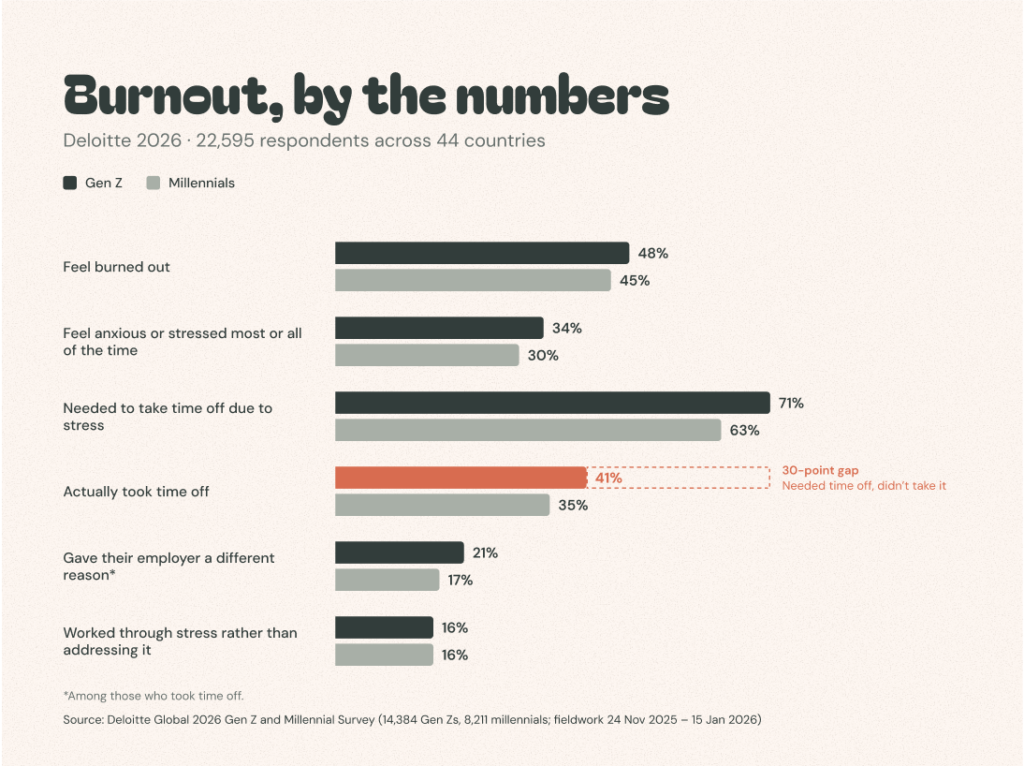
Deloitte’s 2026 survey of 22,595 people across 44 countries found 48% of Gen Z and 45% of millennials burned out, and 58% reporting digital fatigue.
71% of Gen Z said they needed time off for stress. Only 41% took it.
Adults are not a fringe of the toy market. Circana reports buyers aged 15+ account for nearly 20% of global toy sales, with spending more than doubling since 2020.
Nostalgia’s benefits run through self-continuity — the sense of being the same person across time — which supports self-esteem and meaning in life.
The effect is not unconditional. In a study of 190 Syrian refugees, nostalgia raised self-esteem and meaning but lowered optimism among less resilient participants.
Varied nostalgic memories work better than repeatedly revisiting the same one.
If there is one thing every person in their 30s and 20s hates to hear, it’s the line “Grow up!”, especially if you are someone who enjoys doing something remotely nostalgic.
Sure, people are now more open about peculiar or not-so-mainstream hobbies and pastimes. But as soon as an adult has a HotWheels collection or God forbid, Pokémon cards, people feel the need to jump in and voice their opinion.
And the worst part is the “Grow up!” advice can come from anyone. It can be a girl/boyfriend, a wife, a husband, a parent, or even a colleague.
Who decides what is childish or when a grown-up should stop watching cartoons and anime?
Why is it anyone’s business what you do with your spare time?
Well. We can’t answer those questions for them. But we can tell you what the research actually says — and it is a good deal more interesting than “it’s fine, you do you”.
Is Nostalgia Actually Good for Your Mental Health?
Yes, measurably. Across six studies of 4,388 people in the UK, US and China, psychologists at the University of Southampton found that recalling a nostalgic memory raised happiness and reduced the sting of loneliness — and with a brief reminder, the lift was still detectable two days later. The effects are modest but real, and they replicate.
The research here is better than you would expect for something that sounds this soft.
The paper doing most of the heavy lifting is by Xinyue Zhou, Constantine Sedikides and Tim Wildschut — Sedikides and Wildschut run the nostalgia research group at the University of Southampton, and between them they have spent two decades measuring this stuff properly, with control conditions and everything.
Their 2022 paper in Social Psychological and Personality Science ran six studies. Three surveys covering 3,721 people across the UK, the US and China during pandemic lockdowns. Then three experiments where they deliberately triggered nostalgic recall. 4,388 participants in total.
What they found: people who revisited a nostalgic memory reported measurably higher happiness than those who recalled an ordinary one. Lonely people turned out to be more nostalgic, and that nostalgia then raised their happiness — partially offsetting the drop the loneliness had caused. And with a short reminder a day or two later, the lift held.
Their conclusion, in their own words, is that nostalgia is a psychological resource that can be harnessed. Not a symptom to be managed.
Which, functionally, is what your hobby already is.
Why Do Adults Still Collect Toys?
Because collecting activates the same dopamine-driven reward pathway that drives all goal-seeking behaviour, and because possessions genuinely form part of how people define themselves. The pursuit matters more than the object. It is also no longer unusual: Circana reports that buyers aged 15 and over now account for nearly 20% of global toy sales, with their spending more than doubling since 2020.
Buyers aged 15 and over now account for nearly 20% of global toy sales, according to Circana.
Start with the fact that you are not unusual. Circana’s 2026 global toy report puts buyers aged 15 and over at nearly a fifth of all toy sales worldwide, with spending in that group more than doubling since 2020. The global toy market is worth $123 billion and grew 8% in 2025 — and in developed markets, teenagers and adults are responsible for most of that growth.
There is an industry term for you now. You are a kidult, which is an ugly word for a fairly ordinary thing.
As for why — there are two mechanisms worth knowing about, and they explain almost everything about how a collection feels from the inside.
The dopamine and mesolimbic reward loop
Looked at neurologically, collectors are chasing the thrill of the chase rather than the object itself. The mesolimbic reward pathway is the neural circuit in charge of driving motivation and learning through the release of dopamine — and, crucially, it fires hardest in anticipation rather than on arrival.
This is why the hunt for the card so often feels better than owning the card. It is also why the sealed box you never opened is a warning sign rather than a trophy, but we will come back to that.
Belk’s extended self
The second mechanism is Russell Belk’s 1988 research on the extended self, published in the Journal of Consumer Research and still one of the most cited papers in the field. Belk’s argument is that humans have a natural tendency to use material possessions to define and anchor their identities. We are, in part, what we keep.
Put those two together and it is not difficult to understand why adults still collect toys, or why the number of adults doing it keeps going up. A collection is a self-portrait that you assembled slowly, on purpose, out of things that meant something.
Collecting Pokémon trading cards or Dragon Ball action figures may still seem childish to some. You probably have that one annoying friend or family member who never fails to make fun of this harmless hobby of yours.
“Why do you still buy this stuff? You are in your 30s!”
You probably laugh it off or internally scream, “Well, why don’t you fuck right off in your 30s!?”
The fact is that you don’t collect Star Trek action figures or a fully electronic Iron Man mask because you are immature, but simply because you want cool stuff. If anything, you are more mature than your peers about the things you enjoy, and about reclaiming your true self despite the constant societal pressures.
Can Nostalgia Help You Stop Overthinking?
It can, with one condition. Nostalgic media use during the COVID-19 pandemic was associated with better wellbeing in research by Wulf, Breuer and Schmitt — but only when it worked as a resource rather than an escape. Used as avoidance, the same behaviour predicts worse outcomes. The difference is whether you return to the present afterwards.
Wulf, Breuer and Schmitt found nostalgic media use supports wellbeing when it restores rather than replaces.
The study is Escaping the Pandemic Present, by Tim Wulf, Johannes Breuer and Josephine Schmitt, published in Psychology of Popular Media in 2021. Their finding was that during a crisis, people are especially motivated to consume nostalgia-inducing media — and that this is broadly good for them, right up until it isn’t.
Because holding onto nostalgia becomes a double-edged sword the moment you stop using it as inspiration and start using it as an exit. Taking strength, and even borrowing happiness, from your past is perfectly okay. Letting it consume you is a path you don’t want to start down.
With the pressures of life weighing on you every day, it is already challenging to keep your mind sane. Every one of us overthinks. For some of us it is the pressures of parenthood and marriage, for others it is the aging of our parents, and for some it’s both and maybe more.
So the next time you find yourself replaying Pokémon FireRed for the nth time, or YouTubing clips from Johnny Bravo, give yourself some credit.
At the very least, your escape from reality does not involve intoxicating yourself to the point that you lose sight of yourself.
Does Nostalgia Help With Burnout?
It will not fix burnout, and nothing in the research claims it does. What it offers is a low-cost form of recovery for people who are not getting any. In Deloitte’s 2026 survey of 22,595 people across 44 countries, 48% of Gen Z and 45% of millennials reported burnout, and 58% reported digital fatigue specifically — the condition a quiet, analogue, notification-free hobby happens to target.
The burnout generation — it’s the name coined for millennials by Anne Helen Petersen, a BuzzFeed culture writer, back in 2019. Seven years later, nobody is seriously arguing with her.
What the 2026 Deloitte numbers actually show
Today, in 2026, burnout is close to a baseline condition, and the numbers say so. Deloitte’s 2026 Gen Z and Millennial Survey ran from November 2025 to January 2026 and covered 22,595 people across 44 countries. Here is what it found.
What Gen Z and millennials report — Deloitte 2026 (n = 22,595, 44 countries)
Measure
Gen Z
Millennials
Feel burned out
48%
45%
Needed time off due to stress
71%
63%
Actually took the time off
41%
35%
Gave employer a different reason
21%
17%
Report digital fatigue
58%
54%
Anxious or stressed most/all of the time
34%
30%
Long-term financial future as top stressor
44%
39%
Delayed a major life decision over money
55%
52%
Deloitte surveyed 22,595 people across 44 countries between November 2025 and January 2026.
Read the third and fourth rows together, because that is the whole story. 71% of Gen Z needed time off because of stress. 41% took it. And of those who did, one in five told their employer something else.
That’s not a burnout problem. That’s a permission problem.
There’s a specific modern flavour of this too: 58% of Gen Z and 54% of millennials report digital fatigue — the constant alerts, the tool-switching, the low hum of six open tabs. Which goes some way to explaining why grown adults are spending three hours on a plastic brick set that does exactly one thing and never notifies you about anything.
Separately, 34% of Gen Z and 30% of millennials report feeling anxious or stressed most or all of the time. Nostalgic hobbies won’t fix the conditions causing that, but the research suggests they do something measurable for how you carry it.
And look at what’s actually driving it. When Deloitte asked what contributes most to stress, the top answers weren’t laziness or screen time. They were long-term financial futures (44% of Gen Z, 39% of millennials), the health and welfare of family, and day-to-day finances.
Cost of living has been the number one concern for five consecutive years. More than half of both generations — 55% and 52% — say they’ve delayed major life decisions like marriage, starting a family or starting a business because of money. For God’s sake, every one of us knows at least one person who has practically given up on building a family despite very much wanting one, for the very real reason of money.
So when someone tells you to grow up, ask what exactly they think you’re avoiding.
Can Childhood Hobbies Reduce Loneliness?
Yes, and the mechanism is indirect. Zhou and colleagues found that lonely people become more nostalgic, and that nostalgia then raises happiness — partially offsetting the drop loneliness causes. A shared hobby adds a second route by supplying actual social contact. The research frames nostalgia as a psychological resource to be used, not a symptom to be managed.
Zhou et al. (2022) found nostalgia offsets loneliness indirectly; a shared hobby adds the direct route.
They say living in the past and focusing too much on the future is a recipe for disaster. While we do not condone dreaming your life away, reigniting your childhood hobbies — or the dreams you never chased — could help you combat loneliness.
The six-study paper above is the strongest evidence for this. The three survey studies found that the lonelier people were, the more nostalgic they became, and the more nostalgic they became, the happier they reported being. The three experiments then showed this worked causally: people who were prompted to revisit a nostalgic memory came away measurably happier than people prompted to recall an ordinary one.
But life as an adult can be lonely sometimes, especially if you are unapologetically happy with what others may consider trivial or childish hobbies. So it is upon us to take the stigma out of adults buying Hot Wheels that give them a glimpse of their past selves, and to recreate those moments of joy without fear of judgement.
So the next time someone tells you they want to build that 3,803-piece Death Star LEGO, or buy that ridiculously expensive Transformer that can actually fucking transform — just be happy for them, as you would want them to be happy for you.
How Does Play Improve Emotional Regulation?
Absorbing, low-stakes play engages the brain’s default mode network, the system active during rest and self-reflection, which supports emotional processing. Complex building tasks like LEGO and Gunpla add a second effect: a problem with a definite solution, in a session you control, which is the opposite of most adult stress.
Absorbing construction tasks quiet the default mode network — the same system active in rumination.
Any activity that draws on nostalgia or the feel of something familiar — even just daydreaming while listening to music — can activate the brain’s default mode network. That’s the network that comes online when you stop actively concentrating, and it does a lot of the quiet work of processing what has happened to you.
Why LEGO works as a stress tool
It is no wonder that many adults now use complex puzzles, LEGO and Gunpla included, to de-stress. Researchers at the University of Arizona have discussed LEGO’s role in building flexible and creative mindsets in adults, and the appeal is not complicated: it is a problem with a definite solution, on a timescale you control, with an instruction booklet. Name one other part of adult life that offers that.
Of course, these games will stress you out now and then. The piece will be missing, or the step will be wrong, or the thing will not click. But that also provides an opportunity to practise emotional regulation on something where the stakes are zero.
Even though you may not realise it, these childish games are helping you “grow up” more than sitting through a French film pretending to enjoy it.
Does Child-like Curiosity Help You Grow as an Adult?
Yes — and this is where nostalgia stops being consolation and starts being useful. Positive autobiographical memories reinforce self-worth and self-continuity, the sense that you are the same person over time. Sedikides and Wildschut describe this as nostalgia’s meaning-making function: it helps people read their own life as coherent rather than accidental.
Positive memories reinforce self-worth — and making new ones works the same way.
One of the best things about the psychology of nostalgia is that it helps you grow into a better person, if you are willing to make the effort. Adults who take up puzzle-building hobbies like LEGO or Gunpla are more likely to keep acquiring new skills and to work at their problem-solving.
You can also use it as a parent, or an uncle or aunt, to connect with a young one. Imagine sharing a hobby with the little ones you love — not only do you get to spend the time, you get to make memories that could last a lifetime.
Remember that time you wanted to build a model aeroplane and fly it through a hoop? Well, it is never too late for that. You even have your mini servant to hold up the hoop or fetch the plane when you need it.
The first serious LEGO set I built as an adult was the Tumbler — the Batmobile from Bale’s Batman, a little over three thousand pieces. My mini servant wasn’t a niece or a nephew; it was my girlfriend. It took days and days, and it was worth every one of them.
And as you build this new relationship with a child or a significant other, you are simultaneously building up your own self-esteem. Positive memories help reinforce self-worth — what Sedikides and Wildschut call self-continuity, the sense of being recognisably the same person across a life. It helps us find the meaning in the life we have actually lived, rather than the one we meant to.
When Nostalgia Stops Helping
Everything above comes with a limit, and the research is clearer about it than most articles on this subject will admit.
Wildschut et al. (2019) found nostalgia reduced optimism among less resilient participants.
The most instructive study here is Hanin, by Wildschut, Sedikides and Alowidy, published in the European Journal of Social Psychology in 2019. They worked with 190 adult Syrian refugees living in Riyadh. Nostalgic recall raised self-esteem, meaning in life and social connectedness — which is remarkable on its own, given what those participants had lived through.
But it also lowered optimism. And the whole pattern was moderated by resilience: the more resilient participants got the benefits and avoided the costs, while the less resilient ones saw their optimism fall. Nostalgia is bittersweet by design — participants reported genuinely mixed feelings — and that mixture is part of the mechanism, not a flaw in it.
Which gives you a practical test, and it is a simple one. Does the hobby return you to the present, or replace it?
The warning signs are not the hobby itself. They are spending you cannot afford. A collection that has quietly become an obligation. The sealed box you will never open, bought for a version of you that doesn’t exist. Using the thing to avoid a decision rather than to recover from one.
One more finding worth carrying: the same six-study paper found that the benefit holds better when you draw on different memories rather than replaying the same one. Nostalgia works like a varied diet, not a single comfort food.
When I say make your inner child happy, it is not an excuse for anything, or an encouragement to live in the past. Adult responsibilities are very real and you must face them regardless of what life throws at you.
The point is to treat nostalgia, and the things you loved doing, as a resource for strength to move forward — and, above everything, as a space to breathe and be yourself unapologetically.
FAQ
Is it normal for adults to still like childish things?
Yes, and it is increasingly common. Circana reports that buyers aged 15 and over now make up nearly 20% of global toy sales, with spending in that group more than doubling since 2020. Psychologists studying nostalgia treat attachment to childhood objects as ordinary identity maintenance, not regression.
Is nostalgia a sign of depression?
No. Nostalgia is bittersweet by design — mixed affect is part of how it works — but research consistently finds it raises mood and meaning rather than lowering them. Frequent nostalgic thinking paired with withdrawal, loss of interest or persistent low mood is worth discussing with a professional, but nostalgia itself is not a symptom.
What is the psychology behind collecting?
Two mechanisms. The mesolimbic dopamine pathway rewards pursuit rather than possession, which is why the hunt often feels better than the acquisition. And Russell Belk’s 1988 “extended self” research found people routinely use possessions to define and anchor identity. A collection is partly a self-portrait.
Can nostalgia be bad for you?
It can, when it functions as avoidance rather than recovery. In a study of 190 Syrian refugees, nostalgic recall raised self-esteem, meaning and social connectedness but reduced optimism, with the pattern strongly moderated by resilience. The practical test is whether the hobby returns you to the present or replaces it.
How does LEGO help with stress?
Absorbing construction tasks engage the default mode network and offer something adult life rarely does: a problem with a definite solution, on a timescale you control, with no notifications. Researchers at the University of Arizona have discussed LEGO’s role in building flexible and creative mindsets in adults.
What does “kidult” mean?
An adult who buys and enjoys products traditionally marketed to children — toys, games, collectibles, animation. It is an industry term rather than a clinical one, and it describes the fastest-growing segment of the global toy market.
Varun writes about nostalgia, hobbies, and the things we loved before we learned to be embarrassed about loving them. He started Funcle Yeti after noticing how many adults around him were quietly rebuilding the collections they’d given up at fifteen — and how few could explain why it helped.
He is not a psychologist. Every clinical claim on this page comes from published research, linked inline. If you spot one that’s wrong, tell him.
Illustrations generated with AI in the Funcle Yeti house style. Charts produced by Funcle Yeti from cited data.
The blue light of a monitor has a specific kind of weightlessness to it. We have come to a phase where our entire lives are being dominated by these little digital boxes. Think about it – many of us spend hours dragging digital cells across a spreadsheet or shipping code into a cloud, or something else. And the worst part is not that, even when we feel like taking a break from work, we just switch to a smaller screen.
We doomscroll on Insta, TikTok, or a gazillion other apps. And if not that we take up some sort of game or another and we even lie to ourselves by playing some strategy or puzzle game to say that we are just exercising our brain. But in reality we have become a generation that runs after one dopamine, chasing instant-gratification one hit after another.
Our hands are warm, eyes tired, and mind feels hollowed out by a digital world that has become far too smooth. Even our entertainment has grown impatient. Remember when retro racing games like NFS Most Wanted forced you to take a funny-ass looking car (read Chevy Cobalt) at the beginning and work your absolute way to the top? The progression was slow, but it was earned. Modern games, by comparison, hand you a million-dollar supercar as a beginner or let you skip the effort entirely if you can afford to shell out real money on microtransactions. The gratification is instant, but it feels completely unearned. In other words, dopamine has now become a digital commodity almost entirely.
However, in the middle of all this, there is an understated rebellion happening on the dining room tables of grown adults today – Legos or Lego-like brick toys that we all grow up with but never really could afford. In fact, even now Lego charges a premium for adult-oriented products whether it be wicked as a full functional 3000+ piece Batmobile or a massive Death Star from Star Wars.
Young adults, including the Millenials, Zillenials, and even the Gen Z are now intentionally taking time away from their digital prisons to spend more time in the real world. Their joy or dopamine chases are now starting with a heavy box of Lego (building brick sets) that is entirely offline. For the next few days, the digital rectangle doesn’t exist. There are no algorithmic pings, no endless doomscrolling on Instagram, and no corporate noise. There is only a physical (sometimes digital) blueprint, a messy workspace, and a slower, tactile gratification you can actually touch, feel, and build from scratch.
Why do Adults Build Lego Sets?
The psychological pivot from childhood play to adult building isn’t new and neither is it about escaping maturity, but rather about surviving it. When you work in IT, creative fields, or in any white collar jobs, you spend the majority of your life managing intangible systems in front of a screen. It is only natural for the brain to crave a physical, closed loop—a direct, visible consequence of your labor.
Building a complex brick model or a Lego-like set provides exactly that. It forces a deep, structural focus that acts as an automated off-switch for work anxiety. Unlike doomscrolling—which confuses the brain by making you consume massive amounts of random, disjointed information—assembling a model requires genuine cognitive presence.
You are looking at a physical map, handling individual pieces, matching their exact shade in the manual, and watching them slowly take form into something deeply meaningful. The rules are absolute. The path is laid out. Every single micro-action results in a satisfying, physical click. It is an honest, earned progression system. It’s an intentional sanctuary where you can finally put away the phone and put their brains to actual, rewarding use. And the best part is that it doesn’t matter if you are a parent, creators, and typical IT professional.
The High Cost of Adult Lego Hobbies
Let’s be honest about the barrier to entry: this survival mechanism can be an expensive one but only if you are a Lego aficionado. As adults, especially if you are a parent, you would naturally be very careful with money. In this economy, even those of us who play the role of the family funcle, will only indulge in leisurely purchases like a brick set when we have funds to spare.
For years, that financial caution kept our budget strictly tied to smaller, accessible Lego sets in the $12 to $35 range. Those builds were fun, but they were quick snacks—usually topping out under a thousand pieces. Although still very enjoyable, they didn’t offer the deep, multi-day immersion our brain was looking for to truly disconnect.
And let’s face it, Lego sets are not cheap. A 3000 or 4000+ piece Lego set can set you back by hundreds of dollars. Personally, me as a child, always wanted Lego, but it simply wasn’t something I could get. So, buying that massive 3000+ pieces Batman Tumbler Batmobile later in life wasn’t a distraction from reality; it was about making my inner child happy by finally owning something I had always considered profoundly cool.
But the official premium brand tax felt like an irresponsible financial hurdle. The breakthrough happened during a trip to China, where I began exploring local hobby ecosystems and more importantly the Amazon of China – Taobao. If you are fortunate enough to explore this marketplace you will see a whole new sprawling world of highly sophisticated alternative brick engineering.
Here I was able to find an alternative, identical-scale version of the Tumbler for just $60 to $75. The plastic clutch power was entirely solid, the quality was decent, and suddenly, the financial guilt vanished—leaving nothing but the raw, focused challenge of the build.
The Reality of the Workspace
The truth about any Lego build is that it makes the illusion of a pristine, aesthetic hobby disappear, especially if it is a massive 3000 or 4000 piece one. Don’t get me wrong, the real-world process is wonderfully messy.
A massive 3,000+ piece set like the Tumbler doesn’t just arrive as a mountain of loose plastic; it comes organized into specific, numbered stages. You are dealing with roughly 10 or 12 major sets of pieces, with two or three smaller sub-packets nested inside each major stage. To build this step-by-step, you need physical territory.
It is entirely based on how much space you can command in your home. You need a dedicated table or a surface where the pieces can stay exactly where they are, completely undisturbed for days. The last thing you want is the children in your life, whether it’s your own or someone else’s to play with that one critical piece or even worse, losing it forever.
This is where the hobby intersects with a broader, more essential need for adults today: the necessity of personal domain. Afterall, to reclaim your focus, you first have to reclaim your physical environment. Whether it’s a dedicated workbench, a converted garage, or a designated man cave or she-shed, having an isolated perimeter to leave your real-world messes behind is crucial to preserving your sanity and individuality.
Without that uninterrupted escape hatch, a complex Lego project becomes impossible. The stakes feel surprisingly high. If a single technical component or gear goes missing or gets scattered from packet number four, it’s a tragedy and you simply cannot complete the set. So asides from being able to afford these hobbies, you also need to make sure you have a sanctuary which can be messy but still remain untouched until you finally finish the build.
The Lego-Alternative
For a long time, looking outside the mainstream ecosystem felt like a massive gamble involving missing parts or brittle plastic from untrustworthy wholesale sites. And trust me when I say these do happen even though not normally. Maturity is realizing that you don’t need a fancy brand to add value to your hobby so long as it makes you happy.
In fact, a mature subculture of value-conscious builders has proven that premium engineering doesn’t require a commercial trademark logo stamped on every single stud. The reality is that direct manufacturing channels—like the ones found natively on platforms like Taobao—now deliver exceptional plastic density, precise clutch power, and flawless structural integrity for a fraction of the cost. Of course, you could try your luck with suppliers from AliExpress, but the truth is that the quality of the goods can vary significantly. Add to it the fact that you may have to pay a premium for shipping and even add more identical pieces just so they can ship it to you.
So, if you are one of the adult hobbyists who want to scale their builds past 3,000 pieces without draining their savings, it is well worth exploring the alternative brick spaces. It allows you to pay purely for the mechanical design and the physical materials, rather than the global marketing budget of a corporate giant.
Lego – a Toy, a Plastic Trophy or a Living Memory?
The truth about any Lego build is that it makes the illusion of a pristine, aesthetic hobby disappear, especially if it is a massive 3000 or 4000 piece one. Don’t get me wrong, the real-world process is wonderfully messy.
For most of us, a brick or Lego set is meant to be built up and played with, not treated as a liquid asset. And let’s be practical: tearing down a complex, 3,000-piece model just to throw it into a giant box is an absolute nightmare. The pieces get scattered, the components get lost, and trying to sort through tens of unnumbered packets a second time is incredibly confusing.
Keeping a perfectly assembled set on display is entirely practical. The completed model stands as a trophy of your focus—a physical archive of a week where you successfully wrestled your attention span away from the digital void.
More importantly, if you build a set alongside your child, your niece, your nephew, or someone you love, it becomes a permanent monument to a shared memory. It represents quiet hours spent working your brains together, passing pieces back and forth, and watching an object take a meaningful shape. You aren’t just displaying plastic; you are keeping a memory alive in your space forever.